• HOME
  • NEWS
  • EXPLORE
    • CAREER
      • Companies
      • Jobs
    • EVENTS
    • iGEM
      • News
      • Team
    • PHOTOS
    • VIDEO
    • WIKI
  • BLOG
  • COMMUNITY
    • FACEBOOK
    • INSTAGRAM
    • TWITTER
Saturday, June 27, 2026
BIOENGINEER.ORG
No Result
View All Result
  • Login
  • HOME
  • NEWS
  • EXPLORE
    • CAREER
      • Companies
      • Jobs
        • Lecturer
        • PhD Studentship
        • Postdoc
        • Research Assistant
    • EVENTS
    • iGEM
      • News
      • Team
    • PHOTOS
    • VIDEO
    • WIKI
  • BLOG
  • COMMUNITY
    • FACEBOOK
    • INSTAGRAM
    • TWITTER
  • HOME
  • NEWS
  • EXPLORE
    • CAREER
      • Companies
      • Jobs
        • Lecturer
        • PhD Studentship
        • Postdoc
        • Research Assistant
    • EVENTS
    • iGEM
      • News
      • Team
    • PHOTOS
    • VIDEO
    • WIKI
  • BLOG
  • COMMUNITY
    • FACEBOOK
    • INSTAGRAM
    • TWITTER
No Result
View All Result
Bioengineer.org
No Result
View All Result
Home NEWS Science News Health

Bright spot analysis for photodynamic diagnosis of brain tumors using confocal microscopy

Bioengineer by Bioengineer
April 11, 2019
in Health
Reading Time: 2 mins read
0
IMAGE
Share on FacebookShare on TwitterShare on LinkedinShare on RedditShare on Telegram

IMAGE

Credit: Kanazawa University

[Background]

Photodynamic diagnosis using 5-aminolevulinic acid (5-ALA) is now widely used for neurosurgical resection of brain tumors. Distinguishing a tumor from healthy tissue is based on greater 5-ALA-derived protoporphyrin IX accumulation in glioma cells than in non-cancerous cells, resulting in much greater red fluorescence (peak at 635 nm) when excited at 405 nm. However, it is still difficult to precisely distinguish the tumor margin and infiltrating regions from non-tumor tissue because the fluorescent boundary is usually vague. In our previous study, we noticed that bright spots in confocal microscopy images may be able to distinguish tumors from normal tissue.

[Methods]

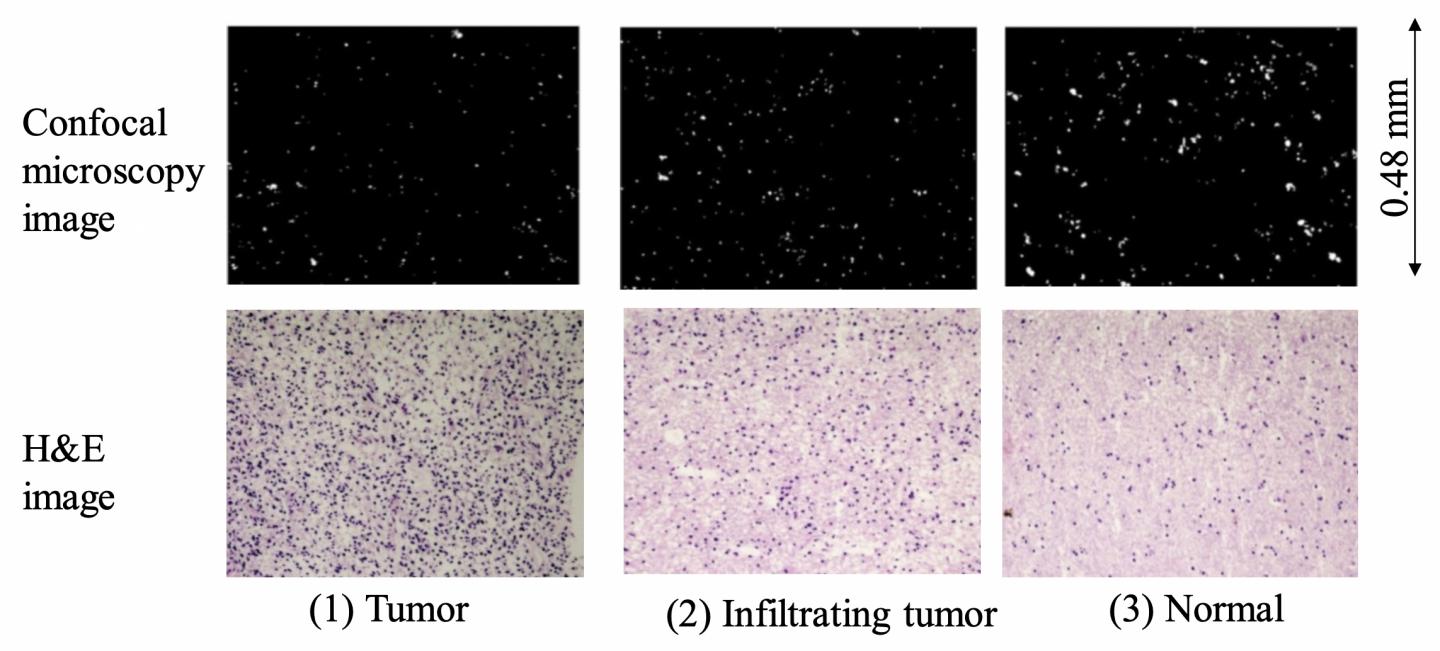
Brain tumor tissues resected from 5-ALA-treated patients was sectioned to evaluate bright spots captured by a 544.5-619.5 nm wavelength band-pass filter that eliminated the fluorescence induced by 5-ALA under a confocal microscope. Boarder regions and adjacent normal tissues were observed. Pathological inspection was performed to confirm the locations of tumors, infiltrating tumor cells, and normal tissue regions by hematoxylin and eosin (H&E) staining of serial sections of the same samples. Bright spot areas were measured in the same region used for pathological inspection. This method was applied to brain tumors with and without red fluorescence as well as glioblastoma (GBM) and non-GBM brain tumors.

[Results]

The bright spot area was substantially smaller in the GBM tumor than in normal brain tissues. It was also smaller in infiltrating tumors than in normal tissue at the margin. The same bright spot pattern was observed in tumors tissues without red fluorescence and in non-GBM tumors. Bright spot fluorescence has been suggested to be derived from lipofuscin based on emission spectra (mainly within 544.5?619.5 nm) and an optimal excitation wavelength (about 405 nm).

[Significance and future prospects]

Bright spot analysis is useful to facilitate discrimination of an infiltrating tumor from bordering normal tissue in photodynamic diagnosis using 5-ALA. This method is also potentially useful for tumors without 5-ALA-derived red fluorescence and non-GBM tumors. The mechanism of bright spot fluorescence reduction in tumors and its application for precise discrimination of brain tumors should be investigated further.

###

Media Contact
Tomoya Sato
[email protected]

Related Journal Article

http://dx.doi.org/10.1016/j.pdpdt.2019.02.005

Tags: Biomedical/Environmental/Chemical EngineeringcancerDiagnosticsMedicine/HealthSurgery
Share13Tweet8Share2ShareShareShare2

Related Posts

Tracking Lanthanide-Labeled Microplastics in Plants

June 25, 2026

Neural Design Enables Zero-Shot Drug-Binding Proteins

June 25, 2026

Genomic Insights into Human Skin Fungi Diversity

June 25, 2026

Chiral Laser Gyroscopes Surpass Lock-In Limit

June 25, 2026
Please login to join discussion

POPULAR NEWS

  • Saying Goodbye to PGY-6: Pediatric Fellowship Realities

    103 shares
    Share 41 Tweet 26
  • Multi-Hospital Study Reveals Long Covid Burden Is Twice as High as Current Estimates

    92 shares
    Share 36 Tweet 23
  • Detection of EDCs in Breast Milk and Infant Urine Up to Six Months Highlights Early Exposure Risks

    77 shares
    Share 31 Tweet 19
  • New Drug Candidate Developed at McMaster Shows Potential for Treating Brain Cancer

    58 shares
    Share 23 Tweet 15

About

We bring you the latest biotechnology news from best research centers and universities around the world. Check our website.

Follow us

Recent News

Tracking Lanthanide-Labeled Microplastics in Plants

POSTECH Researchers Slash Cost of Reconstituted Cell-Free Systems by 95%

AI and Physics Collaborate to Design Advanced Hydrogen Storage Materials

Subscribe to Blog via Email

Success! An email was just sent to confirm your subscription. Please find the email now and click 'Confirm' to start subscribing.

Join 82 other subscribers
  • Contact Us

Bioengineer.org © Copyright 2023 All Rights Reserved.

Welcome Back!

Login to your account below

Forgotten Password?

Retrieve your password

Please enter your username or email address to reset your password.

Log In
No Result
View All Result
  • Homepages
    • Home Page 1
    • Home Page 2
  • News
  • National
  • Business
  • Health
  • Lifestyle
  • Science

Bioengineer.org © Copyright 2023 All Rights Reserved.