


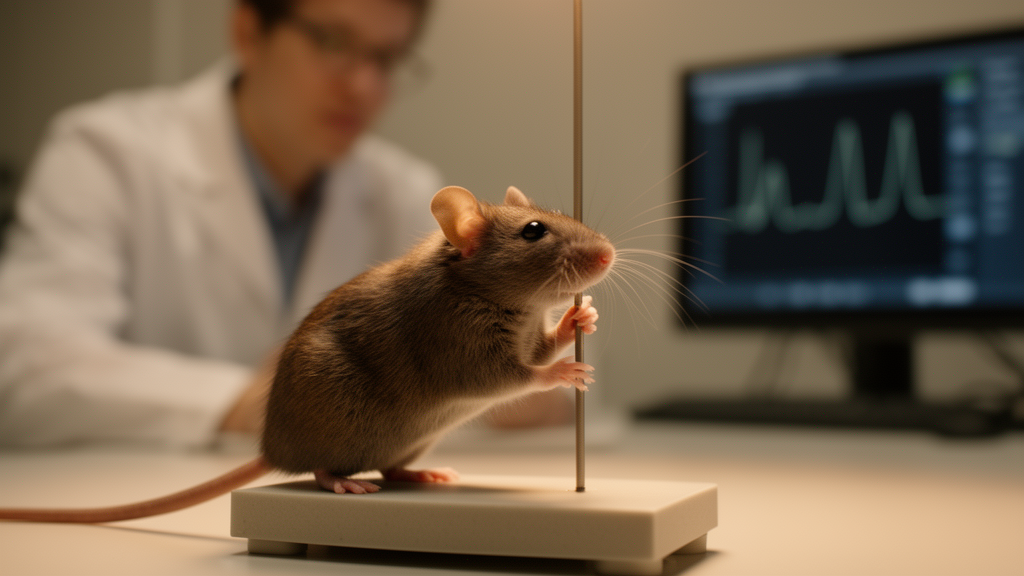
A brief, precisely timed surge of signals from the primary somatosensory cortex (S1) to the secondary motor cortex (M2) helps mice turn touch into action, according to a study published in PLOS Biology. Researchers recorded spiking activity simultaneously from both brain regions while mice performed a tactile delayed go/no-go task, and found that a short, stimulus-triggered communication window predicted whether the animals succeeded on individual trials.
Using time-shifted canonical correlation analysis, the team identified a sharp feedforward increase in S1-to-M2 coupling that peaked at a short latency, consistent with a potentially direct transmission pathway. This transient interaction carried stimulus-selective information: the S1-to-M2 communication subspace aligned with stimulus-coding axes in both regions. In contrast, feedback interactions running in the opposite direction, from M2 to S1, were weaker and occurred with a delay.
To test whether the transient coupling was functionally important, the researchers briefly suppressed S1 activity with optogenetics. This reduced both stimulus selectivity in M2 and the animals’ behavioral discriminability, supporting a role for the short-lived feedforward channel in guiding performance.
The findings indicate that sensorimotor transformation is not supported by sustained linear coupling along stimulus- or choice-related axes. Instead, goal-directed behavior appears to rely on a short-lived, highly selective feedforward communication channel that rapidly transmits reliable sensory representations from somatosensory cortex into motor-planning circuits. Because the work was conducted in mice performing a specific tactile task, the results address cortical communication in that setting; the authors note that the temporal structure of sensory-to-motor communication during such transformation had previously remained poorly understood.
Subject of Research: Feedforward communication between somatosensory and motor cortex during tactile decision-making in mice
Article Title: Transient feedforward communication between somatosensory and premotor cortex supports goal-directed behavior
Article References: Ranjbar-Slamloo, Y., & Kamigaki, T. (2026). Transient feedforward communication between somatosensory and premotor cortex supports goal-directed behavior. PLOS Biology, 24(10), e3004095. https://doi.org/10.1371/journal.pbio.3004095
Image Credits: AI Generated
DOI: 10.1371/journal.pbio.3004095
Keywords: somatosensory cortex, premotor cortex, sensorimotor transformation, optogenetics, go/no-go task, neural coupling, mice, tactile discrimination, motor planning, canonical correlation analysis, Transient, feedforward
News Source: Cassandra Pierce. (October 30, 2026). Brief Sensory-to-Motor Signal Surge Predicts Success in Mouse Touch Tasks. Scienmag.



