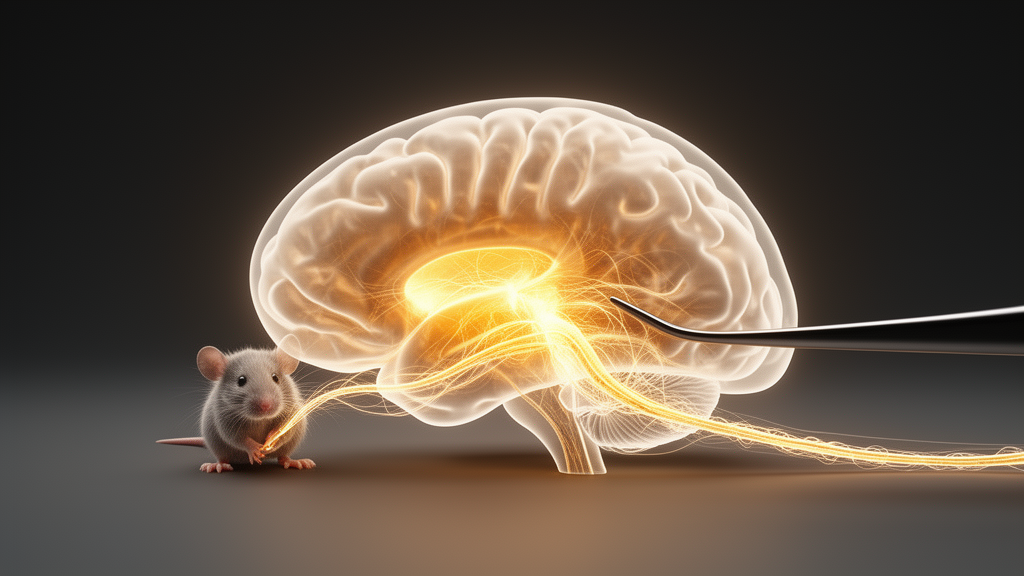
A two-hour squeeze of a sciatic nerve is enough to set off chronic pain that outlives the injury itself, according to a new study in Frontiers in Systems Neuroscience. Researchers at Kunming Medical University and collaborating institutions developed an acute constriction injury (ACI) model in male C57BL/6J mice: they constricted the sciatic nerve for exactly two hours, then completely removed the ligature, leaving no permanent peripheral damage. Over a 250-day observation period, these mice developed long-lasting mechanical allodynia and thermal hyperalgesia on the injured side, followed by delayed mirror-image sensitivity on the opposite side, despite full anatomical and functional recovery of the compressed nerve. The findings support the pain centralization hypothesis, in which a brief peripheral insult triggers self-maintained central sensitization that continues to generate pain after the periphery has healed.
The motivation for the new model lies in a gap between laboratory tools and clinical reality. Traditional neuropathic pain models, such as the chronic constriction injury (CCI) model, induce permanent peripheral nerve damage and therefore cannot mimic the persistent pain that follows a transient nerve compression once it has resolved. To compare the two conditions directly, the team ran a multimodal longitudinal study of three groups—Control, CCI and ACI mice—using behavioral pain assays, somatosensory evoked potentials (SEPs), the sciatic function index (SFI), nerve histology, muscle atrophy measurements, the open field test, and serial 9.4 Tesla pain-evoked BOLD functional MRI of the brain. This combination allowed the researchers to track, in the same animals over time, how peripheral nerve structure, limb function, behavior and whole-brain activation each evolved after the injury.
On the behavioral side, ACI and CCI mice proved strikingly similar. Both groups developed comparable long-lasting ipsilateral mechanical allodynia and thermal hyperalgesia, with delayed contralateral symptoms, across the entire 250-day observation window. Yet the underlying peripheral states diverged sharply. ACI mice achieved robust structural and functional recovery of the sciatic nerve, confirmed by histology and electrophysiological measures, and showed no muscle atrophy. CCI mice, by contrast, suffered irreversible peripheral nerve lesions. In other words, two groups of mice showed the same persistent pain phenotype, but only one of them still had a damaged nerve to explain it.
The serial fMRI data revealed distinct brain activation trajectories behind that shared pain behavior. At day 3, ACI mice exhibited spatially restricted response reductions relative to Control mice and widespread suppression relative to CCI mice, marking an early brain state that differed from both uninjured animals and mice with permanent nerve damage. By day 12, ACI mice showed isolated hypothalamic activation, a pattern that coincided with anxiety-like behaviors detected in both CCI and ACI mice at that time point. By day 250, the ACI brain had shifted to widespread bilateral activation of brainstem descending modulatory networks.
CCI mice followed a different trajectory altogether. They showed cerebellar and somatosensory cortical activation at early and mid time points, and, at late chronic stages, significant deactivation of striatal-limbic circuits. Notably, anxiety-like behaviors persisted in ACI mice at 7 months post-injury, while they were no longer detected in CCI mice at that late stage, a dissociation the authors link to the distinct central signatures of the two models.
Taken together, the data argue that the persistent pain in ACI mice is maintained centrally rather than peripherally. Because the nerve has recovered anatomically and functionally, and because muscle atrophy is absent, the continuing allodynia and hyperalgesia must arise from self-sustaining changes within the central nervous system. The progressive recruitment of hypothalamic and brainstem descending modulatory networks over months is consistent with a central sensitization process that, once triggered by the brief compression, no longer depends on ongoing peripheral input to keep itself running.
The authors propose that the ACI model may facilitate translational research on central-targeted therapeutics for compression-induced persistent neuropathic pain. Because the model separates the central contribution to chronic pain from permanent peripheral damage, it offers a platform for testing interventions aimed specifically at central sensitization—precisely the situation facing patients whose pain persists after a transient nerve compression has resolved. As with any animal model, the findings in male C57BL/6J mice will need to be validated in other settings before they can inform human treatment.
The study’s claims are those of the authors and do not necessarily represent their affiliated organizations or the publisher. The article was received in August 2026 and accepted in October 2026, and the final formatted version is pending publication.
Subject of Research: Neuropathic pain and central sensitization following transient peripheral nerve compression in mice
Article Title: Transient peripheral compression induces persistent central pain: the acute constriction injury model
Article References: Luo, K., Feng, X., Liu, Y., Li, G., Liu, Y., Yang, P., Wang, Y., Sun, Y., Chen, M., Chen, S., & Ao, L. (2026). Transient peripheral compression induces persistent central pain: the acute constriction injury model. Frontiers in Systems Neuroscience, 20, Article 1962461. https://doi.org/10.3389/fnsys.2026.1962461
Image Credits: AI Generated
DOI: 10.3389/fnsys.2026.1962461
Keywords: neuropathic pain, central sensitization, acute constriction injury, chronic constriction injury, sciatic nerve, BOLD fMRI, mechanical allodynia, thermal hyperalgesia, brainstem, hypothalamus, mouse model, Frontiers in Systems Neuroscience
News Source: Cassandra Pierce. (October 26, 2026). Brief Nerve Squeeze Leaves Lasting Pain Imprint in the Brain, Mouse Study Finds. Scienmag.