Credit: Beth Luedeker
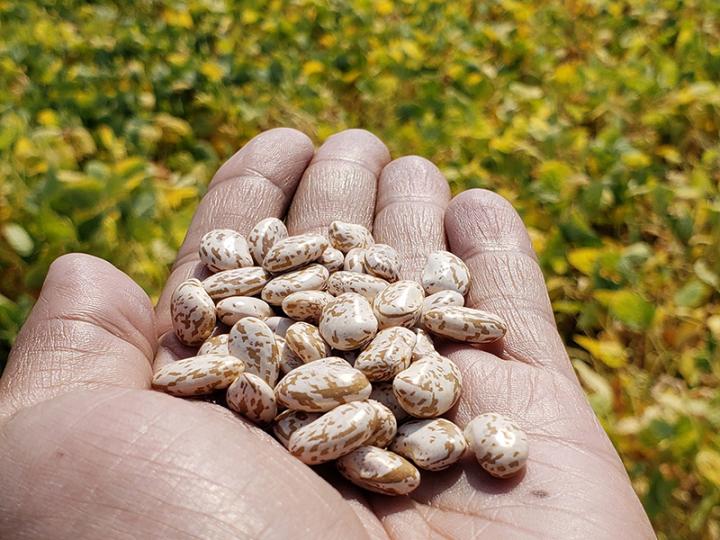
Your morning cereal or oatmeal. The bread on your sandwich. The corn chips for your snack, and the cookies for dessert. Not one would be possible with the humblest of ingredients: the seed.
Seeds such as wheat, rice and corn directly provide about 70% of the calories eaten by people every day. And they ultimately provide nearly every morsel of food, either by providing feed for livestock or by being grown into fruits and vegetables. It’s no overstatement to say that without seeds, civilization would be impossible.
But seeds need our help. They are under stress from climate change, and under pressure to feed a growing population.
Scores of dedicated scientists spend their careers working to improve seeds. They are using the latest scientific advances to make seeds larger, more nutritious, and more resilient to stress.
Rodomiro Ortiz studies how plant breeding can help meet these goals. His research was recently published in Crop Science, a journal of the Crop Science Society of America.
As the science behind seed improvements, plant breeding is the foundation for ensuring agriculture meets humanity’s needs.
“The seeds generated from plant breeding have desired traits that allow increases in productivity, reduce human malnutrition, improve genetic diversity in ecosystems, and ensure sustainable food production under the specter of global warming,” says Ortiz.
Classic plant breeding doesn’t add in extra DNA like genetic engineering does. Instead, plant breeders cross plants that each have uniquely strong features to create a new plant with several beneficial traits. The same process has been used by farmers and scientists for thousands of years to make better crops.
But today, plant breeders have access to more information and more tools than ever. For example, the widespread use of DNA sequencing gives plant breeders huge troves of data about useful genes. By figuring out which genes give rise to which useful traits, plant breeders can develop new varieties of crops much more quickly.
“Genome-derived knowledge of seed biology can enhance crop productivity, to improve food and nutritional supply through plant breeding,” says Ortiz.
But genes are only one piece of the puzzle. Scientists like Ortiz need to know how the plant grows and what it looks like. In the past, scientists might have been able to easily look and tell that one plant had, for example, larger seeds. But today, improving seeds requires ever greater detail.
Enter phenotyping, the science of measurement. A plant’s phenotype is its entire expression of its genes in its environment. The height and color of the plant. Its seeds’ weight and shape. Its tendency to resist or succumb to disease — these are all the phenotype.
Capturing this information is time intensive. Some of these traits are impossible for humans to even see. And seeds in particular are so small, measuring them by hand is unrealistic. Technology comes to the rescue.
“Phenotyping seed traits is a major bottleneck to systematic analysis of seed variation,” says Ortiz. “Advances in digital imaging technology can automatically measure a variety of shape parameters using high resolution images of seeds.”
With these tools in hand, plant breeders can improve seeds and develop new crop varieties faster than ever. Ortiz envisions making seeds larger, so each one has more calories to feed people. Larger seeds can also help the next generation of crops quickly grow in the fields, ready to produce a big yield. And plant breeders are trying to make seed proteins more nutritious or the fats inside seeds stable enough to last on grocery store shelves for longer.
Each of those improvements mean stronger seeds, and better food, for more people. So with your next spoonful of chewy oatmeal, consider the humble seed — and the advanced tech and know-how — behind every bite.
###
Rodomiro Ortiz is a professor of plant breeding at the Swedish University of Agricultural Sciences. This work was supported by the Science Foundation Ireland, Irish Research Council, Natural Sciences and Engineering Council of Canada, and the Manitoba Wheat and Barley Growers Association.
Media Contact
Rachel Schutte
[email protected]
Related Journal Article
http://dx.