Every year, hundreds of thousands of critically ill patients around the world are placed on mechanical ventilators, and for many of them the greatest danger comes not from the machine itself but from a small balloon of rubber sitting in their windpipe. The inflatable cuff at the tip of an endotracheal tube is meant to create an airtight seal between the tube and the tracheal wall, keeping oxygen flowing into the lungs while blocking contaminated secretions from sliding down into the lower airways. When that seal fails, bacteria-laden fluid from the throat can seep past microscopic channels in the cuff folds, seeding the lungs with infection. The result is ventilator-associated pneumonia, the most common healthcare-acquired infection in intensive care units, affecting roughly 20 to 36 percent of ventilated patients and carrying a mortality rate of about 21 percent. A team of engineers and clinicians at the University of Nottingham now argues that the standard laboratory test used to certify how well these cuffs seal has been measuring the wrong thing, and they have built a device to prove it.
The problem lies in how the international standard, EN ISO 5361:2023, asks manufacturers to evaluate tracheal seals. Under the current protocol, an endotracheal tube is inserted into a transparent rigid cylinder, the cuff is inflated to a preset pressure, a five-centimetre column of water is poured above it, and the volume of water leaking past the cuff in ten minutes is recorded. It is a simple, repeatable test, but it bears little resemblance to the inside of a living patient. A real trachea is not a rigid acrylic pipe; it is a compliant, layered structure of soft mucosa and springy cartilage that flexes with every breath. Nor does a real patient lie still on a bench. The airway pressure rises and falls with each mechanical breath, and over days of intubation the cuff slowly loses pressure as gas diffuses through its walls. None of these dynamics appear in the standard test, which means a tube that performs beautifully in the laboratory may behave very differently in a patient’s chest.
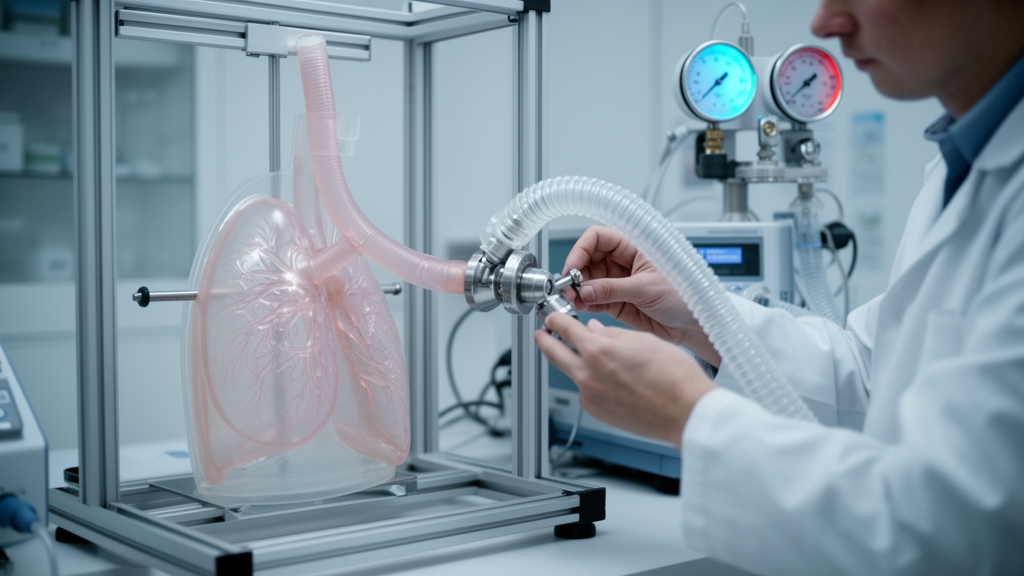
To close that gap, the Nottingham group, led by Delu Zheng and Tamaralayefa B. Agbiki and supervised by Stephen P. Morgan, constructed a benchtop phantom system that brings the clinic into the laboratory. At its heart is a bio-inspired tracheal model with a 22-millimetre internal diameter, fabricated using published ex vivo biomechanical data for human tracheal tissue. The cartilaginous portions of the model replicate reported Young’s modulus values of 3.2 to 23 megapascals and Shore hardness values of 59.6 to 91 ShA, while the mucosal membrane mimics far softer tissue, with moduli of 4 to 18 kilopascals. The result is a heterogeneous artificial airway whose compliant walls deform against the cuff much as living tissue would. Around this tracheal model, the researchers assembled a complete respiratory circuit: a ventilator delivering bilevel pressure ventilation with an inspiratory pressure of 20 centimetres of water and a positive end-expiratory pressure of 4, a two-litre test lung acting as the patient, and an Arduino-controlled automatic cuff inflation system that continuously regulates intracuff pressure using a proportional-integral-derivative control algorithm.
The phantom was designed to run in three modes, each isolating a different aspect of the clinical environment. Standard Mode reproduces the static conditions of the ISO test, with no ventilator and manual cuff inflation. Ventilation Mode adds the ventilator and test lung, introducing the rhythmic pressure swings of mechanical breathing while the cuff remains manually inflated. Auto-inflation Mode completes the picture, adding the automated pressure controller, which uses a miniature pneumatic pump, a solenoid valve and a relay to hold the cuff at its target pressure throughout every ventilation cycle. In all three modes, the researchers followed the ISO protocol’s core logic: the cuff was inflated to 27 centimetres of water, distilled water warmed to 37 degrees Celsius was maintained at a five-centimetre height above the cuff, and a precision balance with 0.01-gram resolution captured every drop that escaped past the seal over one hour.
The team tested two cuff materials that dominate clinical practice: five high-volume low-pressure polyvinyl chloride tubes and five polyurethane-cuffed tubes, all with a 7.0-millimetre internal diameter. The differences were striking. For the PVC tubes, the rigid cylinder phantom reported leakage rates far higher than the bio-inspired model did, with the compliant trachea showing roughly 30 percent less leakage under static conditions, about 50 percent less under ventilation, and approximately 58 percent less with automatic cuff inflation. All comparisons were statistically significant at p less than 0.001, with paired effect sizes ranging from 5.22 to 16.05, indicating enormous differences. In absolute terms, PVC leakage fell from 328.60 millilitres per hour in the cylinder under static conditions to just 81.14 millilitres per hour in the bio-inspired phantom with automatic inflation. The compliant airway, in other words, does not merely refine the numbers; it transforms the apparent performance of the same tube.
The polyurethane cuffs told an even more revealing story. In the rigid cylinder, these tubes showed no measurable leakage at all under any condition, which would seem to certify them as perfect seals. Yet in the bio-inspired phantom under static conditions, a small but measurable leak of 19.67 millilitres per hour appeared, invisible to the standard test but detectable once the airway could flex against the cuff. This finding underscores the central argument of the paper: rigid cylinder testing can mask subtle sealing behaviours that matter clinically. Polyurethane cuffs owe their advantage to physics at the micrometre scale. PVC cuff walls are roughly 50 to 70 micrometres thick and relatively stiff, so when inflated they buckle into large longitudinal folds that form microchannels along the cuff-trachea interface. Polyurethane walls are only about 7 to 10 micrometres thick and far more flexible, allowing the cuff to drape smoothly over the airway surface, shrinking and eliminating those leakage pathways.
Perhaps the most clinically consequential result came from the long-term experiments. The researchers placed inflated cuffs in an oven at 37 degrees Celsius, body temperature, and monitored them continuously for 48 hours. Both materials bled pressure steadily: PVC cuffs lost an average of 12.24 centimetres of water, and polyurethane cuffs lost 9.06, with some individual PVC tubes falling from around 28 centimetres of water to below 15. Since clinical guidelines recommend keeping cuff pressure above roughly 20 centimetres of water to maintain the seal, this silent decay means that a cuff inflated correctly on day one may drift into the danger zone within two days, opening the door to microaspiration without any visible warning. The pressure drop is attributed to gas diffusion through the cuff material and viscoelastic relaxation, processes that accelerate at body temperature and that no static bench test currently accounts for.
The ventilation experiments also produced a counterintuitive insight: mechanical breathing actually reduced fluid leakage. In the bio-inspired phantom, PVC leakage under ventilation was about 48 percent lower than in static mode, and automatic inflation cut it further, by roughly 65 percent relative to baseline. The researchers observed air bubbles travelling proximally through the cuff folds during the inspiratory phase, suggesting that positive airway pressure distal to the cuff generates an outward airflow that transiently opposes liquid ingress. Meanwhile, the automatic inflation system, tuned with controller coefficients of P equal to 3, I equal to 5 and D equal to 0, eliminated measurable cuff deflation entirely across all conditions, stabilising the seal in a way that manual inflation cannot. This aligns with clinical trials suggesting that continuous cuff pressure control may help reduce ventilator-associated pneumonia rates.
The Nottingham team is candid about the limitations of their platform. The phantom uses a single tracheal diameter and fixed ventilator settings, and it cannot reproduce tissue perfusion, mucosal secretions, muscle tone or the anatomical variability of real patients. Only five tubes of each type were tested, and no in vivo validation was performed. Even so, the system, funded by the Medical Research Council, offers something the current standard cannot: a repeatable benchtop model in which cuff materials, tube designs and pressure management strategies can be compared under dynamic, physiologically realistic conditions. As the authors conclude, static pressure retention alone is insufficient to characterise cuff performance, and their bio-inspired phantom reveals sealing behaviours that rigid cylinders simply cannot see. For a device whose failure feeds one of intensive care’s most stubborn infections, that is a meaningful step toward testing tubes the way patients actually experience them.
Subject of Research: A bio-inspired benchtop phantom system for testing endotracheal tube cuff seal performance under mechanical ventilation
Article Title: Phantom system for endotracheal tube cuff seal testing during mechanical ventilation
Article References: Zheng, D., Agbiki, T. B., Correia, R., He, C., Korposh, S., Erdody, S., Hayes-Gill, B. R., Hewson, D. W., Norris, A. M., & Morgan, S. P. (2026). Phantom system for endotracheal tube cuff seal testing during mechanical ventilation. Medical & Biological Engineering & Computing. https://doi.org/10.1007/s11517-026-03691-0
Image Credits: AI Generated
DOI: 10.1007/s11517-026-03691-0
Keywords: endotracheal tube, cuff seal, ventilator-associated pneumonia, mechanical ventilation, bio-inspired phantom, tracheal model, cuff pressure, polyurethane, polyvinyl chloride, microaspiration, EN ISO 5361, medical engineering
News Source: Denise Maddox. (October 9, 2026). Breathing Phantom Puts Ventilator Tube Seals to a Realistic Test. Scienmag.