A single breath may carry faint chemical traces of one of the most consequential events in the reproductive calendar. In a small pilot study published in Reproductive Sciences, researchers measured exhaled volatile organic compounds (VOCs) in healthy women across the follicular, ovulatory, and luteal phases of a natural menstrual cycle, using proton transfer reaction time-of-flight mass spectrometry (PTR-TOF–MS). Their central finding was modest but intriguing: one breath signal, reported at the mass-to-charge ratio m/z 41.04, rose significantly during ovulatory measurements compared with all other sampling days, hinting that the metabolic shifts accompanying ovulation leave a measurable fingerprint in exhaled air.
The answer lies in the pronounced inter- and intra-individual variability of reproductive hormones. Calendar calculations, basal body temperature monitoring, and urine strip tests are widely used, but they are limited by short-lived hormonal peaks, variability between women, and susceptibility to confounding factors. Breath VOCs, which reflect systemic metabolism and can be measured non-invasively and in real time, may offer a complementary window on the physiological state of the cycle.
The menstrual cycle is accompanied by coordinated endocrine and metabolic responses well beyond the reproductive tract. Basal body temperature, breast volume, insulin sensitivity, and end-tidal carbon dioxide concentrations all fluctuate across the follicular and luteal phases. Prior work has suggested that breath profiles of acetone, isoprene, and sulfur-containing compounds may vary across the cycle and around ovulation.
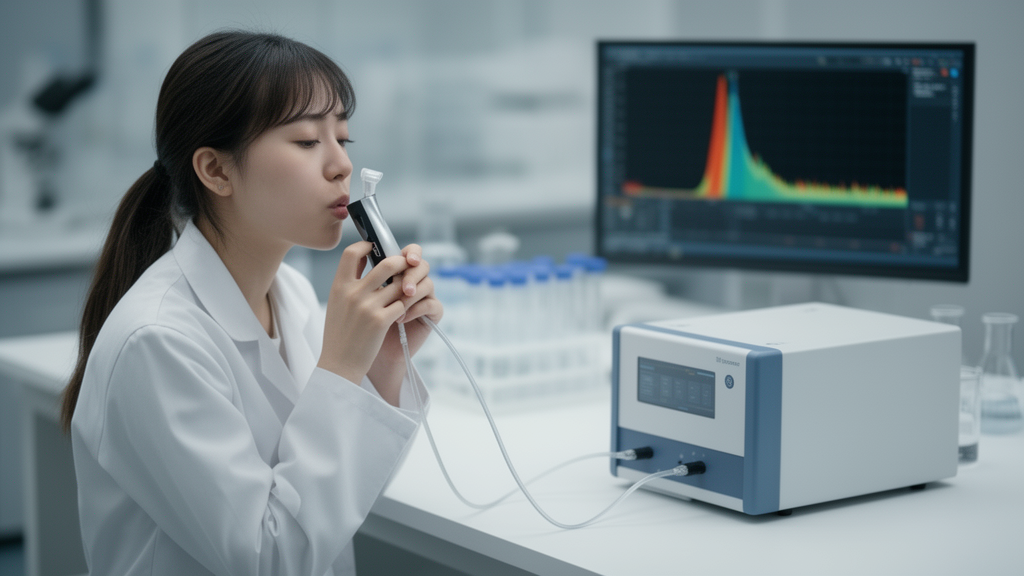
Yet only a limited number of studies have tracked longitudinal changes in breath VOC profiles throughout a natural cycle, and the relationship between breath signals and circulating reproductive hormone concentrations has remained unclear. The new pilot study was designed to probe exactly that gap. Technically, the approach relies on PTR-TOF–MS, an instrument that ionizes trace gases in exhaled breath using hydronium reagent ions and then separates the resulting product ions by their exact mass-to-charge ratios with time-of-flight mass analysis.
In this configuration, the drift tube was operated at 80 degrees Celsius and 2.6 mbar pressure with a drift voltage of 561 V and an electric field strength of 120 Townsend, and the acetone product ion at m/z 59.05 was monitored during exhalation to determine end-tidal points, ensuring that samples reflected alveolar air rather than dead-space gas. The method allows real-time, non-invasive measurement of many signals simultaneously, each reported according to its m/z value with tentative compound assignments drawn from a PTR library. Recruitment was careful and deliberately restrictive.
Ten women with regular menstrual cycles were enrolled; all were healthy non-smokers, not using hormonal contraception or medication, and fasting at the time of sampling. Breath and blood samples were collected on two days in the follicular phase (preovulatory days 0 to 12), on the day of ovulation, and on two days during the mid-luteal phase (postovulatory days 16 to 21). Ovulation was determined by serum luteinizing hormone (LH), estradiol (E2), and progesterone (P) levels, with predefined cut-offs: LH either doubling from baseline or exceeding 10 IU/L, E2 above 100 pg/mL as an indicator of follicular development, and P above 4.5 ng/mL indicating luteinization.
Ovulation was subsequently confirmed through a retrospectively obtained menstrual history. Of the ten recruited women, only five entered the final analysis. Two participants were excluded because their breath measurements had been performed on a different PTR-TOF–MS instrument, a decision made to circumvent any potential cross-instrument variability.
Three more were excluded because fever and/or antibiotic treatment could substantially alter breath VOC profiles and confound the assessment of cycle-related changes. The exclusions, while necessary for data integrity, underscore a recurring challenge in breath research: environmental and behavioral influences, from diet and co-medication to sampling conditions, can shape the VOC composition of exhaled air even under standardized protocols. The statistical picture that emerged was phase-dependent but selective.
Comparing breath VOCs among the follicular, ovulatory, and luteal phases showed trends toward phase-dependent differences for the signals at m/z 41.04 (p = 0.050), m/z 67.05 (p = 0.099), and m/z 69.07 (p = 0.166). When the analysis narrowed to ovulatory versus non-ovulatory measurements, the signal at m/z 41.04 was significantly higher during ovulation (p = 0.021). Median signal intensities were 24,567 (interquartile range 20,851 to 26,962) during ovulatory measurements and 15,480 (13,179 to 16,992) during non-ovulatory measurements, a substantial relative difference for a single ion signal.
In contrast, m/z 67.05 and m/z 69.07 did not reach statistical significance in the ovulatory comparison (both p = 0.064). Just as telling was what did not appear. No significant correlations were observed between any breath VOC signals and serum concentrations of LH, E2, or P, although positive trends were noted between E2 and the signals at m/z 41.04 (Spearman's rho = 0.448, p = 0.145) and m/z 67.05 (rho = 0.497, p = 0.101).
The authors interpret this absence cautiously. In PTR-TOF–MS, the hydrocarbon-related fragment ions at m/z 41.04 and m/z 67.05 are associated with lipid- or isoprene-related metabolism rather than individual compounds, and reporting m/z features rather than fully identified molecules is common practice in exploratory PTR-TOF–MS studies, particularly when signals show reproducible physiological associations. The metabolic backdrop may explain why breath signals lag behind hormone peaks.
Lipid and lipoprotein levels and oxidative stress are known to fluctuate during the menstrual cycle. Mumford and colleagues observed that lipoprotein cholesterol levels vary in response to changing estrogen levels, with low-density lipoprotein cholesterol highest during the follicular phase and high-density lipoprotein cholesterol highest around ovulation. High E2 concentrations during the follicular phase have been shown to have antioxidant properties, while fluctuations of liver enzymes during the normal cycle are possibly mediated by progesterone.
Ovulation itself is associated with profound metabolic and endocrine changes, including increased steroidogenesis, altered lipid turnover, and shifts in oxidative metabolism. Whether lipid peroxidation or oxidative stress-related processes influence specific ion signals, such as ethane- or pentane-related features, in breath remains unresolved. The authors suggest that metabolic markers may not follow the rapid and phase-specific secretion patterns of reproductive hormones, but rather integrate hormonal effects over time, providing complementary information on the physiological state.
The authors are explicit that these findings should be regarded as hypothesis-generating rather than definitive. The main limitations are the small sample size and the exploratory design. Breath VOCs remain susceptible to environmental and behavioral influences despite standardized sampling, and even exhaled isoprene, produced in the muscles, changes rapidly with variations in physical activity and may be influenced by minimal movements during sampling.
The authors note that larger studies with higher temporal resolution and independent validation cohorts should account for confounders such as circadian rhythms, exogenous contaminants, and humidity, and that mixed-effects or generalized estimating equation models would have been appropriate for the repeated-measures structure. No formal correction for multiple comparisons was applied, because stringent correction on a small pilot cohort would substantially increase the risk of Type II errors, and post-hoc power and minimum detectable effect analyses were not conducted. The possibility of selection bias could not be discounted.
What the study does establish is a proof of concept with a clear mechanistic framing. Breath VOCs exhibit phase-dependent alterations across the menstrual cycle, and the observed increase in the m/z 41.04 signal during ovulation may reflect integrated metabolic adaptations associated with endocrine changes rather than direct surrogates of circulating hormone concentrations. In other words, breath chemistry may not mirror the rapid, phase-specific secretion patterns of reproductive hormones; instead, it may integrate hormonal effects over time, providing complementary information on the physiological state that conventional ovulation tests may miss.
The authors frame the results as requiring confirmation in larger prospective studies, positioning breath analysis not as a replacement for hormone-based methods but as a potential adjunct capturing the systemic metabolic consequences of the endocrine events driving ovulation. For now, the signal at m/z 41.04 stands as a promising, unconfirmed lead in a field where the breath may yet speak where hormones fall silent.
Subject of Research: Breath volatile organic compounds across the menstrual cycle measured by PTR-TOF–MS
Article Title: Breath Volatile Organic Compounds Across the Menstrual Cycle: A Pilot Study Using PTR-TOF–MS
Article References: Eckhardt, C., Lederer, W., Wildt, L., Böttcher, B., & Ruzsanyi, V. (2026). Breath Volatile Organic Compounds Across the Menstrual Cycle: A Pilot Study Using PTR-TOF–MS. Reproductive Sciences. https://doi.org/10.1007/s43032-026-02249-7
Image Credits: AI Generated
DOI: 10.1007/s43032-026-02249-7
Keywords: breath analysis, volatile organic compounds, menstrual cycle, ovulation, PTR-TOF-MS, mass spectrometry, reproductive endocrinology, estradiol, luteinizing hormone, progesterone, isoprene, pilot study
News Source: Ophelia Keating. (October 24, 2026). Breath Signal at m/z 41.04 Rises During Ovulation in Small Pilot Study. Scienmag.