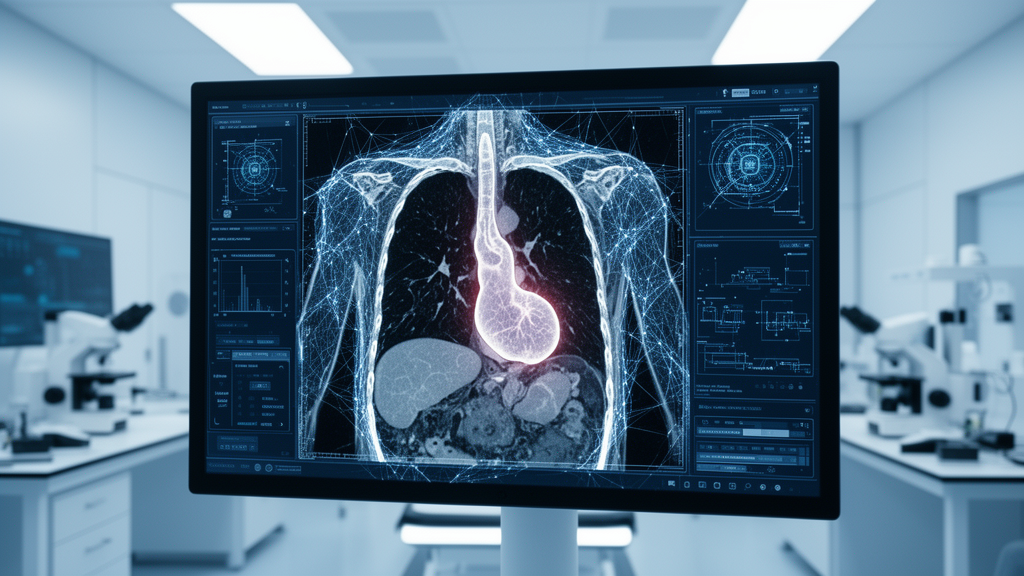
Surgeons treating esophageal squamous cell carcinoma often face a hidden problem: even when computed tomography shows no enlarged lymph nodes, cancer cells may already have spread to nodes that look normal on imaging. A retrospective two-center study published in BMC Medical Imaging reports that an artificial intelligence model combining radiomic features with deep-learning features extracted from CT images can predict this occult lymph node metastasis before surgery, achieving an area under the receiver operating characteristic curve of 0.886 (95% confidence interval, 0.791 to 0.982) in an external test cohort of 46 patients. The work, led by Xinhao Chen and colleagues, focused on patients whose disease was classified as clinically node-negative, meaning standard imaging had not flagged any suspicious nodes.
The study enrolled 300 patients with clinically node-negative esophageal squamous cell carcinoma who underwent surgery with lymphadenectomy, so that postoperative histopathology could serve as the reference standard for whether occult nodal metastasis was truly present. Patients from the first center were assigned chronologically to a training cohort of 214 cases covering January 2019 through December 2023 and a temporal test cohort of 40 cases from January through December 2024. A second center contributed 46 patients treated between January 2019 and December 2023, forming an external test cohort.
Technically, the pipeline drew on two families of information extracted from the primary tumor on CT images. Radiomic features were computed from the tumor images, while deep-learning features were derived from three residual neural network architectures, ResNet50, ResNet101, and ResNet152. The researchers then fused these feature sets, combining radiomic variables with ResNet-derived representations in logistic regression models, and evaluated performance using the area under the curve, the Brier score, calibration, and decision curve analysis. SHAP analysis, a technique that attributes each feature’s contribution to individual predictions, was used to interpret the models.
The best-performing configuration fused radiomic features with ResNet101-derived features in a logistic regression classifier. It yielded an area under the curve of 0.930 (95% confidence interval, 0.896 to 0.965) in the training cohort, 0.910 (95% confidence interval, 0.821 to 0.999) in the temporal test cohort, and 0.886 in the external test cohort. In the external cohort, the model reached an accuracy of 0.826, a sensitivity of 0.792, a specificity of 0.864, and a Brier score of 0.153, a measure of the gap between predicted probabilities and actual outcomes in which lower values indicate better calibration. The wide confidence intervals, particularly in the smaller test cohorts, reflect the limited number of cases available for validation.
SHAP analysis showed that both feature families contributed to the model’s decisions, with deep-learning features accounting for 61.7% of the total mean absolute SHAP contribution and radiomic features for the remaining 38.3%. The authors conclude that the fusion model showed favorable discrimination for preoperative prediction of occult lymph node metastasis across temporal and external testing and may provide complementary information for individualized preoperative nodal risk assessment. They are careful, however, to state the limits of the evidence: the study was retrospective, and prospective multicenter validation is required before the model’s clinical utility can be established.
Subject of Research: CT-based radiomics-deep-learning fusion for predicting occult lymph node metastasis in clinically node-negative esophageal squamous cell carcinoma
Article Title: CT–based radiomics–deep–learning fusion for predicting occult lymph node metastasis in clinically node–negative esophageal squamous cell carcinoma
Article References: Chen, X., Meng, Q., Dai, G., Li, Q., Xu, L., Yang, R., Liu, X., Dong, M., & Wang, F. (2026). CT–based radiomics–deep–learning fusion for predicting occult lymph node metastasis in clinically node–negative esophageal squamous cell carcinoma. BMC Medical Imaging. https://doi.org/10.1186/s12880-026-02964-2
Image Credits: AI Generated
DOI: 10.1186/s12880-026-02964-2
Keywords: esophageal squamous cell carcinoma, occult lymph node metastasis, radiomics, deep learning, ResNet, computed tomography, SHAP, Brier score, decision curve analysis, retrospective study, BMC Medical Imaging, based
News Source: Nathaniel Bowman. (October 24, 2026). AI Model Reads CT Scans to Flag Hidden Esophageal Cancer Spread. Scienmag.