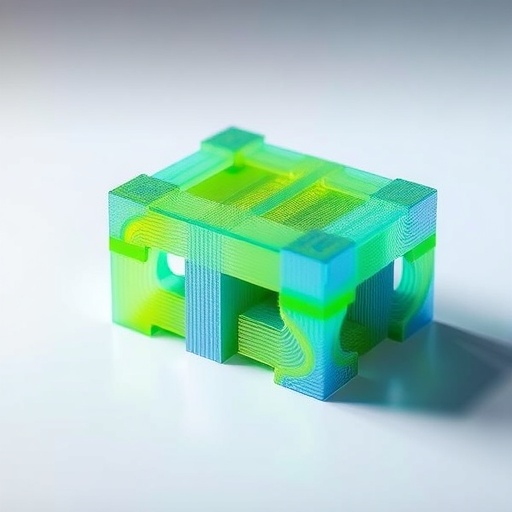
In a groundbreaking advancement poised to redefine additive manufacturing, researchers at the Karlsruhe Institute of Technology (KIT) have introduced a novel multi-material 3D printing technology named CeraMMAM—Ceramic Multi Material Additive Manufacturing. This innovative system allows for the production of high-performance components comprising multiple materials within a single manufacturing process through the use of a universal binder system. Unveiled ahead of the Hannover Messe 2026, CeraMMAM signals a pivotal leap for sectors ranging from aerospace and mechanical engineering to medical applications, promising unprecedented design flexibility and enhanced functionality.
Traditional additive manufacturing techniques, while revolutionary, have often been constrained by the limitation of utilizing pure materials—typically metals or ceramics—throughout the production process. This constraint has restricted the potential of 3D printing technologies in delivering components that integrate varying material properties tailored to specific functional demands. However, the CeraMMAM project at KIT’s Institute of Production Science (wbk) surmounts this barrier by introducing an innovative approach that synthesizes different ceramic materials or combinations of ceramics and metals within a single fabrication workflow. The integration of these materials offers transformative opportunities to engineer components with complex architectures and customized performance characteristics impossible to achieve with homogeneous material constructs.
Central to this pioneering technology is an advanced vat photopolymerization technique. This method leverages a photocurable resin matrix loaded with finely dispersed ceramic or metallic particles. During printing, the resin undergoes localized curing when exposed to light at precise wavelengths, enabling layer-by-layer construction. The breakthrough lies in the sophisticated universal binder system, meticulously engineered to ensure robust bonding among diverse material constituents during the simultaneous curing process. This binder amalgamates liquid polymers, functional additives, and photoinitiators capable of interacting symbiotically with varying particles. After printing, the binder is systematically removed via a debinding stage followed by sintering, resulting in a densified, cohesive multi-material component.
Chantal-Liv Lehmann from wbk articulates the technological marvel that CeraMMAM represents: “Our universal binder system revolutionizes multi-material 3D printing by enabling the creation of components with hybrid and sometimes inherently conflicting material properties. This empowers engineers and designers to explore novel geometries and functionalities that were previously unattainable.” For instance, the technology can fabricate ceramic gears featuring a rigid, wear-resistant exterior seamlessly integrated with a flexible interior matrix, enhancing both durability and operational performance. The meticulous control afforded by this process also supports the intricate replication of delicate microstructures and highly complex geometries, marking a significant milestone in ceramics manufacturing.
The ability of CeraMMAM to integrate metals and ceramics broadens its application horizon dramatically. Ceramics, known for their excellent thermal and electrical insulation properties, can now be coupled with metals’ superior electrical conductivity within a unified component. This integration potentiates breakthroughs in areas such as power electronics, where combining conductive and insulating materials in compact assemblies is critical. Moreover, the technology aligns seamlessly with the progressing demands of 5G and forthcoming 6G telecommunications infrastructure, miniaturized sensing devices for the Internet of Things (IoT), and advanced autonomous vehicle systems. This capacity for multifunctionality, achieved through precise material placement, portends the emergence of next-generation smart components with enhanced reliability and miniaturization.
The CeraMMAM project delves deeper into material science to optimize the binder system for even broader material compatibility. This ongoing refinement aims to facilitate stronger interfaces and minimize residual stresses and defects that traditionally arise from the integration of materials with disparate thermal and mechanical properties. Achieving such synergy will enable mass-scale production of hybrid components without sacrificing structural integrity or performance consistency. Additionally, the scalability of this technology promises smoother transitions from research prototypes to industrial-grade parts tailored for high-demand applications under stringent quality controls.
Beyond the hardware innovation, the CeraMMAM technology encapsulates a paradigm shift in the design philosophy for engineered components. Designers are now empowered to envisage parts where spatially varying material properties can be architected deliberately, conferring multifunctionality within single units. This reduces assembly complexity, lowers weight, and enhances overall system reliability by mitigating interfaces prone to mechanical failure. The holistic integration of multiple materials also portends the development of components with embedded sensing, actuation, or adaptive capabilities, advancing the frontier of smart manufacturing and Industry 4.0 paradigms.
The universal binder system itself is a product of meticulous chemical formulation. It balances photopolymerization kinetics, ensuring rapid curing while preserving compatibility with varied particulate matter. Functional additives tailor the rheology and interfacial adhesion characteristics to enable uniform dispersion and minimize defects. Photoinitiators are selected to activate under specific wavelengths conducive to the intricate layer-by-layer polymerization strategy deployed. This chemical sophistication, combined with optimized printing parameters, yields multi-material parts with seamless internal transitions, crucial for ensuring mechanical resilience and functional integrity.
During post-processing, the debinding stage meticulously eliminates the polymeric binder without compromising the structural layout, followed by sintering to fuse the ceramic and metal particles. This thermal densification requires finely tuned temperature profiles to accommodate materials with divergent sintering behaviors, preventing warping or microcracks. The researchers’ ability to harmonize these parameters demonstrates an acute understanding of material science and thermal engineering, ensuring that the final component meets demanding industrial standards required for aerospace and biomedical applications.
This breakthrough in multi-material additive manufacturing dovetails with broader technological trends emphasizing sustainability and resource efficiency. By consolidating manufacturing steps and reducing the need for assembly, CeraMMAM contributes to lowering energy consumption and material waste throughout the production lifecycle. Furthermore, the capacity to engineer components with region-specific properties enables longer service life and better performance, reducing the frequency of replacement and the associated environmental footprint. This aligns inherently with KIT’s commitment to tackling urgent global challenges such as climate change and sustainable resource utilization through cutting-edge scientific innovation.
The presentation of CeraMMAM’s initial industrial prototypes and demonstrators at Hannover Messe 2026 marks a critical juncture, showcasing the practical viability and transformative potential of this technology to a global audience of innovators, engineers, and industry leaders. This exposure is expected to accelerate the adoption of multi-material additive manufacturing across disciplines and stimulate cross-sector collaborations. The ability to tailor properties at a microscopic scale while producing geometrically complex components on-demand heralds a new era where manufacturing boundaries are continuously expanded, empowering the development of next-generation technologies.
As the capabilities of CeraMMAM evolve, the integration of this technology into established manufacturing chains promises to elevate overall product sophistication. For example, in medical devices, implants with graded stiffness or bioactive surfaces could be custom-manufactured, improving patient outcomes. In aerospace, components engineered for optimized thermal management and mechanical stress distribution will enhance safety and efficiency. In electronics, embedding conductive pathways within ceramic substrates can miniaturize devices and improve performance robustness in harsh environments. The horizon of possibilities is vast, firmly positioning CeraMMAM as a cornerstone technology in the future of manufacturing.
Karlsruhe Institute of Technology’s interdisciplinary approach, combining materials science, mechanical engineering, and photopolymer chemistry, underscores the multifaceted nature of this innovation. It also reflects the broader mission of scientific excellence harmonized with societal impact, reinforcing KIT’s reputation as a leading force in sustainable and resilient technological advancement. The CeraMMAM project exemplifies how fundamental research can be translated into highly applicable solutions, driving forward the nexus of science and industry in an increasingly complex technological landscape.
In summation, CeraMMAM is not merely a technological breakthrough—it represents a new frontier for additive manufacturing, unlocking the potential to fabricate complex, multi-material components with unprecedented precision and functionality. This universal binder system enables the seamless integration of ceramics and metals in a single, streamlined process, challenging conventional manufacturing paradigms and setting the stage for innovative applications across numerous high-tech industries. As the technology matures, it promises to catalyze a wave of innovation, enriching the capabilities and sustainability of future engineered products.
Subject of Research: Multi-material 3D printing technology utilizing universal binder systems for ceramics and metals.
Article Title: Revolutionizing Additive Manufacturing: KIT’s CeraMMAM Unleashes Multi-Material 3D Printing Potential
News Publication Date: April 2026 (Hannover Messe 2026 timeframe)
Image Credits: Markus Breig, Karlsruhe Institute of Technology (KIT)
Keywords
Additive manufacturing, multi-material 3D printing, ceramics, metals, universal binder system, vat photopolymerization, sintering, high-performance components, Karlsruhe Institute of Technology, CeraMMAM, industrial prototypes, heterogeneous materials, advanced manufacturing
Tags: 3d printing for medical applicationsadditive manufacturing in aerospaceadvanced additive manufacturing techniquesceramic and metal 3d printing integrationceramic multi material additive manufacturingCeraMMAM 3d printing systemcustomized 3d printed component designhigh-performance multi-material componentsinnovative 3d printing fabrication workflowmulti-material 3d printing technologymulti-material components for mechanical engineeringuniversal binder system for 3d printing