The increasing demand for sustainable energy sources has driven researchers to explore innovative materials and technologies for energy storage solutions. One area of particular interest has been aqueous zinc-ion batteries (ZIBs), which show promise due to their safety, affordability, and environmental compatibility. Among the myriad of materials being studied, iodine stands out as a potential key player, given its abundant presence in seawater and its ability to enhance battery performance.
Iodine’s theoretical capacity of 211 mAh g−1 coupled with its favorable redox potential of 0.54 V positions it as an attractive candidate for fabricating high-efficiency zinc-iodine batteries. Despite these advantages, the low electrical conductivity of iodine presents a significant barrier to achieving effective redox conversions during energy storage processes. This limitation is exacerbated by the formation of soluble polyiodides, which can migrate toward the zinc anode and lead to undesirable capacity degradation and corrosion of the anode material.
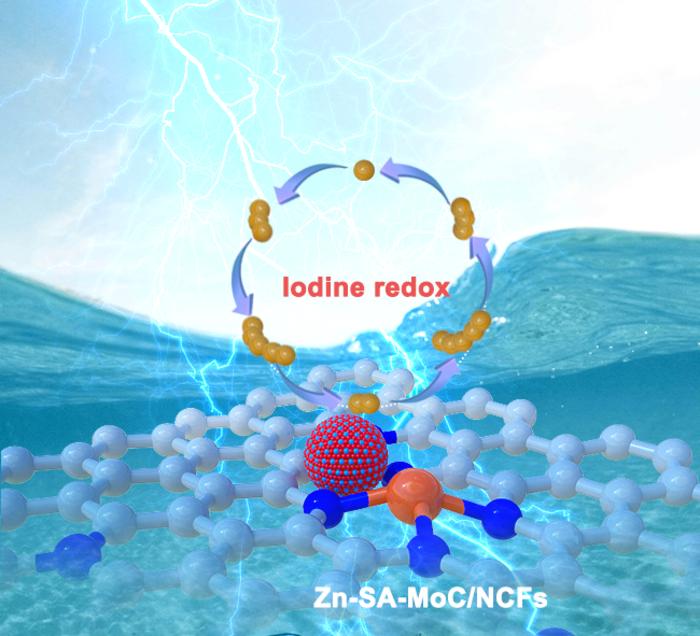
In an exciting development, a research team has introduced a novel approach to tackle the challenges associated with Zn-I2 batteries. By employing a coprecipitation method to encapsulate molybdate ions within a zeolitic imidazolate framework-8 (ZIF-8), researchers are able to create a unique composite material that combines porous carbon fibers with atomic single-zinc (Zn-SA) sites and molybdenum carbide (MoC) clusters. This pioneering design is anticipated to enhance both the electrochemical performance and overall stability of zinc-iodine batteries.
The integration of molybdenum carbides within a hierarchical porous carbon matrix aims to facilitate superior mass transfer, thereby improving the adsorption capacity for iodine species. This architecture not only modulates the catalytic activity of the material but also allows for optimal charge redistribution during the redox reactions. Consequently, the assembled Zn-I2 batteries have demonstrated a remarkable specific capacity of 230.6 mAh g−1 at a current density of 0.5 C, alongside an impressive capacity retention of 90% after enduring 20,000 cycles. Such performance metrics indicate a step forward in the quest for durable and effective energy storage solutions.
What makes this development particularly noteworthy is its novelty; this study is the first to successfully manipulate the electrocatalytic activity of MoC clusters through the incorporation of Zn-N4 sites specifically for iodine redox reactions. This strategy not only sheds light on how to optimize the interaction between iodine and electrode materials but also opens avenues for the design and construction of advanced iodine catalysts. The findings of this research provide a robust framework for developing high-performance ZIBs and inspire future explorations in this burgeoning field of study.
The ability to modulate electronic structures for enhanced interactions during redox reactions indicates significant progress. Understanding the underpinnings of how these single-atom sites interact with iodine species will undoubtedly catalyze further innovation in battery technology. The resultant design criteria emanating from this study can serve as a guide for subsequent research, offering strategies to improve the performance of other energy storage systems.
Moreover, the environmental implications of this research cannot be understated. By leveraging naturally abundant materials and potentially enhancing the safety profile of energy storage systems, such innovations could align well with global sustainability goals. The pursuit of cleaner, safer, and more efficient energy storage options is critical as societies strive to reduce their dependence on fossil fuels and mitigate climate change.
As the scientific community continues to probe the intricacies of zinc-iodine batteries, one cannot help but be optimistic about the prospects of these cutting-edge research developments. The landscape of energy storage is ever-evolving, and with contributions like these, we are likely to witness transformative shifts in how we harness and utilize energy. The implications of this work go beyond academic curiosity; they resonate with the urgent needs of today’s energy challenges, making them of immense significance not just to researchers but to society as a whole.
Simultaneously, the research highlights the interconnectedness of various disciplines, including materials science, electrochemistry, and environmental science. The synergistic approach taken by the research team reflects the collaborative spirit necessary to foster breakthroughs in energy storage technologies. It paves the way for interdisciplinary research that could yield even more innovative solutions in the future.
In closing, the exploration of molybdenum carbide nanoclusters embedded in porous nitrogen-doped carbon fibers holds the promise to revolutionize how we approach energy storage, particularly in the realm of zinc-iodine batteries. As researchers continue to unveil the potential of these materials, the implications for cleaner, more sustainable energy systems become increasingly tangible. The future of energy storage may very well hinge on advancements in this area of research, underscoring the critical importance of ongoing scientific inquiry and innovation.
Subject of Research: Zinc-Iodine Batteries
Article Title: Innovative Composite Materials Enhance Performance of Zinc-Iodine Batteries
News Publication Date: October 30, 2023
Web References: DOI: 10.1016/j.scib.2024.11.042
References:
Image Credits: ©Science China Press
Keywords
Zinc-ion batteries, iodine redox, energy storage, molybdenum carbide, electrochemical performance, nanoclusters, sustainability, advanced materials, batteries technology.