• HOME
  • NEWS
  • EXPLORE
    • CAREER
      • Companies
      • Jobs
    • EVENTS
    • iGEM
      • News
      • Team
    • PHOTOS
    • VIDEO
    • WIKI
  • BLOG
  • COMMUNITY
    • FACEBOOK
    • INSTAGRAM
    • TWITTER
Friday, May 22, 2026
BIOENGINEER.ORG
No Result
View All Result
  • Login
  • HOME
  • NEWS
  • EXPLORE
    • CAREER
      • Companies
      • Jobs
        • Lecturer
        • PhD Studentship
        • Postdoc
        • Research Assistant
    • EVENTS
    • iGEM
      • News
      • Team
    • PHOTOS
    • VIDEO
    • WIKI
  • BLOG
  • COMMUNITY
    • FACEBOOK
    • INSTAGRAM
    • TWITTER
  • HOME
  • NEWS
  • EXPLORE
    • CAREER
      • Companies
      • Jobs
        • Lecturer
        • PhD Studentship
        • Postdoc
        • Research Assistant
    • EVENTS
    • iGEM
      • News
      • Team
    • PHOTOS
    • VIDEO
    • WIKI
  • BLOG
  • COMMUNITY
    • FACEBOOK
    • INSTAGRAM
    • TWITTER
No Result
View All Result
Bioengineer.org
No Result
View All Result
Home NEWS Science News Biology

Breakthrough antimalarial drug delivery system using mesoporous silica nanoparticles

Bioengineer by Bioengineer
March 23, 2018
in Biology
Reading Time: 2 mins read
0
Share on FacebookShare on TwitterShare on LinkedinShare on RedditShare on Telegram
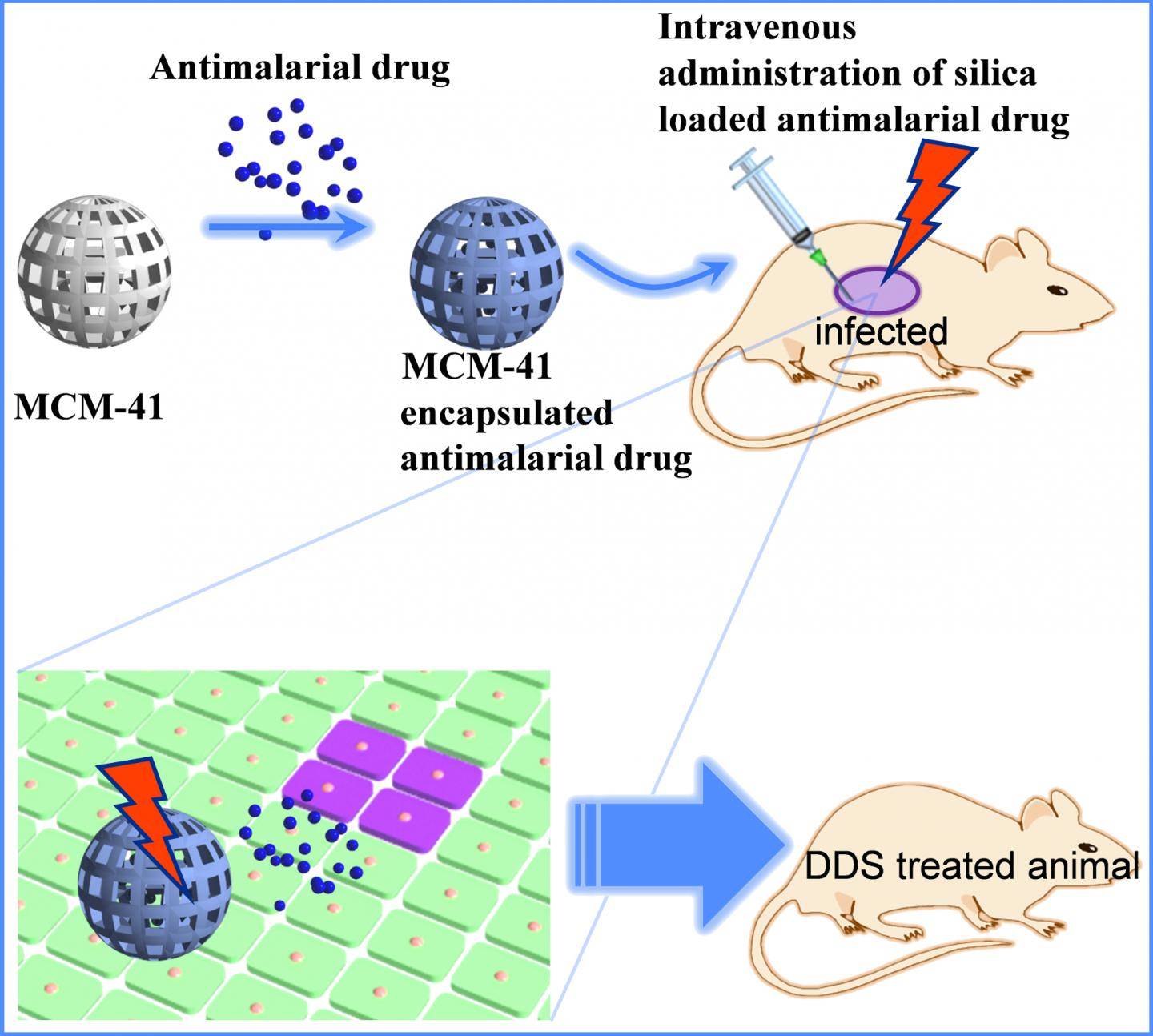
IMAGE

Credit: Shinya Hayami

Drug delivery systems (DDSs) control when and how much drugs are delivered to the body. Numerous DDS studies have been conducted but most have focused on treatments for cancer. New research from Kumamoto University uses a DDS to treat malaria.

The existing treatment for malaria is taken orally and has three main problems: (1) most antimalarial drugs are broken down in the stomach, (2) the drugs have strong side effects, and (3) the medicine stays in the body for only a short time. These issues resulted in malaria treatments that were not particularly effective.

MCM-41 is a porous silica material with a pore size of 2-30 nm. It can incorporate drugs into its pores, which makes it a useful material for DDS applications. A research group headed by Prof. Shinya Hayami from Kumamoto University, Japan believed that MCM-41 could be used as DDS for antimalarial drugs. To test their theory, they created a new DDS by combining the antimalarial drugs Artesunate and Quinine with MCT-41 and performed in vitro and in vivo experiments. They found:

    (1) The release time of the antimalarial medicine became very long, one week or longer, which was an improvement from the standard medication time.

    (2) Compared to ingesting Artesunate or Quinine, the new DDS increased treatment efficiency by 20 and 240 times respectively in animal experiments. (As defined in this study, the therapeutic efficiency is 50% of the effective dose (ED50), and is used as an index of drug strength. The smaller the value of ED50, the greater the action of the drug. In other words, if an effect is obtained with a small amount of a drug, the treatment efficiency is high.)

    (3) MCM-41 itself is non-toxic and inactive. A DDS using MCM-41 is expected to have very weak side effects.

"Using this DDS for antimalarial drugs has introduced a new possibility for highly efficient malaria treatment for the first time," said Professor Shinya Hayami. "We expect that it will be put to practical use in areas where malaria treatment is still necessary. Now, we are planning to develop clinical trials for antimalarial drugs as well as new DDSs for other drugs, like anti-HIV medications."

###

This research was posted online in the journal Scientific Reports on 15 February 2018.

[Source]

Amolegbe, S. A., Hirano, Y., Adebayo, J. O., Ademowo, O. G., Balogun, E. A., Obaleye, J. A., … Hayami, S. (2018). Mesoporous silica nanocarriers encapsulated antimalarials with high therapeutic performance. Scientific Reports, 8(1). doi:10.1038/s41598-018-21351-8

Media Contact

J. Sanderson & N. Fukuda
[email protected]

http://ewww.kumamoto-u.ac.jp/en/news/

Original Source

https://www.nature.com/articles/s41598-018-21351-8 http://dx.doi.org/10.1038/s41598-018-21351-8

Share13Tweet8Share2ShareShareShare2

Related Posts

Early Delivery Improves Outcomes for Mothers and Babies in Hypertensive Pregnancies — Biology

Early Delivery Improves Outcomes for Mothers and Babies in Hypertensive Pregnancies

May 21, 2026
How Atlantic Herring Rewired Their Reproductive Strategy to Thrive in Changing Oceans — Biology

How Atlantic Herring Rewired Their Reproductive Strategy to Thrive in Changing Oceans

May 20, 2026

Study Finds Young Fraser River Chinook Salmon Swimming in Chemical Mixture

May 20, 2026

Thousands of UK Beekeepers Contribute Honey to Advance Environmental Science

May 20, 2026
Please login to join discussion

POPULAR NEWS

  • blank

    New Study Reveals Plants Can Detect the Sound of Rain

    733 shares
    Share 292 Tweet 183
  • ESMO 2025: mRNA COVID Vaccines Enhance Efficacy of Cancer Immunotherapy

    304 shares
    Share 122 Tweet 76
  • Research Indicates Potential Connection Between Prenatal Medication Exposure and Elevated Autism Risk

    846 shares
    Share 338 Tweet 212
  • Breastmilk Balances E. coli and Beneficial Bacteria in Infant Gut Microbiomes

    58 shares
    Share 23 Tweet 15

About

We bring you the latest biotechnology news from best research centers and universities around the world. Check our website.

Follow us

Recent News

Innovative Reusable Brick Walls Revolutionize Construction Industry

Nonlinear Atomic Tunneling Enhanced by Bright Squeezed Vacuum

Label-Free Super-Resolution Imaging of Live Cells

Subscribe to Blog via Email

Success! An email was just sent to confirm your subscription. Please find the email now and click 'Confirm' to start subscribing.

Join 82 other subscribers
  • Contact Us

Bioengineer.org © Copyright 2023 All Rights Reserved.

Welcome Back!

Login to your account below

Forgotten Password?

Retrieve your password

Please enter your username or email address to reset your password.

Log In
No Result
View All Result
  • Homepages
    • Home Page 1
    • Home Page 2
  • News
  • National
  • Business
  • Health
  • Lifestyle
  • Science

Bioengineer.org © Copyright 2023 All Rights Reserved.