

• HOME
  • NEWS
  • EXPLORE
    • CAREER
      • Companies
      • Jobs
    • EVENTS
    • iGEM
      • News
      • Team
    • PHOTOS
    • VIDEO
    • WIKI
  • BLOG
  • COMMUNITY
    • FACEBOOK
    • INSTAGRAM
    • TWITTER
Monday, May 18, 2026
BIOENGINEER.ORG
No Result
View All Result
  • Login
  • HOME
  • NEWS
  • EXPLORE
    • CAREER
      • Companies
      • Jobs
        • Lecturer
        • PhD Studentship
        • Postdoc
        • Research Assistant
    • EVENTS
    • iGEM
      • News
      • Team
    • PHOTOS
    • VIDEO
    • WIKI
  • BLOG
  • COMMUNITY
    • FACEBOOK
    • INSTAGRAM
    • TWITTER
  • HOME
  • NEWS
  • EXPLORE
    • CAREER
      • Companies
      • Jobs
        • Lecturer
        • PhD Studentship
        • Postdoc
        • Research Assistant
    • EVENTS
    • iGEM
      • News
      • Team
    • PHOTOS
    • VIDEO
    • WIKI
  • BLOG
  • COMMUNITY
    • FACEBOOK
    • INSTAGRAM
    • TWITTER
No Result
View All Result
Bioengineer.org
No Result
View All Result
Home NEWS Science News Biology

Breaking up ‘fatbergs’: UBC engineers develop technique to break down fats, oil and grease

Bioengineer by Bioengineer
August 1, 2018
in Biology
Reading Time: 2 mins read
0
Share on FacebookShare on TwitterShare on LinkedinShare on RedditShare on Telegram
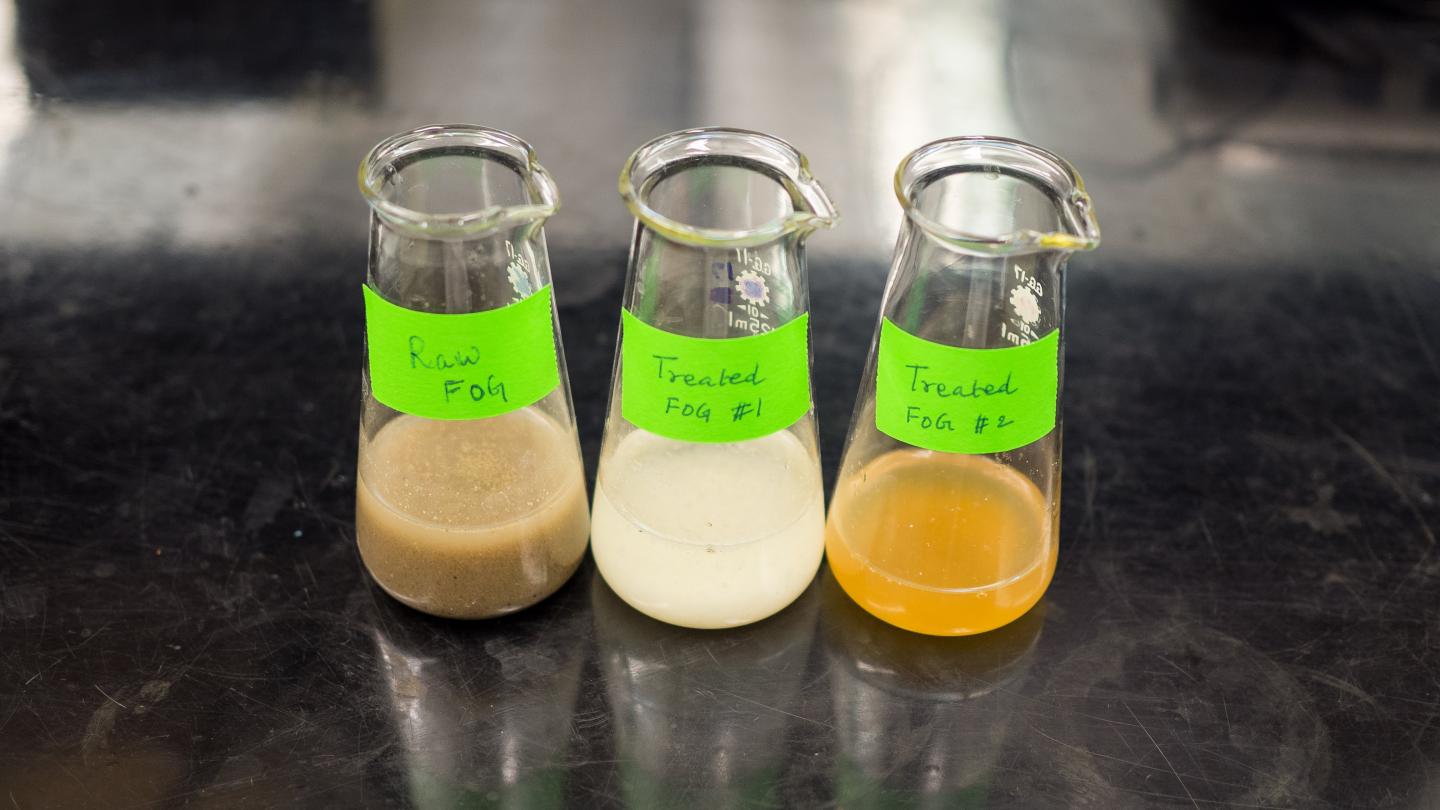
IMAGE

Credit: Clare Kiernan/UBC

Cooking oil and similar waste can clog pipes, harm fish and even grow into solid deposits like the "fatbergs" that recently blocked London's sewage system. But UBC researchers may have found a way to treat these fats, oils and grease–collectively called FOG–and turn them into energy.

Researchers heated FOG samples to temperatures between 90 and 110 degrees Celsius and added hydrogen peroxide, a chemical that kickstarts the breakdown of organic matter. Researchers said the treatment dramatically reduced the volume of solids in the FOG by as much as 80 per cent. It also released fatty acids from the mixture that can be broken down by bacteria in the next stage of treatment.

"FOG is a terrific source of organic material that microorganisms can feed on to produce methane gas, which is a valuable, renewable energy source. But if it's too rich in organics, bacteria can't handle it and the process breaks down. By preheating it to the right temperature, we ensure that the FOG is ready for the final treatment and can make the maximum amount of methane," says research associate Asha Srinivasan.

She added that the methods developed at UBC will enable farmers to load more FOG into their biogas digesters–the large tanks that treat farm wastes, including cow manure, to produce methane. "Farmers typically restrict FOG to less than 30 per cent of the overall feed. But now the FOG can be broken down into simpler forms, so you can use much more than that, up to 75 per cent of the overall feed. You would recycle more oil waste and produce more methane at the same time."

Ultimately, the technology can be used in municipal FOG management programs, says lead researcher Victor Lo, emeritus professor of civil engineering at UBC. "The principle would be the same: you pretreat the FOG so it doesn't clog the pipes, and add it to sewage sludge to produce methane from the mix," said Lo.

"To the best of our knowledge, this type of pretreatment for FOG has not been studied before, although simple chemical methods do exist to break down FOG," added Lo. "We're hoping to do more research to find the optimal ratio of FOG to dairy manure so that they can be pretreated together."

###

Moutoshi Saha, Kit Caufield, Otman Abida and Ping Huang Liao also contributed to the research, described in the July issue of Water, Air & Soil Pollution. (LINK: https://link.springer.com/article/10.1007%2Fs11270-018-3894-y).

For images of the research, visit https://www.flickr.com/photos/ubcpublicaffairs/albums/72157693908236860/with/43785681051/

Media Contact

Lou Bosshart
[email protected]
604-999-0473
@UBCnews

http://www.ubc.ca

Original Source

https://news.ubc.ca/2018/08/01/breaking-up-fatbergs-ubc-engineers-develop-technique-to-break-down-fats-oil-and-grease/ http://dx.doi.org/10.1007/s11270-018-3894-y

Share12Tweet7Share2ShareShareShare1

Related Posts

Uncovering C. elegans Immunity via Genetic Screens — Biology

Uncovering C. elegans Immunity via Genetic Screens

May 16, 2026
Single mother must adapt swiftly — the survival of her colony depends on it — Biology

Single mother must adapt swiftly — the survival of her colony depends on it

May 15, 2026

Why Are Nearly Everyone Right-Handed? It Might Be Linked to How We Learned to Walk

May 15, 2026

Excessive Neuronal Activity Initiates Severe Autoimmune Brain Disorder

May 15, 2026
Please login to join discussion

POPULAR NEWS

  • Research Indicates Potential Connection Between Prenatal Medication Exposure and Elevated Autism Risk

    844 shares
    Share 338 Tweet 211
  • New Study Reveals Plants Can Detect the Sound of Rain

    731 shares
    Share 292 Tweet 182
  • Salmonella Haem Blocks Macrophages, Boosts Infection

    62 shares
    Share 25 Tweet 16
  • Breastmilk Balances E. coli and Beneficial Bacteria in Infant Gut Microbiomes

    58 shares
    Share 23 Tweet 15

About

We bring you the latest biotechnology news from best research centers and universities around the world. Check our website.

Follow us

Recent News

New Survey Finds Just One-Third of Teens Have Private Healthcare Consultations, According to Parents

Micronutrients Linked to Mood and Psychotic Disorders

AI Tool in Radiotherapy Advances Global Fight to Eradicate Cervical Cancer

Subscribe to Blog via Email

Enter your email address to subscribe to this blog and receive notifications of new posts by email.

Join 82 other subscribers
  • Contact Us

Bioengineer.org © Copyright 2023 All Rights Reserved.

Welcome Back!

Login to your account below

Forgotten Password?

Retrieve your password

Please enter your username or email address to reset your password.

Log In
No Result
View All Result
  • Homepages
    • Home Page 1
    • Home Page 2
  • News
  • National
  • Business
  • Health
  • Lifestyle
  • Science

Bioengineer.org © Copyright 2023 All Rights Reserved.