Analyses of TU Graz prove the efficient operation of the cellulose degrading biological nanomachine cellulosome. This can provide new perspectives for applications in industrial biorefineries.
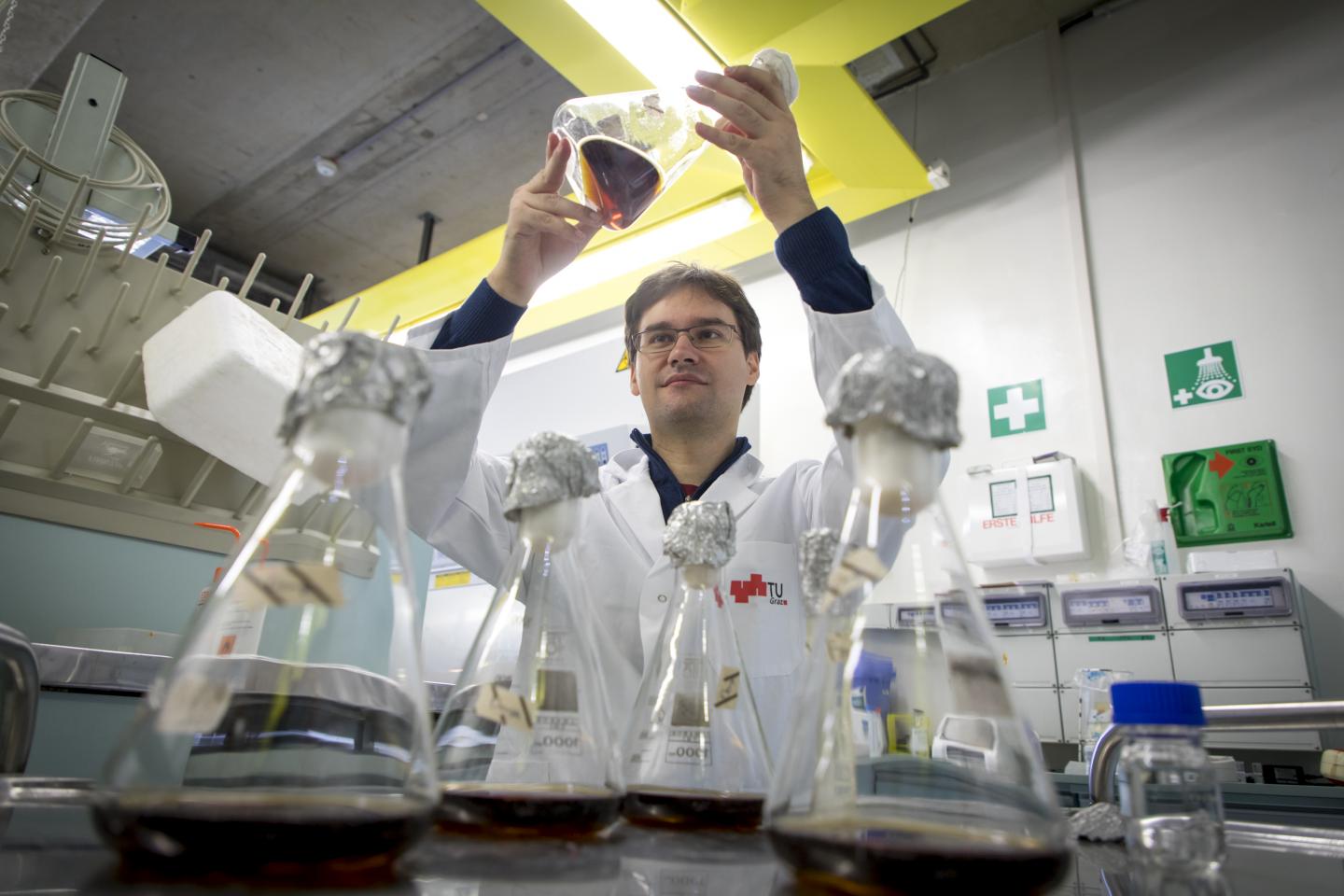
Credit: © Lunghammer – TU Graz
The plant component cellulose is an extremely resistant, water-insoluble polymer that is difficult to break down. This makes the efficient and sustainable use of plant biomass in biorefineries more difficult. “Only when there are sustainable and cost-efficient approaches for the degradation of cellulose will we start to produce fuels, chemicals and materials on a large scale from plant biomass,” explains Bernd Nidetzky, biotechnologist and head of the Institute of Biotechnology and Biochemical Engineering at TU Graz.
Cellulose degradation in nature
In nature, the biological breakdown of cellulose occurs either through cellulases or through cellulosomes. Cellulases are enzymes that differ in their specificity and mode of action and are synergistically involved in the degradation of cellulose from woody plants such as trees or shrubs. Although individual cellulases may be located in close proximity to each other, they are individual, physically independent units. A cellulosome, on the other hand, is a protein complex, an ordered and physically interconnected collection of enzymes necessary for cellulose degradation.
Bernd Nidetzky and his team have set themselves the task of better understanding and visualising cellulosomes as essentially cellulose-degrading biological nanomachines. The researchers have now taken a decisive step towards this goal in an Austrian Science Fund (FWF) supported project. They were able to visualize a cellulosome at the single-molecule level during cellulose degradation by means of time-lapse atomic force microscopy and thus gain insights into its mode of operation. The results have been published in the journal ACS Central Science.
Nanomachines at work
In concrete terms, the researchers document the degradation of cellulose using a cellulosome from the bacterium Clostridium thermocellum. It is shown that the cellulosome dynamically adapts to the different surface conditions of the cellulose. “When binding to cellulose, the cellulosome switches to elongated, even thread-like forms and morphs them dynamically on a time scale of less than one minute according to the requirements of the attacked cellulose surface. Compared to cellulases, which detach material when sliding along crystalline cellulose surfaces, cellulosomes remain locally bound for minutes and remove the underlying material. The consequent roughening of the surface leads to efficient degradation of cellulose nanocrystals,” explains Bernd Nidetzky.
Outlook for biorefineries
“Our analyses prove that cellulosomes are extremely efficient in breaking down cellulose. They could therefore play a central role in the development of new approaches for biorefineries,” stressed Nidetzky. By exploiting the different mechanisms of action of enzyme complexes in the form of a cellulosome and free enzymes, cellulose degradation can be carried out faster, more completely and with less enzyme requirement. The synergies between the degradation mechanisms of cellulase and cellulosomes could thus help in the design of hybrid cellulase systems and provide new perspectives for applications in biorefineries.
###
Original publication:
Eibinger, Manuel; Ganner, Thomas; Plank, Harald; Nidetzky, Bernd: A biological nanomachine at work: watching the cellulosome degrade crystalline cellulose. ACS Central Science, 2020.
DOI: 10.1021/acscentsci.0c00050
This publication is the result of work on the Austrian Science Fund FWF-supported project “Cellulosomes – Cellulose degradation by means a cellulosome originated (operational time: 1st January 2019 to 31st December 2021).
This research work is being carried out at TU Graz in the Field of Expertise “Human and Biotechnology” one of five research foci of TU Graz.
Contact:
Bernd NIDETZKY
Univ.-Prof. Dipl.-Ing. Dr.techn.
TU Graz | Institute of Biotechnology and Biochemical Engineering
Phone: +43 664 88783103
[email protected]
Media Contact
Bernd Nidetzky
[email protected]
Original Source
https:/
Related Journal Article
http://dx.