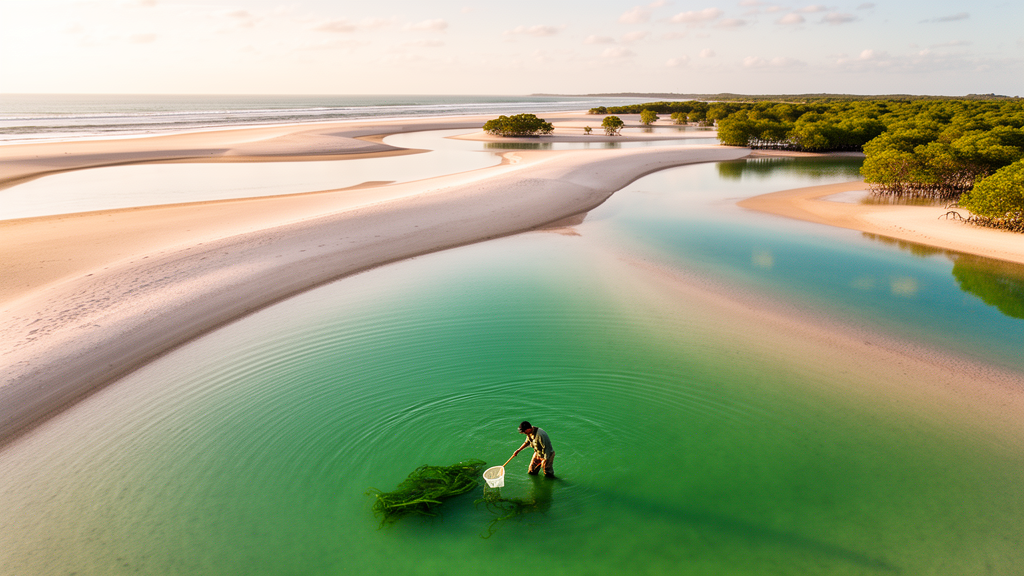
Along Brazil’s 8,500-kilometer coastline, hidden behind sandbars and barrier islands, lie hundreds of shallow water bodies that rank among the most productive ecosystems on Earth. Coastal lagoons occupy roughly 13 percent of the planet’s coastal zone, yet in Brazil they have never been systematically counted — until now. A new study published in the journal Estuarine Management and Technologies has mapped 300 coastal lagoons along the entire Brazilian shore and, through a systematic review of nearly five decades of literature, revealed a striking imbalance: although these ecosystems teem with macroalgae that could serve as powerful sentinels of environmental health, scientists have formally documented their seaweed flora in just 11 of the 300 lagoons. The result is one of the largest blind spots in Brazilian coastal science, and the researchers argue it urgently needs to be filled if the country hopes to protect these increasingly threatened waters.
Coastal lagoons are saline or brackish shallow basins oriented parallel to the shoreline, cut off from the open ocean by sandy barriers, shoals, reefs or chains of islands, with only restricted or ephemeral connections to the sea through tidal channels. Because these channels may open and close naturally or through human intervention, lagoons can range from nearly fresh to hypersaline. They are true ecotones, transitional zones where terrestrial and marine systems intermingle, and their multiple boundaries — with the sea, the land, the atmosphere, sediments and freshwater inflows — generate steep physicochemical gradients that fuel extraordinary biological productivity. Annual primary production in these systems ranges from 50 to more than 500 grams of carbon per square meter per year, placing them on par with the ocean’s great upwelling regions. Because most lagoons are shallow enough for sunlight to reach the seabed, and because winds constantly resuspend nutrient-rich sediments, benthic algae and seagrasses can outproduce even the phytoplankton in the water column.
That productivity underwrites an impressive portfolio of ecosystem services. Lagoons serve as spawning grounds and nurseries for commercially valuable fish, sequester carbon, cycle nutrients, purify water, buffer local climates and support tourism, transport and food provision for densely populated coastal communities. But the same proximity to cities makes them vulnerable. Nearly half of the world’s coastal wetlands have been lost or degraded over the past century through the combined pressures of local human activity and climate change, and Brazilian lagoons face warming trends documented across every one of the country’s marine ecoregions, alongside projected sea-level rise of up to 0.98 meters by 2100. Within these systems, macroalgae occupy a pivotal position: they anchor food webs, drive nutrient cycling and respond rapidly to changes in depth, turbidity, light and nutrient levels, which is why they are widely used worldwide as bioindicators of pollution and ecological degradation.
To establish how much is actually known about Brazilian lagoon macroalgae, the research team first turned to satellite imagery. Using Google Earth at scales of 200 to 1,000 meters, they inspected the entire coastline, georeferencing every water body that met the classical definition of a coastal lagoon and applying a cutoff distance of 5.5 kilometers from the maritime shoreline to exclude inland lakes. The census identified 300 lagoons, distributed unevenly across all five of Brazil’s marine ecoregions. The Rio Grande ecoregion in the far south dominated the tally with 124 lagoons — 41.3 percent of the total — followed by the Northeast with 25.7 percent and the Southeast with 17 percent. Of Brazil’s 17 coastal states, only three — Amapá, Pará and Piauí — lacked typical lagoons, while Rio Grande do Sul alone accounted for 29 percent of them, with Santa Catarina, Rio de Janeiro and Bahia close behind.
The literature search was equally exhaustive. The team queried five databases — SciELO, Web of Science, Scopus, Google Scholar and the CAPES Periódicos portal — in English and Portuguese, using the keywords alga, seaweed, lagoon and Brazil in various combinations. More than 20,000 initial documents surfaced, but after rigorous screening under PRISMA guidelines only 13 peer-reviewed articles survived the filters. Snowballing through their bibliographies, searches of theses and dissertations, and a sweep of the publication records of all 62 authors involved eventually expanded the corpus to 48 studies. Even so, those 48 papers covered just 11 lagoons, and the effort was heavily skewed: 17 documents concerned the Patos Lagoon in Rio Grande do Sul, while 22 addressed seven different lagoons in Rio de Janeiro state. Only four states — Alagoas, Rio de Janeiro, Santa Catarina and Rio Grande do Sul — have any lagoon macroalgae research at all. Notably, the number of studies correlated strongly with lagoon size, with a Pearson correlation coefficient of 0.92, and with the proximity of research institutions, suggesting science follows convenience as much as ecological importance.
The catalogued flora comprised 213 macroalgal taxa, dominated by red algae (Rhodophyta, 56 percent of taxa), followed by green algae (Chlorophyta, 32.4 percent) and ochrophytes (11.7 percent). The richest site was the hypersaline Araruama Lagoon in Rio de Janeiro, with 119 taxa, followed by Itaipú with 72, Patos with 60 and Conceição with 56. The most frequently recorded genera were the green opportunists Ulva, Chaetomorpha and Cladophora, along with the red algae Bryocladia subtilissima and Gymnogongrus griffithsiae. Yet when the researchers compared assemblages across lagoons using Bray-Curtis similarity coefficients on presence-absence data, no two lagoons grouped above 50 percent similarity. Even at a lenient 20 percent cutoff, the Mundaú and Açú lagoons stood entirely alone. This striking dissimilarity presents the study’s central unresolved question: are Brazil’s lagoons genuinely unique, each harboring a distinct flora with high beta diversity, or are they simply understudied, their true floras unknown?
Several ecological patterns did emerge from the fragmented record. Algal richness and abundance generally decline from lagoon entrances toward their inner reaches, mirroring patterns described in bays and estuaries and likely driven by salinity — a key determinant of macroalgal distribution — along with substrate, light, nutrients and turbulence. Opportunistic green algae dominate the inner, low-salinity zones, while red algae and ochrophytes retreat toward the sea connections. Araruama Lagoon is a fascinating exception: despite salinity increasing toward its interior, reaching values of up to 80 in the world’s largest permanent hypersaline lagoon ecosystem, its stable extreme conditions support comparatively high richness. Even there, however, decades of shell extraction for soda ash production removed nearly half of the hard substrate algae need, and richness has fallen by roughly a third over 26 years as urbanization and tourism increased nutrient inputs and reduced water transparency.
The review also exposed how geography and history shape the science. The Patos Lagoon, the largest choked-type lagoon in the world and South America’s biggest at 10,227 square kilometers, hosts the longest-running research program thanks to the Brazilian Long-Term Ecological Research initiative (PELD), which has monitored its estuary continuously since 1998. It is the only Brazilian lagoon where isotope studies of macroalgae have been conducted, and the site of the country’s first macroalgal bioindicator study in 1982. By contrast, the Amazonian ecoregion contains a single lagoon — Jansen, in Maranhão, artificially maintained by a sluice gate against one of the world’s largest tidal ranges — with no macroalgae studies whatsoever. In the Northeast, strong sediment drift frequently seals lagoon entrances, leaving little hard substrate for algal attachment and murky waters that may explain both fewer algae and fewer phycologists.
The authors are candid about the limitations of their synthesis. Old identifications could not be re-examined, so taxonomically complex groups such as the morphologically plastic Ulva may inflate richness estimates; some historical references, including the only record of the Açú Lagoon flora — found in conference proceedings purchased from a used bookstore — could not be obtained at all, and inconsistent terminology for lagoons across languages and legal frameworks may have hidden relevant studies from the search. Still, the message is unambiguous. Macroalgae are cost-effective, sensitive and well-established ecological indicators, and Brazil’s management frameworks, including the ReBentos network and emerging Marine Spatial Planning, could integrate them immediately. The researchers call for targeted surveys, standardized comparative methods, digitization of historical collections and expansion of long-term monitoring to unstudied lagoons. Without baselines, they warn, conservation planning, pollution control and protected-area design for these 300 ecosystems will proceed blind — and whether each lagoon is a botanical treasure or a terra incognita may never be known before it changes forever.
Subject of Research: Distribution of coastal lagoons and the diversity and monitoring potential of their macroalgal flora in Brazil
Article Title: Macroalgae in coastal lagoons: a systematic review from Brazil
Article References: Amaral, H. B. F., Copertino, M., & Creed, J. C. (2026). Macroalgae in coastal lagoons: a systematic review from Brazil. Estuarine Management and Technologies, 3, 87-112. https://doi.org/10.3897/emt.3.186569
Image Credits: AI Generated
DOI: 10.3897/emt.3.186569
Keywords: coastal lagoons, macroalgae, Brazil, systematic review, bioindicators, biodiversity, eutrophication, Rhodophyta, Patos Lagoon, Araruama Lagoon, ecosystem services, marine ecoregions
News Source: Margaret Porter. (October 17, 2026). Brazil’s Hidden Lagoons: 300 Coastal Ecosystems, but Their Seaweed Remains a Mystery. Scienmag.