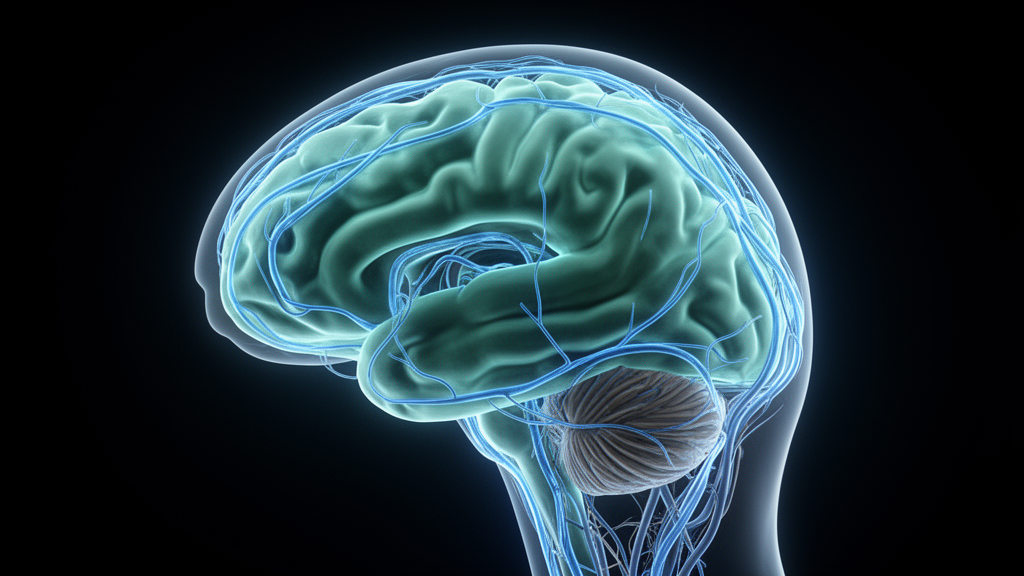
Migraine is far more than a severe headache. It is a neurological disorder that affects more than a billion people worldwide, and for decades researchers have struggled to pin down the underlying biology that transforms an ordinary brain into one prone to disabling attacks of throbbing pain, nausea, and sensitivity to light. Now a team of researchers in China has turned its attention to one of the most intriguing and relatively recent discoveries in neuroscience: the glymphatic system, the brain’s waste-clearance network, and whether its failure might help explain why some people develop episodic migraine while others progress to the chronic form of the disease.
The glymphatic system, first described in animal studies little more than a decade ago, is a network of channels that runs alongside blood vessels, known as perivascular spaces, through which cerebrospinal fluid flushes metabolic waste out of brain tissue. During sleep, this clearance system ramps up its activity, washing away proteins and byproducts that accumulate during waking hours. When glymphatic function falters, waste products linger, and scientists have linked such dysfunction to Alzheimer’s disease, small vessel disease, and sleep disorders. Whether the same machinery is disturbed in migraine has been an open question, and the new study, published in BMC Medical Imaging, offers one of the most comprehensive noninvasive assessments to date.
Researchers led by Ying Yang and Huang Xu of the First Affiliated Hospital of the University of Science and Technology of China enrolled 123 participants: 38 patients with episodic migraine, who experience headaches on fewer than 15 days per month; 46 patients with chronic migraine, defined by headaches on 15 or more days per month; and 39 healthy controls. Rather than relying on a single imaging marker, the team deployed a multimodal magnetic resonance imaging strategy that captured three complementary windows into glymphatic activity, allowing them to probe the system from structural, diffusion, and functional perspectives simultaneously.
The first measure was the diffusion tensor image analysis along the perivascular space, or DTI-ALPS index. This technique exploits the fact that water molecules diffuse more freely along the channels surrounding vessels in the brain’s deep white matter. By measuring diffusion in directions perpendicular to the ventricle walls and comparing it with diffusion along the medullary vessels, the index provides an indirect estimate of how efficiently fluid moves through perivascular spaces. A lower DTI-ALPS index is interpreted as reduced glymphatic clearance capacity. The second measure was choroid plexus volume, the size of the tissue structures that produce cerebrospinal fluid, which researchers have proposed as a marker of fluid production and inflammatory activity. The third was BOLD-CSF coupling, a functional metric that quantifies how tightly fluctuations in the blood oxygen level dependent signal, a proxy for neural activity, are synchronized with the pulsing motion of cerebrospinal fluid, a relationship thought to reflect the driving force that pushes fluid through the glymphatic channels.
The results were striking in their pattern of selectivity. After adjusting for age, sex, years of education, and other relevant covariates, the researchers found that both the left, right, and mean DTI-ALPS indices were significantly lower in patients with episodic migraine and in patients with chronic migraine compared with healthy controls, differences that held up under stringent Bonferroni correction for multiple comparisons. In other words, the diffusion signature of impaired perivascular clearance was present in both migraine groups, suggesting that altered glymphatic function may be a feature of the disease across its spectrum rather than a consequence of chronification alone.
The functional measure told a more nuanced story. Patients with chronic migraine showed significantly weaker global BOLD-CSF coupling than healthy controls, again surviving Bonferroni correction. When the researchers broke the coupling analysis down to the level of individual brain networks, they found that chronic migraine patients exhibited weaker coupling specifically within the dorsal attention network, a circuit involved in directing attention to external stimuli that has previously been implicated in migraine pathophysiology. However, this network-level difference did not survive false discovery rate correction, meaning it should be treated as a suggestive rather than definitive finding. Notably, episodic migraine patients did not show significant global coupling differences, hinting that the functional component of glymphatic impairment may deepen as the disease becomes chronic.
Perhaps the most unexpected result concerned the choroid plexus. Contrary to the hypothesis that cerebrospinal fluid production structures would be altered in migraine, choroid plexus volume did not differ significantly across the three groups. Yet the volume measure was not entirely inert. In patients with chronic migraine, partial correlation analyses revealed significant negative correlations between the DTI-ALPS index and choroid plexus volume metrics, meaning that patients with larger fluid-producing structures tended to show weaker perivascular diffusion markers. This inverse relationship, significant at corrected thresholds, suggests that different components of the glymphatic machinery may compensate for one another or that a common underlying process shapes both measures in chronic disease.
The clinical correlations added another layer of complexity. In episodic migraine patients, the researchers observed negative associations between scores on the Headache Impact Test-6, a widely used questionnaire measuring the burden of headaches on daily life, and choroid plexus volume metrics. Patients reporting greater headache impact tended to have smaller choroid plexus volumes. However, these associations did not survive correction for multiple comparisons, so the authors were careful not to overstate them. No similarly robust relationships emerged between imaging measures and clinical scales in the chronic migraine group, underscoring how difficult it remains to link brain waste-clearance markers to the day-to-day experience of headache severity.
What emerges from the study is a picture of heterogeneity rather than uniform breakdown. The structural diffusion marker was impaired in both migraine subtypes, the functional coupling marker was impaired only in chronic migraine, and the fluid production marker was preserved in volume yet inversely related to diffusion measures in chronic patients. The authors argue that this pattern demonstrates the inadequacy of any single MRI metric for characterizing glymphatic-related alterations in migraine and makes the case for a multidimensional imaging framework that combines structural, diffusion, and functional measures. Such a framework, they suggest, could better capture the variable ways in which waste clearance is disturbed across individuals and disease stages.
The findings carry broader implications for how scientists think about migraine biology. If glymphatic dysfunction is genuinely involved, it could connect migraine to a growing list of conditions in which impaired brain clearance plays a role, and it might explain long-standing clinical observations such as the strong association between migraine and sleep disturbances. It also raises the possibility, still speculative, that interventions targeting sleep quality, fluid dynamics, or perivascular health could one day complement existing migraine therapies. For now, the study is cross-sectional, capturing a single moment in time, so it cannot establish whether glymphatic changes cause migraine, result from it, or reflect a shared mechanism. Longitudinal studies tracking patients as migraine progresses from episodic to chronic forms, along with studies that directly validate the imaging markers against invasive measures of clearance, will be needed to settle those questions. But by showing that the brain’s washing system leaves detectable fingerprints in routine MRI, the work opens a tangible new avenue for understanding one of medicine’s most common and stubborn neurological disorders.
Subject of Research: Glymphatic system dysfunction measured by multimodal MRI in episodic and chronic migraine
Article Title: The heterogeneity of glymphatic-related MRI alterations in migraine: a cross-sectional multimodal study
Article References: The heterogeneity of glymphatic-related MRI alterations in migraine: a cross-sectional multimodal study. (n.d.). https://doi.org/10.1186/s12880-026-02926-8
Image Credits: AI Generated
DOI: 10.1186/s12880-026-02926-8
Keywords: migraine, glymphatic system, MRI, DTI-ALPS index, BOLD-CSF coupling, choroid plexus volume, chronic migraine, episodic migraine, cerebrospinal fluid, neuroimaging, perivascular spaces, headache
News Source: Cassandra Pierce. (October 15, 2026). Brain Washing Disrupted in Migraine: MRI Reveals Glymphatic System Clues. Scienmag.