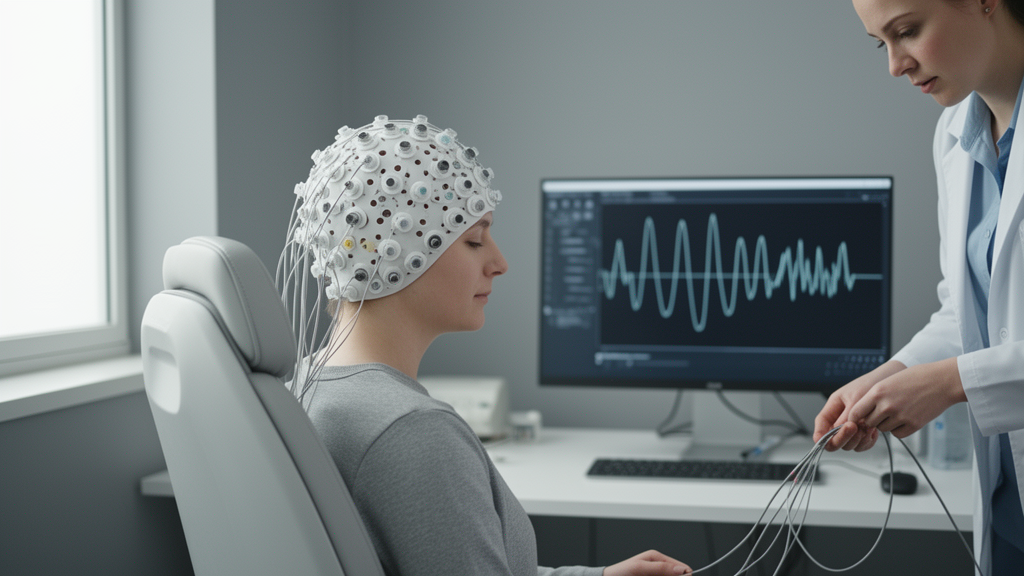
Event-related potentials, or ERPs, are among the most powerful tools in human neuroscience. Recorded through electrodes on the scalp, these tiny electrical fluctuations—measured in millionths of a volt—track the brain’s cognitive and emotional processes with millisecond precision. But their very sensitivity raises a critical question: when researchers measure the same brain signal repeatedly within a single session, how much of the variation they see reflects real changes in the mind, and how much is simply noise? A new study from the University of Victoria, published in Frontiers in Neuroscience, tackles this question head-on and delivers findings that could reshape how multi-task EEG experiments are designed.
The research team, led by Katherine Boere and Olav Krigolson, focused on two of the most widely used ERP components in cognitive neuroscience. The first is the P300, a positive deflection peaking roughly 250 to 500 milliseconds after a stimulus appears, largest over parietal regions of the scalp. The P300 is thought to reflect context updating—the brain revising its internal model of the world when new information arrives—along with the allocation of attentional resources. Its neural basis has been traced to phasic activity of the locus coeruleus–norepinephrine system, a neuromodulatory hub involved in surprise and arousal. The second component is the rewards positivity, a frontocentral signal appearing about 250 to 350 milliseconds after feedback during reward-based learning. It encodes the discrepancy between expected and actual outcomes—the brain’s reward prediction error—and converging evidence links it to phasic dopaminergic signaling in midbrain reward circuits, reflected at the level of the anterior cingulate cortex.
The researchers zeroed in on three distinct sources of variability that can distort ERP measurements when tasks are administered in sequence. The first is test–retest reliability: the consistency of a measure across repeated assessments. The second is time-related variability: systematic changes in component amplitude that unfold across repeated measurements, such as the attenuation documented when people grow fatigued during sustained, cognitively demanding tasks. The third is order effects: the influence a preceding task exerts on the ERP elicited by the task that follows. Each source can independently alter ERP amplitudes, and failing to account for one can lead researchers to misattribute its influence to another—a serious problem in a field where effects are often measured in single-digit microvolts.
To disentangle these factors, twenty-six adults completed five cognitive assessments distributed over approximately two hours. Each assessment contained two tasks: a passive visual oddball task, in which participants watched a stream of colored circles and infrequent green oddballs appeared among frequent blue ones, and a two-armed bandit task, in which participants chose between two colored squares associated with different win probabilities and then received WIN or LOSE feedback. Task order was independently randomized within each assessment, so the same participant sometimes completed the oddball first and sometimes the bandit first. EEG was recorded with a 64-electrode system, re-referenced to the averaged mastoids, band-pass filtered, and cleaned of ocular artifacts using independent component analysis. The P300 was quantified at the parietal site Pz as the difference between oddball and frequent waveforms, while the rewards positivity was quantified at the frontocentral site FC2 as the difference between win and loss waveforms.
The reliability results revealed a striking asymmetry. The P300 demonstrated excellent test–retest reliability across all five assessments, with an intraclass correlation coefficient of 0.91—and the underlying oddball and frequent conditional waveforms were similarly excellent at 0.91 and 0.93. The rewards positivity told a more nuanced story. Its difference wave, the standard measure used in most studies, showed only moderate reliability at 0.52. Yet the underlying win and loss conditional waveforms were both excellent, each at 0.92. This divergence has a statistical explanation: when two constituent measures are highly correlated, subtracting one from the other removes the variance they share while retaining condition-specific and error variance, so a difference score can be less reliable than either of its parts. For researchers using the rewards positivity as an individual-difference measure—for example, as a potential biomarker in depression research—the authors recommend reporting the conditional waveforms alongside the difference score.
The amplitude trajectories across the session produced the study’s most unexpected finding. Contrary to the hypothesis that both components would decline as participants fatigued, P300 amplitude increased systematically across the five assessments, rising by roughly 0.65 microvolts per assessment. The rewards positivity, by contrast, showed no evidence of a linear change, with a slope of −0.32 microvolts per assessment that did not reach statistical significance. The P300 result is the inverse of the attenuation typically documented in sustained, fatigue-inducing paradigms, where repeated stimulus exposure occurs alongside prolonged continuous cognitive engagement. The authors suggest several possible mechanisms: repeated exposure to the task may have improved the efficiency of stimulus evaluation and probability estimation, freeing resources for the context-updating operations associated with the P300. The distributed structure of the protocol—with breaks between assessments—may also have contributed, though the study lacked a continuous no-break comparison condition to isolate that factor.
Perhaps the most practically important result was what the researchers did not find. Mixed-effects models revealed no evidence of an overall effect of task order on either component’s amplitude, and adding an Order × Assessment interaction did not improve model fit for either the rewards positivity or the P300. This null result is theoretically meaningful because the two components are associated with partly distinct neuromodulatory systems—noradrenergic locus coeruleus activity for the P300 and dopaminergic signaling tied to anterior cingulate cortex function for the rewards positivity—making it plausible that prior engagement of one system could bias the subsequent response of the other. The data did not support that possibility, suggesting that within sessions of this length, sequential administration of these tasks does not systematically distort ERP amplitudes.
The study’s statistical approach was as careful as its design. Reliability was quantified using a two-way random-effects, absolute-agreement intraclass correlation model, classified as poor below 0.50, moderate from 0.50 to 0.75, good from 0.75 to 0.90, and excellent above 0.90. Changes in amplitude across assessments were tested with linear mixed-effects models that included participant as a random intercept, accounting for stable between-person differences in component size. Order effects were evaluated with mixed-effects models treating assessment number as a categorical factor, avoiding any assumption of a linear trend. Planned comparisons using paired-sample t-tests showed no difference between the first and second assessments for either component, but significant differences between the first and fifth assessments for both—hinting that any changes in the rewards positivity may reflect growing familiarity with the reward contingencies rather than progressive fatigue.
The authors are candid about the limitations. The sample of twenty-six participants constrains the power to detect small order effects, and the single two-hour session cannot address test–retest reliability across the days-to-weeks intervals most relevant to clinical and longitudinal applications. The inter-assessment intervals were unequal—15, 15, 30, and 30 minutes—so assessment number was confounded with elapsed time, meaning effects of repeated task exposure cannot be fully separated from those of recovery time. Only one task pair was examined, and subjective fatigue and motivation were not measured directly, limiting the ability to adjudicate between practice and fatigue as explanations for the rising P300.
Even so, the practical implications are substantial. For laboratories running multi-task EEG protocols, the findings suggest that the order in which the oddball and bandit tasks are administered need not be a source of anxiety, but that time-related amplitude changes—particularly the systematic increase in P300 amplitude across repeated short assessments—must be considered when interpreting repeated-measures designs. The divergence between the moderately reliable rewards positivity difference wave and its highly reliable conditional waveforms offers a concrete methodological recommendation: report both. As ERP research moves increasingly toward multi-component, within-session protocols, studies like this one provide the psychometric foundation that separates robust brain measures from measurement noise.
Subject of Research: Examining sources of variability in repeated testing of the rewards positivity and P300 ERP components
Article Title: Examining sources of variability in repeated testing of the rewards positivity and P300 ERP components
Article References: Boere, K., Hammerstrom, M. R., Hopkins, J. A., Barss, I. K., Dauphinee, R., Montgomery, P. J., & Krigolson, O. E. (2026). Examining sources of variability in repeated testing of the rewards positivity and P300 ERP components. Frontiers in Neuroscience, 20, Article 1960493. https://doi.org/10.3389/fnins.2026.1960493
Image Credits: AI Generated
DOI: 10.3389/fnins.2026.1960493
Keywords: neuroscience, EEG, event-related potentials, P300, rewards positivity, test-retest reliability, brain imaging, psychometrics, Examining, sources, variability, repeated
News Source: Cassandra Pierce. (October 17, 2026). Brain Signals Stay Steady in Repeated Testing, Study Finds. Scienmag.