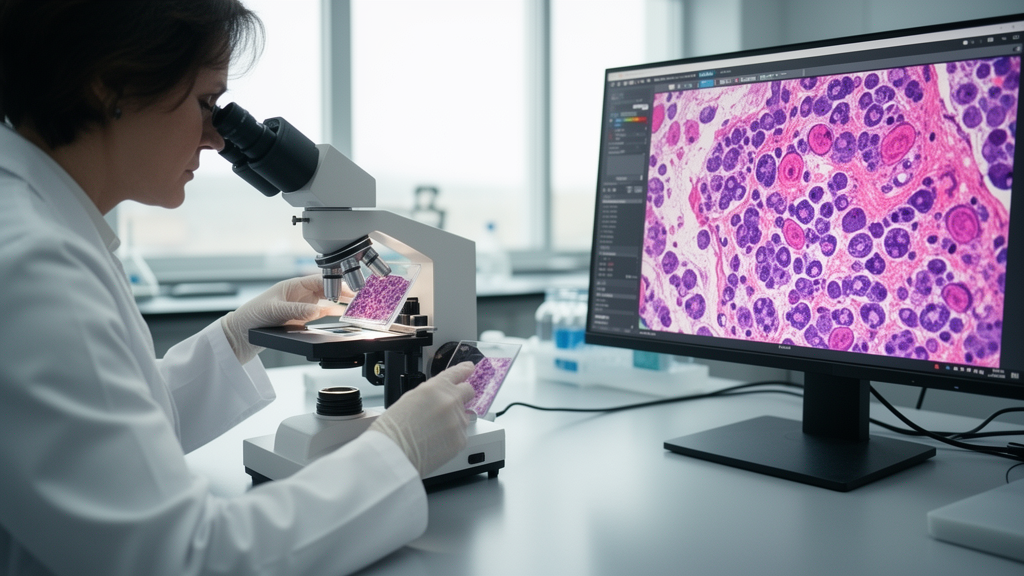
Artificial intelligence systems trained to read microscopic images of tumor tissue can predict whether a melanoma patient carries a specific cancer-driving mutation with accuracy approaching that of laboratory sequencing, according to a new study that could help speed up treatment decisions for one of the most aggressive forms of skin cancer.
The research, published in *The Lancet Digital Health*, addresses a critical bottleneck in modern cancer care. Roughly half of all melanomas carry mutations in the BRAF gene, which drives uncontrolled cell growth. Patients whose tumors harbor these mutations can be treated with targeted drugs that block the faulty protein, often with striking results. But identifying who carries the mutation currently requires molecular testing — extracting DNA from tumor tissue and sequencing it — a process that takes days to weeks and adds cost at every step.
“What we’re trying to do is use the information that’s already there in the slide,” the research team explained in their paper. Pathology slides, stained and mounted on glass, have been the backbone of cancer diagnosis for more than a century. Pathologists examine them under a microscope to determine tumor type, aggressiveness, and spread. What has been harder to extract is the invisible molecular information — the genetic signature of the tumor — that increasingly determines which drug a patient should receive.
The team, drawn from institutions across Europe and North America, assembled one of the largest collections of melanoma slide images linked to confirmed BRAF mutation status ever compiled. They gathered whole-slide images — digitized versions of pathology slides that can contain billions of pixels each — from thousands of patients across multiple hospitals and countries. Each slide was paired with the result of molecular testing that confirmed whether the patient’s tumor carried a BRAF mutation.
Training an AI system on such data presents a formidable technical challenge. A single slide contains hundreds of thousands of tiny patches of tissue, and only some of them carry relevant information about the tumor’s genetics. The researchers used a technique called multiple-instance learning, which allows the algorithm to learn from slides labeled only at the patient level — positive or negative for the mutation — without requiring experts to annotate which specific regions of tissue matter. The system essentially teaches itself which visual patterns correlate with the underlying genetic change.
The results were striking. Across multiple independent test sets from different hospitals and scanning equipment, the AI predicted BRAF mutation status with area under the curve values consistently above 0.80 — a level of discrimination the authors describe as comparable to earlier studies using far smaller and less diverse datasets. In practical terms, the system correctly identified a large majority of mutation-positive tumors while flagging relatively few false positives.
Perhaps more importantly, the model proved robust. It performed well across slides scanned by different scanners, at different hospitals, and in patients of different ages and disease stages. This kind of generalizability has been the Achilles’ heel of medical AI: algorithms that dazzle on data from a single institution often collapse when confronted with the messy variability of real-world clinical practice. The multi-center design of this study suggests the approach may genuinely travel.
The researchers also probed what the AI was actually looking at. Heat maps of the model’s attention revealed that it focused on tumor cells themselves rather than surrounding stromal tissue, and that certain cellular features — nuclear size, pigmentation, and architecture — appeared to drive its predictions. This offers a tantalizing hint that the mutation leaves a visible fingerprint in how cells look under the microscope, something pathologists have long suspected but never been able to systematically exploit.
Still, the authors are careful about what the technology can and cannot do. The model is not designed to replace molecular testing, which remains the gold standard for treatment decisions. Instead, they envision it as a triage tool: a rapid, cheap first pass that could prioritize which patients get sequenced quickly, flag likely mutation-positive cases in settings where molecular testing is delayed or unavailable, and eventually help pathologists working in resource-limited regions where sequencing infrastructure is thin.
The implications extend beyond melanoma. The same approach — pairing routine pathology images with molecular labels — could in principle be applied to predict mutations in lung, breast, colorectal, and other cancers where targeted therapies depend on genetic profiling. If the visual fingerprints of genetic change are general, the pathology slide could become a kind of poor man’s biopsy of the genome, extractable from images already collected as part of standard care.
For patients, the near-term promise is simpler: fewer waiting days between diagnosis and the start of the right drug. In melanoma, where the disease can progress from localized to life-threatening in months, that interval matters. The study’s authors argue that with further validation and regulatory review, AI-assisted mutation prediction from routine slides could move into clinical use within a few years — not as a replacement for the molecular lab, but as its fastest-running scout.
Subject of Research: AI-based prediction of BRAF mutation status in melanoma from whole-slide pathology images
Article Title: An evaluation of pathology foundation models with weakly supervised learning for BRAF mutation prediction in melanoma whole slide images
Article References: Godson, L., Breen, J., Wright, A. I., Magee, D., Bansal, D., Treanor, D., & Clarke, E. L. (2026). An evaluation of pathology foundation models with weakly supervised learning for BRAF mutation prediction in melanoma whole slide images. Frontiers in Medical Technology, 8, Article 1835452. https://doi.org/10.3389/fmedt.2026.1835452
Image Credits: AI Generated
DOI: 10.3389/fmedt.2026.1835452
Keywords: melanoma, BRAF mutation, artificial intelligence, pathology, whole-slide imaging, multiple-instance learning, targeted therapy, precision oncology, digital pathology, machine learning, cancer diagnostics, molecular testing
News Source: Nathaniel Bowman. (October 17, 2026). AI Reads Tumor Slides to Predict Melanoma Gene Mutations, Offering Faster Targeted Therapy Triage. Scienmag.