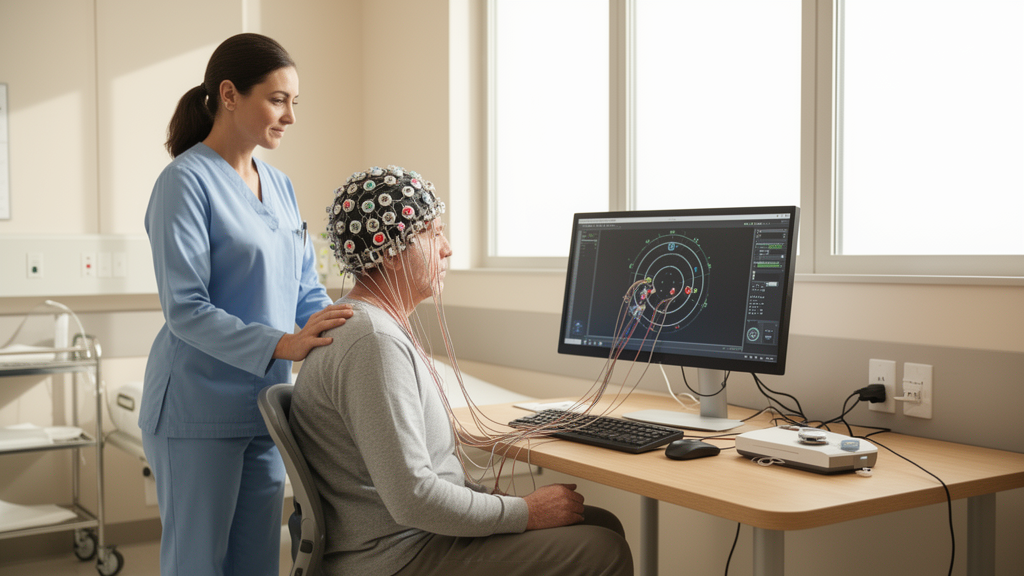
Brain-computer interface technology shows a promising short-term benefit for improving attention in stroke survivors, but its effect on broader global cognitive function remains statistically uncertain, according to a recent systematic review and meta-analysis. Post-stroke cognitive impairment affects approximately 30 to 60 percent of stroke survivors, presenting a substantial rehabilitation challenge while effective therapeutic interventions remain limited. Investigators conducted a focused quantitative synthesis of recent randomized controlled trials published between 2021 and 2026 to systematically evaluate whether interface-based rehabilitation measurably improves specific cognitive domains in this clinical population.
To locate eligible research, investigators searched four major biomedical databases including PubMed, the Cochrane Central Register of Controlled Trials, Embase, and Web of Science from January 2021 through May 2026. The search initially identified 663 records, from which 544 unique records were screened and 40 full-text reports were assessed against formal eligibility criteria. Studies qualified for inclusion if they were randomized controlled trials comparing brain-computer interface systems against conventional rehabilitation or sham controls in stroke patients while reporting at least one standardized cognitive measure.
Ultimately, seven randomized controlled trials encompassing 405 randomized participants met all inclusion criteria for the systematic review. The researchers analyzed the trials using random-effects models with restricted maximum likelihood estimation and Hartung-Knapp-Sidik-Jonkman tests based on a t-distribution. Standardized effect sizes were calculated using Hedges’ g along with 95 percent prediction intervals. In addition, the methodological quality was formally evaluated using the Cochrane Risk of Bias 2 tool, while the overall certainty of the body of evidence was graded using the GRADE framework.
For the primary outcome of global cognitive function, evaluated using the Montreal Cognitive Assessment, the quantitative synthesis drew upon two pairwise comparisons originating from a single three-arm randomized trial involving 89 participants. This analysis yielded a pooled effect size of g = 0.58 with a 95 percent confidence interval ranging from -0.52 to 1.68 and a p-value of 0.095. Because the confidence interval crossed zero and failed to achieve statistical significance, the investigators concluded that evidence supporting widespread improvements in overall cognition remains inconclusive.
In contrast, pooled results across three clinical trials comprising 218 participants demonstrated a statistically significant improvement in post-stroke attention. Patients receiving interface-assisted interventions achieved a large gain in attention performance, reflected by a pooled Hedges’ g of 0.86 with a 95 percent confidence interval of 0.77 to 0.95 and a significance level of p < 0.001. This positive effect remained robust in a planned sensitivity analysis restricted specifically to performance-based cognitive tests, which showed an identical effect size of g = 0.86 with a 95 percent confidence interval of 0.28 to 1.43 (p = 0.034).
Preliminary findings from individual small trials suggested potential positive trends across other targeted cognitive abilities, though the evidence base remains constrained by modest sample sizes. Specifically, single small trials indicated improvements in working memory, showing a Hedges’ g of 1.30 with a 95 percent confidence interval of 0.53 to 2.07, as well as processing speed, which yielded a Hedges’ g of 0.94 with a 95 percent confidence interval of 0.21 to 1.68.
Despite these encouraging signals for specific cognitive skills, formal evaluation revealed substantial variations in evidentiary strength across domains. The certainty of evidence was graded as moderate for attention outcomes, low for global cognitive recovery, and very low for all remaining cognitive domains. The authors emphasized that specific interface paradigms, training dosages, and intervention timing must currently be viewed as exploratory hypotheses rather than established clinical recommendations. They concluded that adequately powered, sham-controlled randomized trials featuring standardized cognitive outcomes and longer follow-up periods are essential to clarify long-term efficacy.
Subject of Research: Brain-computer interface efficacy for post-stroke cognitive impairment
Article Title: Efficacy of BCI-based interventions for post-stroke cognitive impairment: a systematic review with quantitative synthesis of recent randomized controlled trials (2021–2026)
Article References: Yang, L., Chen, L.-L., Chen, L., & Deng, S.-J. (2026). Efficacy of BCI-based interventions for post-stroke cognitive impairment: a systematic review with quantitative synthesis of recent randomized controlled trials (2021–2026). Frontiers in Neurology, 17, Article 1919047. https://doi.org/10.3389/fneur.2026.1919047
Image Credits: AI Generated
DOI: 10.3389/fneur.2026.1919047
Keywords: brain-computer interface, post-stroke cognitive impairment, neurorehabilitation, stroke rehabilitation, randomized controlled trials, systematic review, meta-analysis, attention recovery, global cognition, Montreal Cognitive Assessment, working memory, processing speed, Hedges g, Cochrane RoB 2, GRADE framework, rehabilitation medicine
News Source: Cassandra Pierce. (November 19, 2026). Brain-Computer Interfaces Aid Attention After Stroke but Global Cognitive Benefits Remain Uncertain. Scienmag.