• HOME
  • NEWS
  • EXPLORE
    • CAREER
      • Companies
      • Jobs
    • EVENTS
    • iGEM
      • News
      • Team
    • PHOTOS
    • VIDEO
    • WIKI
  • BLOG
  • COMMUNITY
    • FACEBOOK
    • INSTAGRAM
    • TWITTER
Thursday, October 29, 2026
BIOENGINEER.ORG
No Result
View All Result
  • Login
  • HOME
  • NEWS
  • EXPLORE
    • CAREER
      • Companies
      • Jobs
        • Lecturer
        • PhD Studentship
        • Postdoc
        • Research Assistant
    • EVENTS
    • iGEM
      • News
      • Team
    • PHOTOS
    • VIDEO
    • WIKI
  • BLOG
  • COMMUNITY
    • FACEBOOK
    • INSTAGRAM
    • TWITTER
No Result
View All Result
Bioengineer.org
No Result
View All Result
Home NEWS Science News Health

Brace adherence, not brace design, decides whether clubfoot returns after Ponseti correction

by
October 29, 2026
in Health
Reading Time: 2 mins read
0
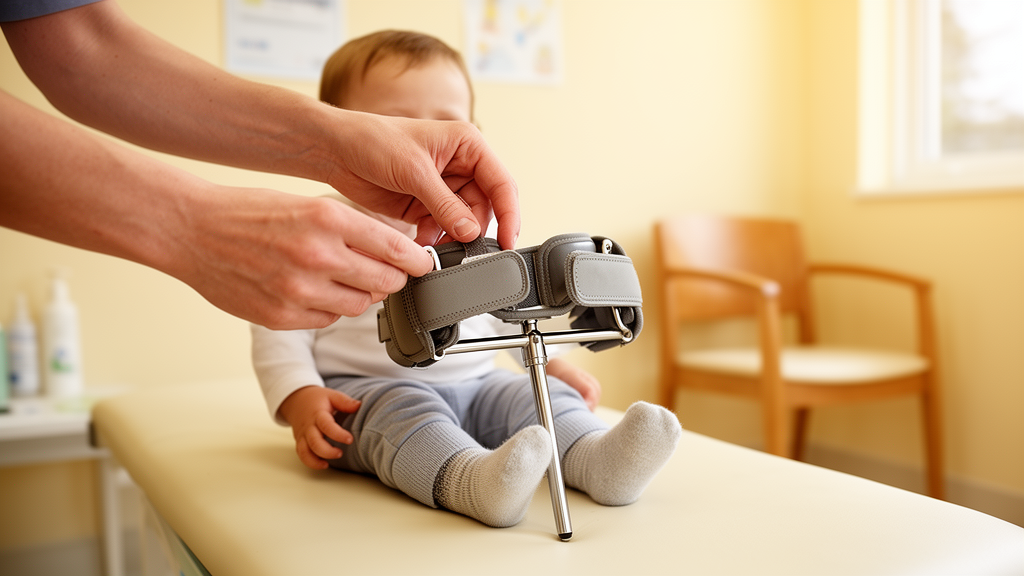
Brace adherence, not brace design, decides whether clubfoot returns after Ponseti correction

Brace adherence, not brace design, decides whether clubfoot returns after Ponseti correction

Share on FacebookShare on TwitterShare on LinkedinShare on RedditShare on Telegram

Adherence to foot abduction bracing is the single strongest factor in whether clubfoot returns after Ponseti correction, outweighing the type of brace a child wears, according to a systematic review published in BMC Musculoskeletal Disorders. The review found that non-adherence raised the odds of relapse by factors of five to eleven, and it concluded that fixed abduction orthoses remain the evidence-based first-line option for maintaining correction.

Congenital clubfoot affects approximately one to two per 1,000 live births. Reported relapse rates in the literature range from 6 percent to 47 percent, a spread that reflects differences in brace types, wearing schedules, and healthcare settings.

The review team, led by Bibek Banskota and colleagues, searched MEDLINE (PubMed), Embase, and Scopus from inception to December 31, 2024. They included twenty-five studies covering at least 2,317 patients and 2,927 clubfeet in the primary studies: nineteen primary studies and six contextual sources. Quality was assessed with design-specific tools including Cochrane RoB 2, the Newcastle–Ottawa Scale, AMSTAR-2, SANRA, AGREE II, and CROSS. Because the studies were substantially heterogeneous, the findings were synthesized narratively without meta-analysis.

Across the primary studies, relapse rates ranged from 0 percent to 48 percent over a mean follow-up of 42 months. The lowest relapse rates, between 8 and 12.1 percent, followed full-time bracing for three months and then nighttime use until age four to five years. Higher baseline Pirani scores, evertor weakness, and prolonged casting predicted inferior outcomes.

Brace design mattered mainly for adherence rather than for relapse prevention directly. Dynamic and unilateral designs showed better adherence, at 81 to 88 percent, than Denis-Browne splints, at 47 to 67 percent. However, the review notes that biomechanical equivalence between dynamic and fixed orthoses has not been established, so the adherence advantage of newer designs cannot yet be read as equivalent clinical protection.

Studies using sensors to measure actual wear revealed a persistent gap between what families report and what children actually wear: parent-reported adherence overestimates actual brace use.

Socioeconomic and health-system barriers limited adherence, particularly in low- and middle-income countries, where the review paid specific attention to the feasibility of maintenance bracing.

The authors conclude that successful programs need active, family-centered support, including structured counseling, protocolized follow-up, and reduction of socioeconomic barriers, especially in LMICs.

Subject of Research: Effectiveness of foot abduction bracing in preventing relapse after Ponseti correction of congenital clubfoot

Article Title: Effectiveness of bracing in preventing relapse in patients with clubfoot: a systematic review

Article References: Banskota, B., Bhusal, R., Sharma, S., Yadav, P. K., & Banskota, A. K. (2026). Effectiveness of bracing in preventing relapse in patients with clubfoot: a systematic review. BMC Musculoskeletal Disorders. https://doi.org/10.1186/s12891-026-10691-6

Image Credits: AI Generated

DOI: 10.1186/s12891-026-10691-6

Keywords: clubfoot, Ponseti method, foot abduction brace, bracing adherence, relapse, systematic review, orthopedics, pediatric orthopedics, Denis-Browne splint, low- and middle-income countries, adherence monitoring, Effectiveness

News Source: Ophelia Keating. (October 29, 2026). Brace adherence, not brace design, decides whether clubfoot returns after Ponseti correction. Scienmag.

Tags: adherence monitoringbracing adherenceclubfootDenis-Browne splinteffectivenessfoot abduction bracelow- and middle-income countriesorthopedicspediatric orthopedicsPonseti methodrelapsesystematic review
Share12Tweet7Share2ShareShareShare1

Related Posts

Dysarthria leads diagnosis in teen with Becker myotonia and CLCN1 variant

Dysarthria leads diagnosis in teen with Becker myotonia and CLCN1 variant

October 29, 2026
Nano Cubosome Gel Boosts Flibanserin Skin Delivery Nearly Twofold in Rats

Nano Cubosome Gel Boosts Flibanserin Skin Delivery Nearly Twofold in Rats

October 29, 2026

Lab-Grown Model Reproduces Vascular Damage and Skin Fibrosis of Systemic Sclerosis

October 29, 2026

Kidney Stone Surgery Trial Retracted Over Ethics Approval and Data Concerns

October 29, 2026

POPULAR NEWS

  • One Transformer Reads Three Brain-Signal Types at Once, Hitting 71% Accuracy

    One Transformer Reads Three Brain-Signal Types at Once, Hitting 71% Accuracy

    29 shares
    Share 12 Tweet 7
  • Research report: Case Report: Probable paroxysmal sympathetic hyperactivity during vascular and postoperative critical illness with bilateral white matter abnormalities

    29 shares
    Share 12 Tweet 7
  • Propionate, Not Extra Protein, Drives Reproductive Gains in Young Range Cows

    29 shares
    Share 12 Tweet 7
  • Deep Learning Model Predicts Adhesive Hydrogel Strength Under Distribution Shift

    29 shares
    Share 12 Tweet 7

About

We bring you the latest biotechnology news from best research centers and universities around the world. Check our website.

Follow us

Recent News

Dysarthria leads diagnosis in teen with Becker myotonia and CLCN1 variant

Nano Cubosome Gel Boosts Flibanserin Skin Delivery Nearly Twofold in Rats

Lab-Grown Model Reproduces Vascular Damage and Skin Fibrosis of Systemic Sclerosis

Subscribe to Blog via Email

Enter your email address to subscribe to this blog and receive notifications of new posts by email.

Join 85 other subscribers
  • Contact Us

Bioengineer.org © Copyright 2023 All Rights Reserved.

Welcome Back!

Login to your account below

Forgotten Password?

Retrieve your password

Please enter your username or email address to reset your password.

Log In
No Result
View All Result
  • Homepages
    • Home Page 1
    • Home Page 2
  • News
  • National
  • Business
  • Health
  • Lifestyle
  • Science

Bioengineer.org © Copyright 2023 All Rights Reserved.