


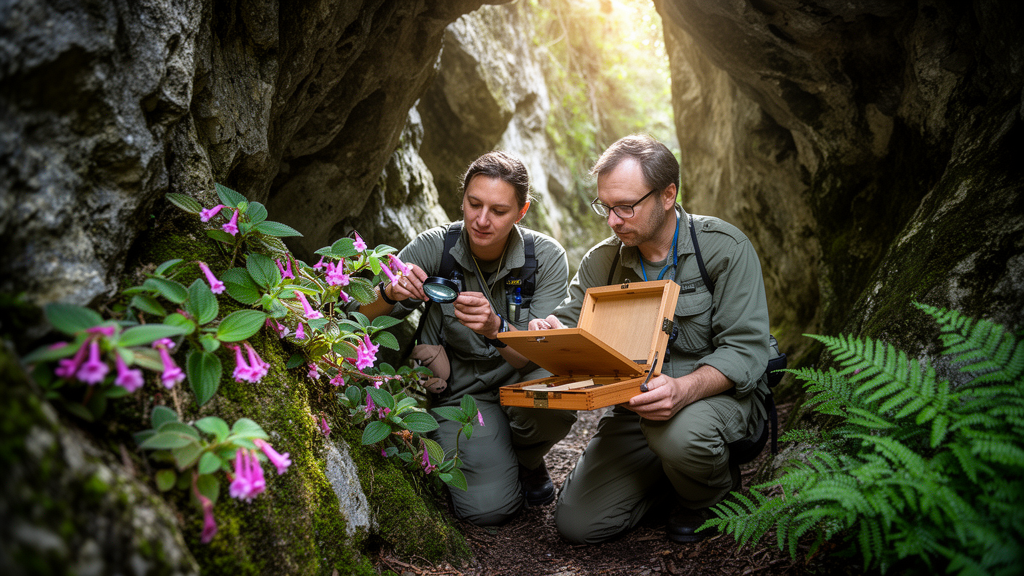
Deep in the karst caves and limestone valleys of Guizhou Province, China, a group of rosette-forming flowering plants has been hiding a case of mistaken identity. In a study published in the journal Botanical Studies, researchers report that two species of the genus Oreocharis, long accepted as distinct by the botanical community, are in fact the same plants described twice under different names. The work also elevates one of those names to the rank of variety, formally reshuffling the classification of a genus that has undergone dramatic upheaval over the past decade and a half.
Oreocharis, in its broadened sense, is today the second largest genus of the plant family Gesneriaceae in China, surpassed only by Primulina. Its modern form is the product of a major taxonomic consolidation: beginning in 2011, molecular systematics and morphological studies folded the genera Isometrum, Bournea, Dayaoshania, Deinocheilos, Opithandra, Paraisometrum, Ancylostemon, Thamnocharis, Tremacron and the rosulate members of Briggsia into a single expanded Oreocharis. Although Bournea was briefly split off again in 2020, subsequent research supported its reintegration. The result is a genus of roughly 159 species, concentrated in southwestern and southern China, with about ten species extending into Vietnam, Myanmar, Japan and Thailand.
That consolidation, however, created fertile ground for confusion. The authors of the new study note that frequent revisions, differing acceptance of competing classification systems among scholars, and insufficient field investigation have made errors in species publication relatively common in the genus. The genus is also extraordinarily diverse in floral traits, with corollas ranging from tubular and funnel-shaped to bell-shaped and urn-shaped, in colors spanning white, red, yellow, purple and multicolored combinations, and with stamens varying widely in position, fusion and fertility. Such diversity, combined with a long research history that includes many nineteenth- and early twentieth-century descriptions by European botanists, means that old and new names sometimes collide.
The first collision the researchers investigated involved Oreocharis wanshanensis and Oreocharis brachypoda, two species whose type localities lie only about 20 kilometers apart in Tongren City, Guizhou. The story begins in April 2003, when a botanist collected a gesneriad in Shamu Cave in Wanshan District and described it as a new species of Isometrum, named Isometrum wanshanensis. When Isometrum was merged into the expanded Oreocharis, the name became Oreocharis wanshanensis. Eleven years later, in April 2014, another scholar collected a similar plant in Jiulong Cave in Bijiang District and published it as Oreocharis brachypodus, a name later corrected to Oreocharis brachypoda on grammatical grounds. Both names were accepted by major botanical nomenclature databases including IPNI, Tropicos and Plants of the World Online.
When the team compared the original published descriptions and then examined living plants at both type localities, the two species proved highly consistent. On the type specimen of O. wanshanensis the leaf blade appears lanceolate, but field observations of multiple individuals revealed a continuous transition between oblanceolate and obovate leaf shapes, matching the variation seen in O. brachypoda. Disk morphology, described as many-lobed or entire in the O. brachypoda protologue, ranges from parted to entire in O. wanshanensis populations as well. The pistil of O. brachypoda is generally slightly longer than that of O. wanshanensis, but this difference falls within a continuous variation range of 8 to 17 millimeters. In short, the researchers found no qualitative characteristics that could reliably separate the two, while their quantitative characteristics overlapped.
Both species had previously been linked to a third relative, Oreocharis villosa, originally described in 1986 as Isometrum villosum from specimens collected in Shizhu County, Chongqing. The new study confirms that O. villosa is genuinely distinct: it differs from the two cave plants in bearing branched cymes of two to three branches, two to three per plant, each with eight to ten flowers, divergent anther thecae, and a style shorter than the ovary, whereas O. wanshanensis and O. brachypoda have unbranched cymes with one to four flowers, confluent anther thecae, and a style nearly equal in length to the ovary. Petiole length and leaf shape proved unstable across populations, but the flower number per inflorescence, anther thecae condition, and style-to-ovary length relationship consistently separated O. villosa from the other two.
Molecular evidence reinforced the morphological case. The team analyzed nuclear ribosomal ITS and chloroplast trnL-F sequences from 68 species obtained from GenBank plus 23 newly collected samples, building a concatenated matrix of 1,637 base pairs and reconstructing phylogenies with maximum likelihood and Bayesian inference. In the resulting tree, 103 Oreocharis samples formed a strongly supported monophyletic group, and the 12 samples of O. villosa, O. wanshanensis and O. brachypoda formed a subclade with maximal support. Within that subclade, O. wanshanensis and O. brachypoda were nested together as a well-supported clade. Haplotype network analysis of ITS sequences showed that haplotypes of the two species are directly connected by only a small number of mutation steps, while O. wanshanensis and O. villosa differ by 16 nucleobase substitutions and share no haplotypes, suggesting natural genetic isolation between them. The trnL-F network showed direct connections and shared haplotypes among all three.
The second case concerned an even older name. Oreocharis notochlaena was described in 1906 by Augustin Abel Hector Léveillé as a species of Didissandra, based on specimens collected by Laborde and Bodinier in 1899 at Tchao-sé, now Zhaosi Village in Huaxi District, Guizhou. The name migrated through several genera before settling in Oreocharis. Meanwhile, a plant first collected in Yunnan in 1906 by F. Ducloux sat unstudied in the Paris herbarium until 1997, when Weitzman and colleagues described it as Paraisometrum mileense, the type species of a new genus, later transferred to Oreocharis. After that first collection, no botanist recorded the plant in the wild for a century, until populations were rediscovered in Shilin County, Longlin County and Xingyi City. When the research group rediscovered O. notochlaena in Guizhou, they found no essential morphological difference between it and O. mileensis: descriptions of pannose versus lanuginous indumentum on leaves, bracts and peduncles dissolved under direct observation, with all material proving pannose, and leaf shapes showing continuous transitions between populations.
The molecular data told the same story. Twenty-six samples of O. notochlaena and O. mileensis formed a clade with maximal support in the phylogenetic analysis. ITS haplotype networks revealed shared haplotypes between the two populations of O. notochlaena and direct connections by few mutation steps to O. mileensis samples from Xingyi City in Guizhou and Longlin County in Guangxi, while Yunnan samples formed their own highly supported group without shared haplotypes. The 26 trnL-F sequences contained only a single haplotype with no polymorphic sites, underscoring how little the chloroplast genome differentiates these plants. The authors note that trnL-F, being maternally inherited and more conservative, is better suited to tracing deeper evolutionary history, while ITS carries the informative variation in this group.
Applying the rules of the 2018 International Code of Nomenclature for Algae, Fungi, and Plants, the Shenzhen Code, the team formally proposed that Oreocharis wanshanensis be treated as a variety of O. villosa, publishing the new combination Oreocharis villosa var. wanshanensis, with O. brachypoda reduced to a synonym of that variety. O. mileensis, in turn, becomes a synonym of the older name O. notochlaena. The newly recognized variety is known from Wanshan and Bijiang districts of Tongren City and from Hunan Province, growing on rocks in shady valleys at 270 to 1,300 meters altitude, while O. notochlaena in its broadened sense spans Huaxi District, Huishui County and Xingyi City in Guizhou plus Yunnan and Guangxi, on stone walls beneath limestone forest at 1,000 to 1,200 meters. By clarifying the relationships among these five species, the study trims redundant names from the genus and, the authors argue, lays a more reliable foundation for conserving plants that grow in some of China’s most specialized and fragile karst habitats.
Subject of Research: Taxonomic revision of the flowering plant genus Oreocharis in China using morphology, molecular phylogenetics and haplotype networks
Article Title: Two new synonyms and a name at new rank of Oreocharis Benth. (Gesneriaceae) in China
Article References: Xiong, X., Li, M., Li, Z., Wen, F., & Bai, X. (2025). Two new synonyms and a name at new rank of Oreocharis Benth. (Gesneriaceae) in China. Botanical Studies, 66(1), Article 40. https://doi.org/10.1186/s40529-025-00485-9
Image Credits: AI Generated
DOI: 10.1186/s40529-025-00485-9
Keywords: Oreocharis, Gesneriaceae, taxonomy, China, synonymization, molecular phylogenetics, haplotype network, ITS, trnL-F, Guizhou, plant nomenclature, endemic plants
News Source: Drew Townsend. (October 29, 2026). Botanists Untangle Duplicate Names of Cave-Dwelling Chinese Gesneriads. Scienmag.



