A quiet but consequential piece of botanical detective work has just settled the identity of a flowering plant first named by Carl Linnaeus himself in 1753. In a study published in the journal Italian Botanist, a researcher has formally designated a lectotype for Hemerocallis liliastrum, the name Linnaeus coined for what is now known as Paradisea liliastrum, a striking white-flowered species of the asparagus family that graces mountain meadows across the Pyrenees, the Jura, the Alps, and the northern Apennines. The designation, anchored to a single herbarium sheet preserved in the Linnean Herbarium in London, ensures that the name will continue to mean exactly what botanists have always taken it to mean, closing a taxonomic loophole that had lingered for more than two and a half centuries.
The technical stakes here are higher than they might appear. In botanical nomenclature, every species name ultimately rests on a physical type specimen, a pressed and dried plant that serves as the definitive reference point for what the name actually describes. When Linnaeus described thousands of species in his monumental Species Plantarum of 1753, he did not always designate a single specimen as the type, and later botanists must trace back through his sources to identify what scholars call original material, the specimens and illustrations Linnaeus actually consulted when he wrote his diagnosis. For Hemerocallis liliastrum, this exercise had never been completed, leaving the name formally untypified and therefore vulnerable to reinterpretation.
The new study traces the full documentary trail that Linnaeus followed. His 1753 diagnosis, describing a plant with a simple flower stalk and six-petaled, bell-shaped corollas, drew on his own earlier account in the Hortus Cliffortianus of 1738 and on Adriaan van Royen’s Florae Leydensis Prodromus of 1740, where the plant appeared under a descriptive polynomial phrase meaning daylily with tuberous root and six-petaled corollas. Linnaeus also cited Haller’s 1742 work, though the researcher found that the relevant polynomial phrase cannot actually be located in that source, only a passing reference to the epithet liliastrum. Additional synonyms came from the sixteenth- and seventeenth-century botanists Bauhin, Clusius, and Dalechamps, who had described the plant under names such as Phalangium magno flore and Phalangium allobrogicum majus.
What makes this investigation genuinely fascinating is the sheer diversity of original material that survived. Five distinct items can be traced to Linnaeus’s desk in 1753: two herbarium specimens from the Adriaan van Royen Herbarium, now conserved at the Naturalis Biodiversity Center in Leiden in the Netherlands; one specimen in Linnaeus’s own herbarium in London; and two published illustrations, one by Dalechamps from 1586 and one by Clusius from 1605. Each of these items could, in principle, have served as the type, and each carries its own risks of ambiguity. Illustrations, however accurate, can be difficult to match unambiguously to living populations, and herbarium sheets vary enormously in completeness and preservation quality.
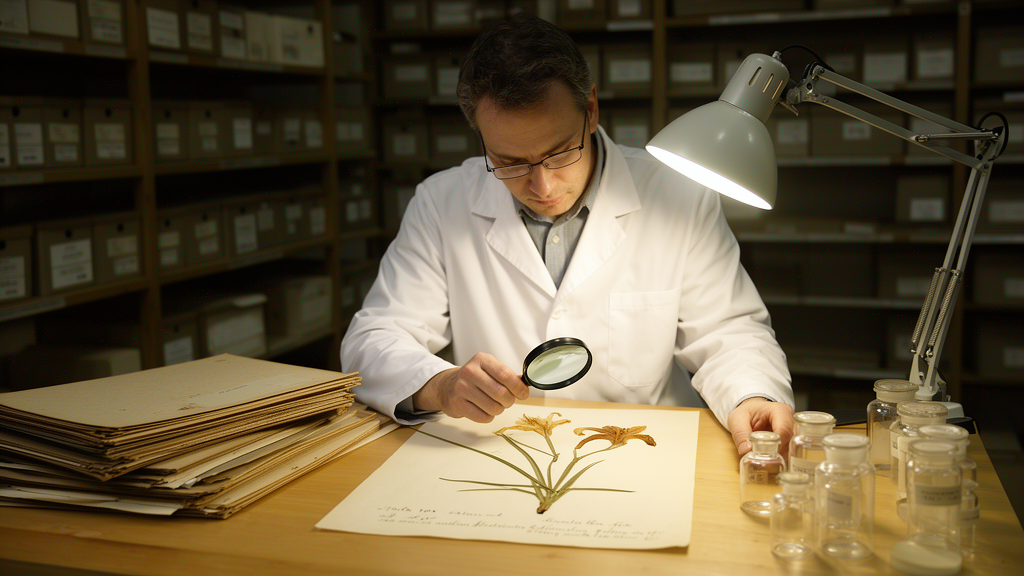
The specimen in the Linnean Herbarium, catalogued as number 432.9 in the standard Savage numbering system, bears Linnaeus’s own handwritten annotation reading 2 Liliastrum, a detail that confirms it was part of the working material he consulted when composing Species Plantarum. The researcher examined a specimen in the Clifford Herbarium at the Natural History Museum in London that is clearly identifiable as the same species, but discovered that it is not associated with the relevant entry in that collection and therefore cannot be considered original material. This kind of archival nuance is precisely what separates a rigorous typification from a superficial one, and it demonstrates why herbarium curation remains a living science rather than a merely archival one.
Among the five traced items, the study designates the complete and better-preserved specimen in the Linnean Herbarium as the lectotype, the single specimen that now serves as the nomenclatural anchor for the name. The choice is not arbitrary. Under the International Code of Nomenclature for algae, fungi, and plants, when multiple original materials exist, a later botanist must select one as the lectotype to fix the name’s application. The researcher deliberately chose the specimen that corresponds to the current concept of the species as understood in modern regional floras, including recent treatments of the French, Italian, and Iberian floras. This ensures continuity: the name will continue to refer to the same plant that botanists have been calling Paradisea liliastrum for generations.
The taxonomic history of the species reads like a microcosm of eighteenth- and nineteenth-century botany. After Linnaeus’s original description, the plant was shuffled through a remarkable series of generic assignments as botanists debated where it belonged. It was moved to Anthericum in 1762, then to Phalangium in 1804, then to Czackia in 1818, then to Liliastrum album in 1829, then to Pleisolirion in 1837, before finally settling in Paradisea in 1840 thanks to the Italian botanist Antonio Bertoloni. Two of these later combinations were formally ruled illegitimate under the nomenclatural code because they duplicated names already in use. Each move reflected shifting ideas about the boundaries of genera in the asparagus family, a group whose classification has been revolutionized in recent decades by molecular phylogenetics, which now places Paradisea in the subfamily Agavoideae within the family Asparagaceae.
Paradisea liliastrum itself is a plant worth knowing. It produces elegant spikes of white, star-shaped flowers and is native to southwestern Europe, with its range concentrated in the great mountain chains of the continent. In the Apennines, its occurrence is limited to the northern part of the range, a distribution pattern that has attracted attention from biogeographers studying post-glacial recolonization. The species has been documented in standard references such as Pignatti’s Flora d’Italia and Tison and de Foucault’s Flora Gallica, and its nomenclatural stability matters for conservation assessments, ecological studies, and any research that depends on unambiguous species identification.
Why should a typification, a seemingly dry administrative act, generate interest beyond the herbarium walls? The answer lies in the foundational role that names play in all of biology. Every ecological survey, every conservation plan, every pharmacological screen, and every genomic study depends on names that refer to precisely defined organisms. When a name like Hemerocallis liliastrum remains untypified, there is always a theoretical possibility that a future botanist could reinterpret it differently, potentially destabilizing the name of a well-known European wildflower and forcing a cascade of nomenclatural changes. By fixing the lectotype now, the researcher has eliminated that risk, a small act of housekeeping with outsized consequences for the stability of botanical literature.
The study also highlights the enduring value of historical collections. The van Royen Herbarium in Leiden, the Burser Herbarium in Uppsala, and the Linnean Herbarium in London are not merely relics of eighteenth-century science; they are active research infrastructure that continues to resolve questions about the natural world. The researcher noted that Bauhin’s polynomials are associated with original material that Linnaeus studied in the Burser Herbarium in Uppsala, though no entry for the relevant phrase is preserved there, a detail that narrowed the field of candidates. In an era when herbaria face funding pressures and occasional calls to discard collections, this typification stands as a vivid reminder that pressed plants on century-old sheets still carry the authority to define species, and that the careful study of historical documents remains one of the most powerful tools in modern biodiversity science.
Subject of Research: Botany
Article Title: Typification of the Linnaean name Hemerocallis liliastrum
Article References: Peruzzi, L. (2025). Typification of the Linnaean name Hemerocallis liliastrum. Italian Botanist, 20, 41-44. https://doi.org/10.3897/italianbotanist.20.170416
Image Credits: AI Generated
DOI: 10.3897/italianbotanist.20.170416
Keywords: Typification, Linnaean, name, Hemerocallis, liliastrum, scientific research
News Source: Drew Townsend. (October 17, 2026). Botanists Fix the Name of a Linnaean Lily With a 270-Year-Old Herbarium Sheet. Scienmag.