• HOME
  • NEWS
  • EXPLORE
    • CAREER
      • Companies
      • Jobs
    • EVENTS
    • iGEM
      • News
      • Team
    • PHOTOS
    • VIDEO
    • WIKI
  • BLOG
  • COMMUNITY
    • FACEBOOK
    • INSTAGRAM
    • TWITTER
Tuesday, May 5, 2026
BIOENGINEER.ORG
No Result
View All Result
  • Login
  • HOME
  • NEWS
  • EXPLORE
    • CAREER
      • Companies
      • Jobs
        • Lecturer
        • PhD Studentship
        • Postdoc
        • Research Assistant
    • EVENTS
    • iGEM
      • News
      • Team
    • PHOTOS
    • VIDEO
    • WIKI
  • BLOG
  • COMMUNITY
    • FACEBOOK
    • INSTAGRAM
    • TWITTER
  • HOME
  • NEWS
  • EXPLORE
    • CAREER
      • Companies
      • Jobs
        • Lecturer
        • PhD Studentship
        • Postdoc
        • Research Assistant
    • EVENTS
    • iGEM
      • News
      • Team
    • PHOTOS
    • VIDEO
    • WIKI
  • BLOG
  • COMMUNITY
    • FACEBOOK
    • INSTAGRAM
    • TWITTER
No Result
View All Result
Bioengineer.org
No Result
View All Result
Home NEWS Science News Biology

Bone transplant could resolve aging jaw defects

Bioengineer by Bioengineer
August 30, 2022
in Biology
Reading Time: 2 mins read
0
Figure 1
Share on FacebookShare on TwitterShare on LinkedinShare on RedditShare on Telegram

Tohoku University scientists in Japan have made a scaffold that supports the growth of new bone in large jaw defects in mice. Their findings, published in the journal PNAS Nexus, bring scientists one step closer to addressing the issues currently facing the treatment of large jaw bone defects, especially in the elderly.
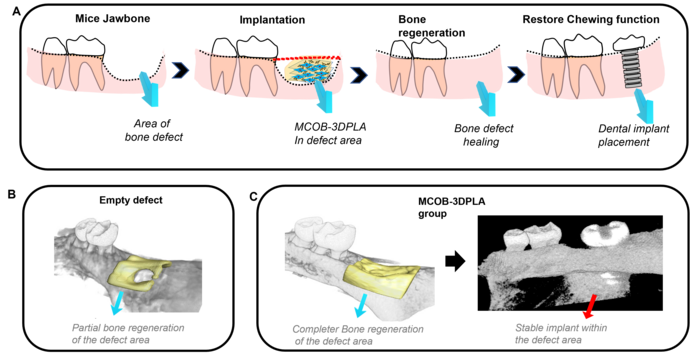
Figure 1

Credit: Tohoku University

Tohoku University scientists in Japan have made a scaffold that supports the growth of new bone in large jaw defects in mice. Their findings, published in the journal PNAS Nexus, bring scientists one step closer to addressing the issues currently facing the treatment of large jaw bone defects, especially in the elderly.

As people age, they become prone to losing bone tissue in their jaws, making it difficult to eat. There are several ways to treat this, but each has its limitation, especially when the defect is large and not completely surrounded by bone. Scientists are working on finding ways to transplant bone cell-carrying scaffolds into these defects to stimulate new bone growth.

Masahiro Saito is professor of dental conservation at Tohoku University. He and his team develop regenerative therapies for dentistry that could also have applications in the broader orthopaedics and medical fields. The team has fabricated a scaffold made from polylactic acid and gelatin that is showing promise for treating large bone defects.

Their cotton-like scaffold is made using a technique called electrospinning, which involves applying high voltage to a polymer solution to stretch its fibres using an electric field. The team found that their scaffold was strong enough to hold and grow bone cells, including immature osteoblasts taken from human jaw bones.

However, when human cell-carrying scaffolds were transplanted into large defects in pig jaws, they failed to form new bone. The team believes that the pigs’ immune systems rebelled against the human cells.

So instead, the team tried the same technique using bone cells from mice and then implanting the cell-carrying scaffolds into defects in mice jaws. This led to a successful result: strong bone formed inside the large defects within eight weeks. The bone was strong enough to withstand the insertion of dental implants. This shows promise for using the bone as a base for use with dentures and tooth implants.

Further research is needed. The team wants to test the technique using pig bone cells on large pig jaw defects. If successful, they can then use human bone cells in human clinical trials at Tohoku University Hospital. “We plan to complete the application for manufacturing and marketing approval to sell this as a product for regenerative medicine by 2026,” says Saito.


Journal

PNAS Nexus

DOI

10.1093/pnasnexus/pgac151

Article Title

Correction of large jaw bone defect in the mouse using immature osteoblast-like cells and a three dimensional polylactic acid scaffold.

Article Publication Date

8-Aug-2022

Share12Tweet8Share2ShareShareShare2

Related Posts

Qualcomm Co-Founder Andrew Viterbi Donates $5 Million to Propel AI-Driven Research at Sanford Burnham Prebys Medical Discovery Institute — Biology

Qualcomm Co-Founder Andrew Viterbi Donates $5 Million to Propel AI-Driven Research at Sanford Burnham Prebys Medical Discovery Institute

May 5, 2026
Scientists Identify Seven Distinct Pneumonia Subphenotypes Through Human Lung Analysis — Biology

Scientists Identify Seven Distinct Pneumonia Subphenotypes Through Human Lung Analysis

May 5, 2026

Study Reveals Most Birds Have Yet to Evolve Optimal Wing Shapes for Flight

May 5, 2026

Fungi Harness Ancient Antimicrobial Proteins to Combat Hosts and Their Microbiomes

May 5, 2026

POPULAR NEWS

  • Research Indicates Potential Connection Between Prenatal Medication Exposure and Elevated Autism Risk

    835 shares
    Share 334 Tweet 209
  • New Study Reveals Plants Can Detect the Sound of Rain

    721 shares
    Share 288 Tweet 180
  • Scientists Investigate Possible Connection Between COVID-19 and Increased Lung Cancer Risk

    68 shares
    Share 27 Tweet 17
  • Salmonella Haem Blocks Macrophages, Boosts Infection

    61 shares
    Share 24 Tweet 15

About

We bring you the latest biotechnology news from best research centers and universities around the world. Check our website.

Follow us

Recent News

High-Fructose Diet Drives Osteoporosis via Cholesterol

Foldable Magnetic Flux Enables Robust Wireless Charging

Pentoxifylline: New Adjunct Therapy for Pediatric Pneumonia

Subscribe to Blog via Email

Enter your email address to subscribe to this blog and receive notifications of new posts by email.

Join 82 other subscribers
  • Contact Us

Bioengineer.org © Copyright 2023 All Rights Reserved.

Welcome Back!

Login to your account below

Forgotten Password?

Retrieve your password

Please enter your username or email address to reset your password.

Log In
No Result
View All Result
  • Homepages
    • Home Page 1
    • Home Page 2
  • News
  • National
  • Business
  • Health
  • Lifestyle
  • Science

Bioengineer.org © Copyright 2023 All Rights Reserved.