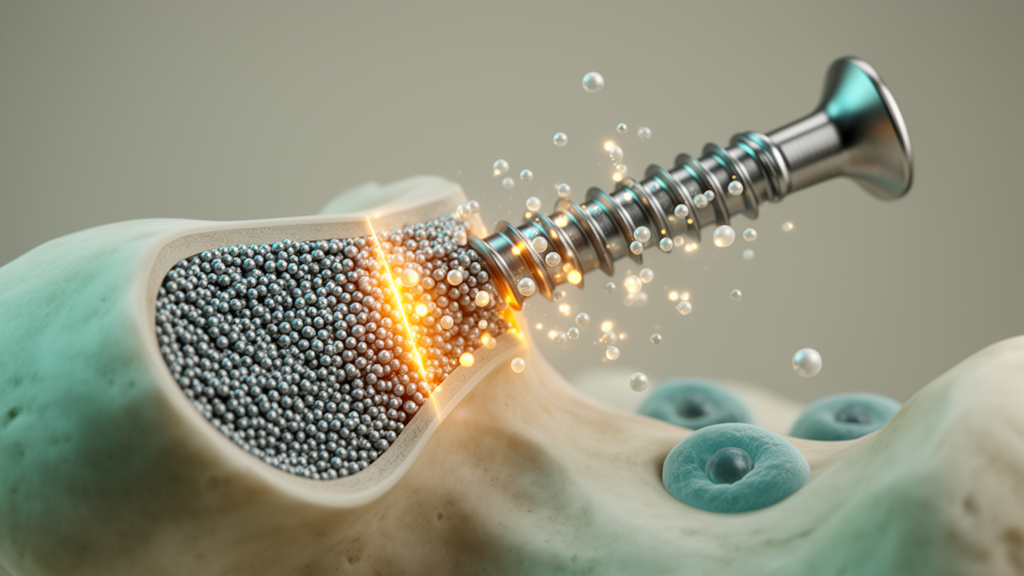
Coatings of this material, chemically written Ca10(PO4)6(OH)2, are already applied to metal bone implants to improve fixation, exploiting the natural affinity between the ceramic and the mineral phase of bone to promote osteoblast adhesion, proliferation and differentiation, and to allow direct bone-implant contact without an intervening fibrous tissue layer. A new open-access review in Future Journal of Pharmaceutical Sciences argues that this familiar ceramic should be treated not as an inert scaffold but as an active, engineerable component of drug delivery, one whose atomic-scale lattice can be tuned to decide when, where and how fast a therapeutic payload leaves an implant.
The review, authored by Olumakinde Charles Omiyale and Svetlana Aleksandrovna Ulasevich and published on 4 September 2026, addresses a problem that standard hydroxyapatite coatings cannot solve on their own. Once a metal implant is placed, it enters a window of vulnerability: bacteria can colonize the surface and form biofilms that systemic antibiotics penetrate poorly, driving peri-implantitis or osteomyelitis; excessive inflammation, poor vascularization and, in oncology patients, local tumor recurrence or spread add further risks. A static film of ceramic provides mechanical and osteoconductive support but cannot sense these changes, cannot act on them, and cannot control the speed at which any drug leaves its entrapment site. The authors’ central premise is that all three shortcomings can be attacked by treating the apatite lattice itself as a controllable carrier.
The technical heart of the argument lies in crystal chemistry. Stoichiometric hydroxyapatite crystallizes in the hexagonal space group P63/m with two distinct calcium positions, Ca(I), coordinated by nine oxygen atoms in columns parallel to the crystallographic c-axis, and Ca(II), arranged in triangles around the hydroxyl channel. Divalent ions such as strontium, zinc and magnesium can substitute for calcium at these sites in ratios governed by ionic radius and valence, modifying lattice parameters, crystallinity and solubility; silver and copper substitutions confer intrinsic antibacterial activity, while electronic-structure modifications can shift optical absorption into the near-infrared. Quantitatively, the key parameter is the solubility product: stoichiometric hydroxyapatite is among the least soluble calcium phosphates, with a value close to 10 to the power of minus 58, and it dissolves slowly at physiological pH. Two levers change that. Carbonate substitution raises the solubility product substantially, and calcium-deficient apatite or beta-tricalcium phosphate dissolve even more readily. Dissolution is also strongly pH-dependent, accelerating sharply below pH 6.5, precisely the range that characterizes both infection and malignancy. A carbonate- or strontium-substituted, low-crystallinity apatite is therefore intrinsically pH-responsive without any organic gate at all.
The review then connects this chemistry to the kinetic language of pharmaceutics. Release from these carriers is modeled with standard equations: zero-order kinetics for constant-rate dosing, first-order for concentration-proportional release, the Higuchi model for diffusion proportional to the square root of time, and the Korsmeyer-Peppas power law, Mt/M∞ = kt^n, whose exponent distinguishes Fickian diffusion, at n of 0.45 or below, from coupled diffusion and matrix degradation. Diffusion-limited mesoporous matrices follow Higuchi and Fickian profiles; erosion of low-crystallinity or carbonate-substituted coatings pushes the exponent upward toward zero-order behavior. A successful gated system is one that switches between a near-flat off state and a rapid on state when the trigger arrives.
Where quantitative data exist, the review anchors these relationships to numbers. Pupilli and colleagues synthesized hydroxyapatite nanorods with increasing magnesium-for-calcium substitution and loaded them with doxorubicin. At physiological pH the drug remained largely retained after seven days in both unsubstituted and magnesium-substituted carriers, but under mildly acidic conditions typical of an osteosarcoma or infected microenvironment, cumulative release over the same period reached roughly 15 percent for unsubstituted hydroxyapatite and about 19 percent for the magnesium-substituted analogue, a measurable shift that preserved the lattice’s underlying pH-gating. Mocanu and colleagues modeled calcium, strontium, magnesium, zinc and phosphate release from multi-substituted nano-hydroxyapatite with the Korsmeyer-Peppas equation, describing a two-stage mechanism of initial surface-controlled exchange followed by slower bulk diffusion; magnesium substitution slowed calcium release, while increasing strontium content moved the material toward higher solubility, consistent with lattice destabilization by the larger Sr2+ ion. The authors caution that no general calibration curve from substitution level to release rate yet exists, and that effect magnitudes depend on particle size, synthesis route and the specific ion pair.
Beyond the lattice itself, the review catalogues the gates that can be built onto it. Endogenous triggers exploit pathological biochemistry: acidic pH of 5.5 to 6.5 at infected sites and 6.5 to 7.0 in tumors, driven by bacterial metabolism, hypoxia and aerobic glycolysis; over-expressed enzymes such as matrix metalloproteinases at invasive tumor fronts, alkaline phosphatase at osteoblast surfaces and in osteosarcoma, and cathepsin B in metastatic lysosomes; and redox gradients, with intracellular glutathione at 2 to 10 millimolar against 2 to 20 micromolar extracellularly. One striking example is a mesoporous hydroxyapatite matrix carrying vancomycin through pH-dependent benzoic-imine bonds on a polydopamine shell; the bonds broke at the pH of Staphylococcus aureus biofilms, about 5.5, yielding roughly a four-log reduction in colony-forming units versus a non-responsive control, though the result came from a single-strain, single-timepoint model, and pH-gated systems respond to any sufficiently acidic compartment, including healing callus and sterile inflamed tissue.
Exogenous triggers offer external spatial and temporal control. Near-infrared light in the 750 to 1000 and 1000 to 1350 nanometer windows drives photothermal agents such as polydopamine, gold nanostructures and copper sulfide, or photosensitizers such as chlorin e6 for photodynamic killing; a quaternary-chitosan-coated nano-hydroxyapatite system with chlorin e6 markedly reduced Streptococcus mutans biofilms and limited demineralization in an artificial-tooth model, though light attenuates rapidly once bone and overlying muscle are added. Superparamagnetic iron oxide nanoparticles enable magnetic hyperthermia and magnetomechanical stimulation under alternating fields, and ultrasound provides cavitation, thermal and sonodynamic effects; an alginate-based hydrogel containing 1 to 7 percent hydroxyapatite supported ultrasound-triggered release of model cargoes, with protein release rates significantly higher in hydroxyapatite-containing gels. Temperature-sensitive polymers, chiefly poly(N-isopropylacrylamide) with its lower critical solution temperature near 32 degrees Celsius, collapse when heated and release their payload, though the polymer is not biodegradable, a concern for long-term implants.
Combining triggers raises specificity through molecular logic gates. Doxorubicin-loaded gold-nanorod/mesoporous-silica/hydroxyapatite nanoparticles released drug slowly at neutral pH and faster under acid with near-infrared irradiation; MMP- and redox-gated mesoporous hydroxyapatite carriers hold release at low baseline until extracellular enzyme and intracellular reducing environments are met in sequence; and hydroxyapatite/copper sulfide/iron oxide hybrids, including gadolinium-doped forms, combine photothermal and magnetic hyperthermia with MRI guidance for osteosarcoma. The review is blunt about the evidence base, however: all such multi-responsive systems remain at the in vitro or small-animal stage, none has been independently replicated under conditions approximating clinical use, and AND-gated specificity is best regarded as a demonstrated principle rather than a validated performance advantage over well-optimized single-trigger systems.
On translation, the picture is sober but not discouraging. No stimulus-responsive hydroxyapatite product of the kind described has entered clinical use or, to the review’s knowledge, a registered human trial. The clinical precedent sits one step down the complexity ladder: antibiotic-loaded calcium sulfate, beta-tricalcium phosphate and hydroxyapatite/collagen composites are already used for local treatment and prophylaxis of bone infection, with several CE-marked formulations in Europe, though the corresponding US pathway has moved more slowly. These passive systems release drug at a fixed dissolution rate set at formulation, with no disease-specific gating. The review identifies concrete obstacles: oversimplified animal models that miss the comorbidities and chronic pathology of real patients; a poorly understood protein corona that can hide responsive sites and alter surface behavior; unknown long-term fates of organic gates such as poly(acrylic acid), PNIPAM and disulfide linkers; sterilization damage to organic phases even when the mineral tolerates gamma irradiation; and compendial standards, the ISO 13779 series and ASTM methods, that certify composition, bond strength and dissolution but carry no acceptance criterion for trigger-dependent release. The authors’ proposed near-term route is deliberately incremental: adding a single, well-characterized substitution-based pH sensitivity to an antibiotic-loaded bone void filler already familiar to regulators, while systematic single-substitution studies, a standardized in vitro trigger-response assay and head-to-head single- versus multi-trigger comparisons build the evidence base for the fully programmable implants they envision next.
Subject of Research: Crystal-chemical design of stimuli-responsive hydroxyapatite nanomaterials for bone implant coatings and triggered drug delivery
Article Title: Crystal-chemical design of stimuli-responsive hydroxyapatite nanomaterials for bone implant coatings and triggered drug delivery: from lattice engineering to release control
Article References: Omiyale, O. C., & Ulasevich, S. A. (2026). Crystal-chemical design of stimuli-responsive hydroxyapatite nanomaterials for bone implant coatings and triggered drug delivery: from lattice engineering to release control. Future Journal of Pharmaceutical Sciences, 12(1), Article 87. https://doi.org/10.1186/s43094-026-01020-8
Image Credits: AI Generated
DOI: 10.1186/s43094-026-01020-8
Keywords: hydroxyapatite, bone implants, drug delivery, stimuli-responsive materials, crystal chemistry, release kinetics, implant coatings, pH-responsive, photothermal therapy, biofilms, translational readiness, nanomaterials
News Source: Louis Brooks. (October 29, 2026). Bone Implant Coatings Reimagined as Smart, Trigger-Activated Drug Delivery Systems. Scienmag.