Dogs testing positive for canine parvovirus at a veterinary teaching hospital in Kumasi, Ghana, were far more likely to be admitted for hospital care and to die than dogs with similar signs who tested negative, according to a cross-sectional study conducted at the Kwame Nkrumah University of Science and Technology (KNUST) Veterinary Teaching Hospital. Among 129 CPV-positive dogs, the overall mortality rate was 26.4 percent (34 of 129), compared with 8.5 percent (7 of 82) among dogs that tested negative. The positive dogs were also 7.57 times more likely to require inpatient care than their CPV-negative counterparts, an association that was highly statistically significant.
The study, published in the journal Companion Animal Health and Genetics, enrolled dogs presented at the hospital between August 2023 and August 2024. Eligible animals were those showing clinical signs suggestive of canine parvoviral enteritis, including vomiting, diarrhoea, inappetence and lethargy. In total, 211 dogs met the criteria and were included in the analysis. Diagnosis was confirmed using a Vcheck CPV antigen test kit, a rapid immunochromatographic assay, run in conjunction with a V200 analyser from Bionote Inc. of Korea, following the manufacturer’s instructions and protocols described in a related earlier study by the same research group.
The study population was dominated by young animals. The dogs ranged in age from 3 to 144 weeks, with a median of 16 weeks and an interquartile range of 10 to 24 weeks, and the age distribution was not normally distributed. Body weight was likewise non-normally distributed, with a median of 7.0 kilograms (interquartile range 4.6 to 10.8 kilograms), while body temperature approximated a normal distribution with a mean of 38.97 degrees Celsius. There were 131 male and 80 female dogs. Local indigenous breeds were the most commonly represented group with 57 dogs, followed by crossbreeds (31), Boerboels (25), German Shepherds (21), Bullmastiffs (20) and Rottweilers (16), with a long tail of other purebreds. Vaccination records showed that 102 of the 211 dogs, or 48.3 percent, had documented prior CPV vaccination, 90 dogs (42.7 percent) were reportedly unvaccinated, and records were unavailable for 19 dogs (9.0 percent).
To identify which features at presentation were associated with a positive test, the researchers first ran univariable logistic regression. Appetite status, vomiting, faecal consistency, the smell of faeces, diarrhoea status and body weight were all significantly associated with the odds of a CPV diagnosis, while lethargy and body temperature were not. Body temperature in the CPV-positive dogs ranged widely, from 36.7 degrees Celsius to 41.2 degrees Celsius, with a mean of 38.9 degrees Celsius, and their body weights ranged from 0.8 to 37.0 kilograms with a median of 6.2 kilograms.
In the multivariable model, four factors remained independently associated with CPV diagnosis. Dogs with haemorrhagic diarrhoea had the highest odds, at 6.84 times those of dogs without diarrhoea (95 percent confidence interval 2.76 to 16.98; p < 0.001), whereas non-haemorrhagic diarrhoea did not remain statistically significant once other variables were adjusted for. Complete loss of appetite carried 4.29 times the odds compared with normal appetite (95 percent CI 1.11 to 16.63; p = 0.035), although reduced appetite alone was not statistically significant. Vomiting was associated with 2.75-fold higher odds (95 percent CI 1.35 to 5.59; p = 0.005). Each additional kilogram of body weight was associated with a 6 percent reduction in the odds of testing positive (OR = 0.94, 95 percent CI 0.90 to 0.99; p = 0.010), a pattern the authors attribute to the heightened susceptibility of puppies and young dogs, which generally weigh less than adults.
The final model showed acceptable calibration, with a Hosmer–Lemeshow chi-square of 11.64 (p = 0.168), and was statistically significant overall (Omnibus test chi-square 62.55, p < 0.001). It had moderate explanatory power, with a Nagelkerke R-squared of 0.348, and good discrimination, with an area under the receiver operating characteristic curve of 0.80 (95 percent CI 0.73 to 0.86). Multicollinearity among predictors was low, with variance inflation factors between 1.055 and 1.164. Notably, foul-smelling faeces, which had shown a strong univariable association (OR = 5.20, 95 percent CI 2.85 to 9.50), was excluded from the final model, though the authors note it remains clinically relevant as a marker of severe mucosal damage in parvoviral enteritis.
The findings on clinical signs come with an important caveat that the authors emphasise: not all confirmed cases displayed the hallmark features at admission. Some patients lacked haemorrhagic diarrhoea, showed no vomiting, were not anorexic, and had no diarrhoea at all. The authors point out that the haemorrhagic character of the diarrhoea typically emerges as disease progresses, while earlier stages may involve non-haemorrhagic diarrhoea of variable colour and consistency, and they cite similar patterns reported in Ghana and Egypt where a significant proportion of dogs with non-haemorrhagic diarrhoea tested positive. The absence of any single sign therefore does not exclude CPV, and thorough assessment of suspected cases remains necessary.
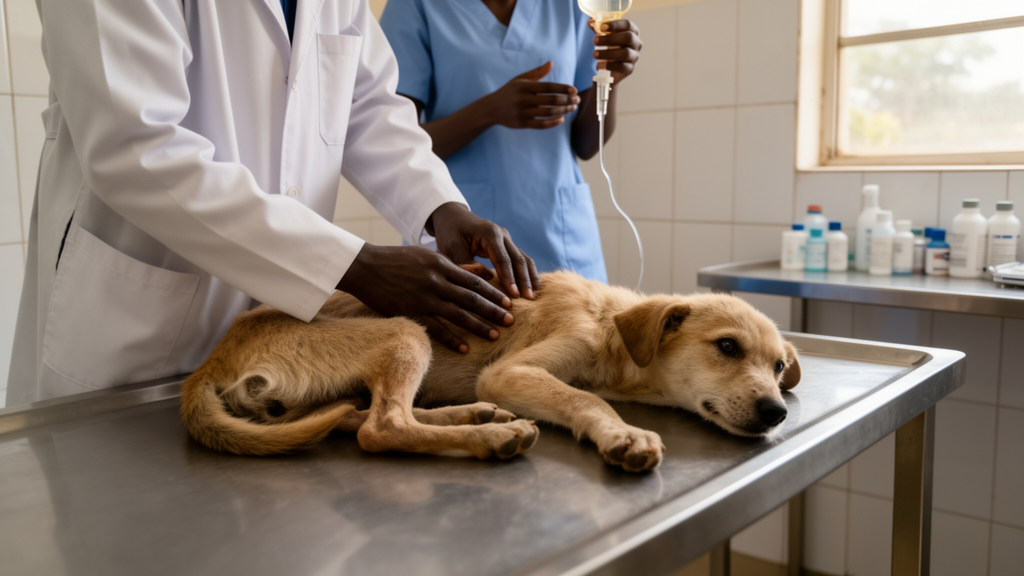
Service type was examined among the 206 dogs that received treatment; animals that received no treatment or died before treatment began were excluded from this analysis. Inpatient care predominated among treated CPV-positive dogs, accounting for 75.8 percent (94 of 124) of cases, with outpatient management at 24.2 percent (30 of 124). In this study, inpatient care meant admission with continuous observation and typically at least two treatment sessions per day, while outpatients received a single in-clinic treatment session per day and were discharged home with owner-administered medications. The choice between the two was made jointly by the attending clinician and the owner based on disease severity, owner preference, logistics and finances. Among CPV-positive cases, all dogs of certain breeds, including Bullmastiffs, Caucasian Shepherds, Maltese, Shih Tzus, Alsatian Shepherds and American Bullies, were managed as inpatients, while outpatient care was most common among local breeds (40.0 percent) and crossbreeds (30.0 percent). In univariate analysis of the positive cases, female dogs, dogs aged 12 weeks or younger, dogs aged 13 to 24 weeks, and foreign breeds showed higher odds of inpatient care than their reference groups, but none of these associations reached statistical significance.
Treatment was broadly standardised but adapted to severity, consisting primarily of fluid therapy with intravenous Ringer’s lactate, dextrose saline, normal saline or dextrose fluids, adjusted to hydration status. Antibiotics typically included amoxicillin–clavulanic acid or penicillin–streptomycin, often combined with metronidazole, with ceftriaxone, ceftiofur or gentamicin reserved for selected cases. Antiemetic support relied mainly on metoclopramide, with ondansetron used when indicated, and adjunct therapies included antispasmodics, gastric protectants, injectable B-complex and multivitamins, oral rehydration solutions and nutritional supplementation. Inpatients received more intensive and frequent treatment than outpatients. Clinical outcomes were classified at discharge: recovery required resolution of the primary signs, cessation of vomiting and diarrhoea, return of appetite and rehydration, while death was recorded if the dog died during hospitalisation or the owner reported death at home.
Across the whole cohort, 166 dogs (78.67 percent) received treatment and recovered. Among the 129 CPV-positive dogs, two died before treatment could be administered, three received no treatment at the facility and one was lost to follow-up, leaving incomplete treatment outcome data for six cases. Of the remaining positive dogs, 70.54 percent (91 of 129) recovered following treatment and 24.81 percent (32 of 129) died despite it; including the two dogs that died before treatment, the overall mortality rate among CPV-positive dogs was 26.4 percent. By contrast, 91.46 percent (75 of 82) of CPV-negative dogs recovered and 8.54 percent (7 of 82) died. The authors note that all three untreated dogs were CPV positive, which they suggest may reflect the financial or logistical constraints the disease imposes on owners. The reported mortality sits below figures from Nigeria and Cameroon but above those reported in the United States and Portugal, and is comparable to a figure from the United Kingdom, differences the authors attribute to variations in disease severity at presentation, level of care, diagnostics, vaccination coverage and regional comorbidities. The study has limitations the authors themselves flag: the CPV-negative group comprised heterogeneous causes of acute gastroenteritis, the rapid antigen test can produce false negatives, laboratory severity indicators were not consistently available, owner recall may have affected some data, and the allocation of inpatient versus outpatient care was not randomised, complicating causal comparisons. The authors conclude that strengthening vaccination coverage, client education and access to supportive care is crucial to reducing CPV-related deaths in Ghana.
Subject of Research: Clinical predictors, care type and outcomes of canine parvovirus infection in dogs presented at a veterinary teaching hospital in Kumasi, Ghana
Article Title: Clinical factors, service type, and clinical outcomes associated with canine parvovirus in dogs presented at the KNUST Veterinary Teaching Hospital in Kumasi, Ghana
Article References: Agbota, J. D., Folitse, R. D., Opoku, E. D., Kodie, D. O., Tasiame, W., & Emikpe, B. O. (2026). Clinical factors, service type, and clinical outcomes associated with canine parvovirus in dogs presented at the KNUST Veterinary Teaching Hospital in Kumasi, Ghana. Companion Animal Health and Genetics, 13(1), Article 3. https://doi.org/10.1186/s40575-026-00153-6
Image Credits: AI Generated
DOI: 10.1186/s40575-026-00153-6
Keywords: canine parvovirus, dogs, Ghana, veterinary medicine, haemorrhagic diarrhoea, hospitalisation, mortality, logistic regression, vaccination, puppies, cross-sectional study, companion animal health
News Source: William Thompson. (October 29, 2026). Bloody Diarrhoea, Vomiting and Low Body Weight Mark Canine Parvovirus Cases in Ghanaian Hospital Study. Scienmag.