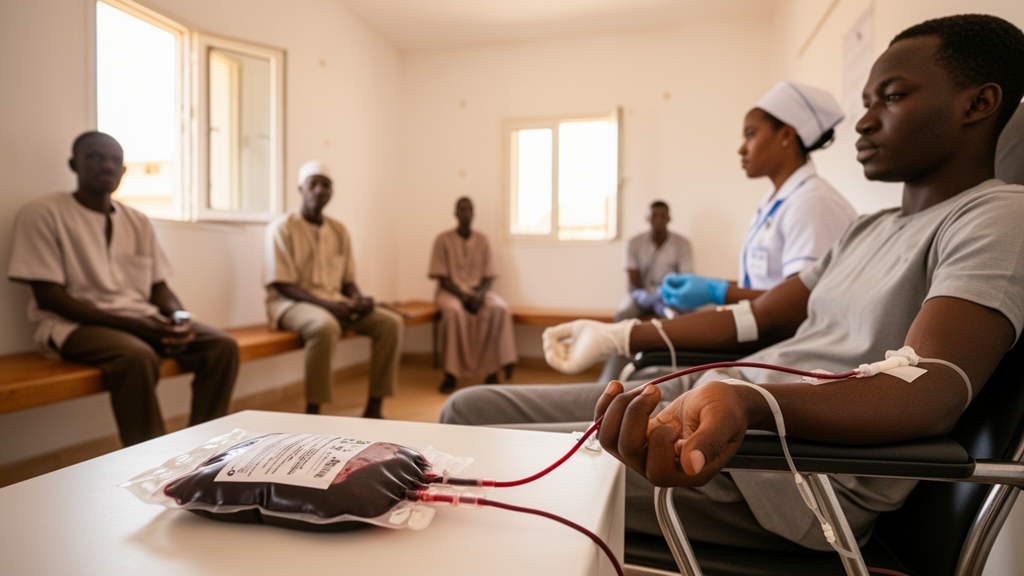
When the COVID-19 pandemic swept across the world, much of the attention focused on countries with dense surveillance networks and high testing capacity. In many parts of sub-Saharan Africa, official case counts remained strikingly low, fueling debate about whether the virus truly spared the continent or simply went undetected. A new study from Niamey, Niger, published in BMC Infectious Diseases, offers a compelling answer. By screening thousands of blood donors at the Centre National de Transfusion Sanguine (CNTS), researchers found that a majority of apparently healthy adults carried antibodies against SARS-CoV-2, revealing an enormous reservoir of infections that never appeared in clinical statistics.
The research team, led by Hamidou Lazoumar Ramatoulaye of the Centre de Recherche Médicale et Sanitaire in Niamey together with colleagues at the CNTS, the Institut Pasteur de Paris and partner institutions, conducted a cross-sectional serosurvey between October 2021 and March 2022. This window captured a period when the Delta variant was driving waves across West Africa and vaccination campaigns were only beginning to reach significant fractions of the population. Rather than relying on patients who sought care, the investigators turned to blood donors, a population that is largely healthy, well characterized demographically, and already giving blood samples for routine screening.
The methodological design was straightforward but rigorous. Using systematic random sampling with a sampling interval of six, the team enrolled 3,656 blood donors at the CNTS. Each participant completed a structured questionnaire covering socio-demographic characteristics, possible prior exposure to SARS-CoV-2, symptoms experienced during the pandemic, and preventive practices. Blood samples drawn during donation were then tested for antibodies against the virus, allowing the researchers to distinguish prior infection and vaccine-induced immunity from the naive immune profiles of people who had never encountered the virus. Statistical associations between categorical variables were assessed with chi-square and Fisher’s exact tests, and multivariate analysis was used to identify factors independently associated with seropositivity.
The demographic profile of the cohort reflected the realities of blood donation in Niger. The sex ratio was heavily skewed, with 4.1 male donors for every female donor, a pattern consistent with donation practices in many West African settings. Only 12 percent of participants had received at least one dose of a COVID-19 vaccine, meaning that the vast majority of antibodies detected in the study reflected genuine infection rather than immunization. This distinction proved crucial for interpreting the results, because it allowed the team to estimate how extensively the virus had circulated silently through the urban population of Niamey.
The headline finding was striking. Overall seroprevalence reached 65 percent among vaccinated donors and 53 percent among those who had never been vaccinated, a difference that was statistically significant with a p-value below 0.01. In other words, even setting aside vaccine recipients entirely, more than half of unvaccinated healthy adults had been infected with SARS-CoV-2 by early 2022. Given that symptomatic testing in Niger had identified only a small fraction of this number, the results imply that the overwhelming majority of infections, likely the asymptomatic and mild cases that never reached a clinic, escaped detection entirely. This pattern mirrors what serosurveys in other countries have shown, but the gap between confirmed cases and true exposure appears especially wide in this setting.
Age patterns within the vaccinated group added further nuance. Among vaccinated donors, seropositivity climbed to 87 percent in the over-fifty age group, a rate significantly higher than in younger participants. This may reflect a combination of longer cumulative exposure over the course of the pandemic and greater likelihood that older adults who chose vaccination had also experienced prior infection, producing antibody responses detectable by the assays used. Intriguingly, no such age gradient appeared among unvaccinated donors, where seropositivity rates were statistically indistinguishable across age groups (p-value = 0.54). The authors suggest this uniformity points to intense, widespread community transmission that affected all adult age bands similarly, rather than the age-stratified waves seen in countries where early containment measures altered transmission dynamics.
Blood group emerged as an unexpected variable in the analysis. Among vaccinated donors, individuals with the O negative blood group showed lower seropositivity than other groups, at 46 percent, while among the unvaccinated it was the O positive group that was less frequently seropositive, at 48 percent. The biological interpretation of such associations remains debated in the literature. Some studies have proposed that ABO blood type influences susceptibility to SARS-CoV-2 infection or the severity of disease, potentially through effects on viral binding or on the clotting and inflammatory cascades that accompany infection. The Niamey findings add a data point from a West African population, though the authors are careful to present these as observational associations rather than proof of a protective mechanism.
The multivariate analysis identified two symptoms independently associated with seropositivity: headache and anorexia. This is consistent with the clinical spectrum of COVID-19 as documented worldwide, where headache is among the most commonly reported symptoms and loss of appetite frequently accompanies systemic infection. The association suggests that even in a population where most infections were silent, those who did experience certain symptoms were more likely to have mounted an antibody response detectable at the time of the survey. At the same time, the fact that most seropositive donors reported no distinctive illness at all underscores how easily the virus moved through the community without triggering clinical suspicion.
Beyond the specific numbers, the study carries an important message about surveillance strategy. The authors argue that blood donor seroprevalence studies provide a rapid, scalable, and ethically deployable form of surveillance that is particularly suited to tracking respiratory viruses with high rates of asymptomatic carriage. Blood collection infrastructure already exists in most countries, samples are drawn routinely, and donors give informed consent as part of standard practice. Tapping into this system allowed the Nigerien team to generate population-level exposure data at a fraction of the cost and logistical complexity of a dedicated household serosurvey, and to do so in a setting where diagnostic testing capacity was limited.
The implications extend to pandemic preparedness across the region. If more than half of healthy adults in Niamey had been infected by early 2022 while official counts captured only a sliver of that burden, then case-based surveillance alone is a poor guide to the true state of an epidemic in similar settings. Periodic serosurveys anchored in transfusion centers could help health authorities estimate the susceptible fraction of the population, time vaccination campaigns and other mitigation measures more effectively, and monitor the emergence of new variants. As the authors conclude, making the circulation of the virus visible in healthy people is an essential step toward implementing strategies that reduce transmission, and the humble blood donation bag may prove to be one of public health’s most valuable windows into hidden epidemics.
Subject of Research: SARS-CoV-2 seroprevalence among blood donors in Niamey, Niger
Article Title: Seroprevalence against SARS-CoV-2 among blood donors in Niamey, Niger, from October 2021 to March 2022
Article References: Ramatoulaye, H. L., Ibrahim, K. D., Mayaki, Z., Oumar, A. A. D., Sylviane, F. C. A., Moussa, A., Oumarou, G. I., Sidikou, B. A., Zeinabou, A. K. A., Barkiré, F. H., Alhassane, Z. D., Djamila, Z. S., Aminou, E. Y. Y. M., Seini, S. H., Testa, J., Richard, V., & Jambou, R. (2026). Seroprevalence against SARS-CoV-2 among blood donors in Niamey, Niger, from October 2021 to March 2022. BMC Infectious Diseases. https://doi.org/10.1186/s12879-026-14590-y
Image Credits: AI Generated
DOI: 10.1186/s12879-026-14590-y
Keywords: SARS-CoV-2, seroprevalence, blood donors, Niger, Niamey, COVID-19, surveillance, asymptomatic infection, serosurvey, public health, vaccination, West Africa
News Source: Kristina Jarvis. (October 9, 2026). Blood Donors in Niger Reveal Vast Hidden Spread of SARS-CoV-2. Scienmag.