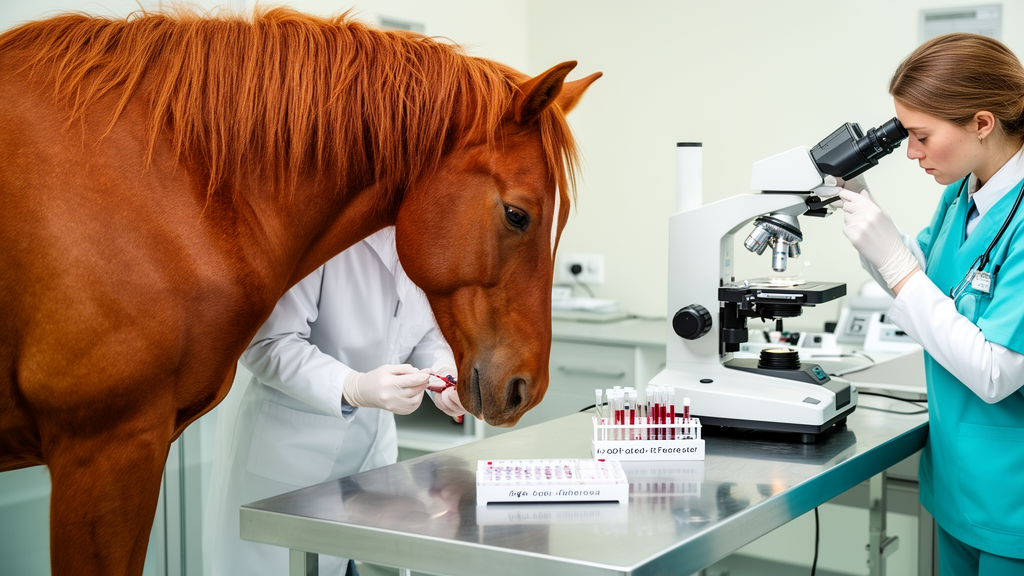
An ex vivo blood-cell assay did not reliably distinguish horses with gastric ulcers from those without them in an experimental study led by Adelaide University researchers. Investigators collected blood from 77 horses, exposed immune cells from those samples to substances designed to trigger an immune response, and measured production of the inflammatory molecule interleukin-1 beta, or IL-1β. The approach was evaluated as a possible biomarker for Equine Gastric Ulcer Syndrome, or EGUS, with the broader veterinary challenge of identifying clinically important pain in horses in mind.
Because the assay was performed on cells outside the body, the experiment assessed whether a blood-based cellular response tracked ulcer-associated disease rather than directly measuring pain in living animals. Of the 64 horses included in the final analysis, 59, or 92.2%, had gastric lesions. Only 25% showed a measurable response in the blood-cell assay.
The investigators found no significant association between that response and the presence of EGUS, and the assay could not reliably differentiate horses with ulcers from those without them. They also detected no significant difference in facial pain scores between horses whose blood cells produced a measurable response and those whose cells did not. These findings indicate that this particular immune-response measurement was not a dependable indicator of ulcer status or a useful discriminator based on facial pain scores in the analyzed population.
The experiment used an ex vivo toll-like receptor agonist response assay. Blood immune cells were stimulated with substances intended to activate immune pathways, after which production of IL-1β was measured. The molecule was selected because it has been linked to pain and inflammation in other species.
The researchers suggested that the response in circulating blood cells may not have been sensitive enough to detect effects associated with gastric ulcers, particularly when inflammation or pain is localized to the stomach. The study was also limited by the high proportion of horses with gastric lesions in the final sample and by the fact that blood-cell responses are separated from the anatomical site of disease. The researchers did not present the results as evidence that gastric ulcers do not cause pain; rather, they showed that the immune response measured by this assay did not track the presence of EGUS reliably.
EGUS is difficult to assess because horses cannot directly report where they are hurting, while outward signs of discomfort may be subtle, inconsistent or easily overlooked. The presence of a gastric lesion also does not necessarily reveal how much pain or discomfort an individual horse is experiencing. The condition is highly prevalent, particularly in the Thoroughbred racing industry, with previous studies reporting gastric disease in 80–100% of racehorses for one major form of the disease.
Dr Gustavo Ferlini Agne said the negative result shows that this particular blood test is not yet the solution to identifying pain associated with gastric disease and provides information about where further investigation is needed. Ferlini Agne said larger studies and testing approaches better suited to horses will be required. The researchers also identified careful assessment of pain-related behavior and inflammation as components of future work intended to give veterinarians stronger evidence for recognizing and managing conditions suspected of causing pain.
Those proposed directions follow directly from the study’s central limitation: stimulation of circulating immune cells did not produce a response that corresponded significantly with ulcer status, and facial pain scores did not differ significantly according to whether the cellular response was measurable. The peer-reviewed study, “Evaluating ex vivo toll-like receptor agonist response as a potential biomarker in equine gastric ulcer syndrome,” was published in The Veterinary Journal on 26 August 2026. Its result is specific to the tested ex vivo immune-cell response, offering a negative experimental finding rather than proof that objective assessment of pain in horses is impossible.
Subject of Research: Experimental evaluation of an ex vivo immune-cell assay for detecting gastric ulcer-associated changes in horses
Article Title: Blood test falls short in quest to detect gastric ulcer pain in horses
Article References: Blood test falls short in quest to detect gastric ulcer pain in horses. Original publication (Bibliographic details unavailable.)
Image Credits: AI Generated
DOI: Not provided
Keywords: equine gastric ulcer syndrome, horses, blood-cell assay, pain assessment, gastric lesions, immune response, interleukin-1 beta, veterinary diagnostics, horse welfare, experimental study, Blood, test
News Source: William Thompson. (October 26, 2026). Blood-cell assay fails to distinguish gastric ulcers in experimental horse study. Scienmag.