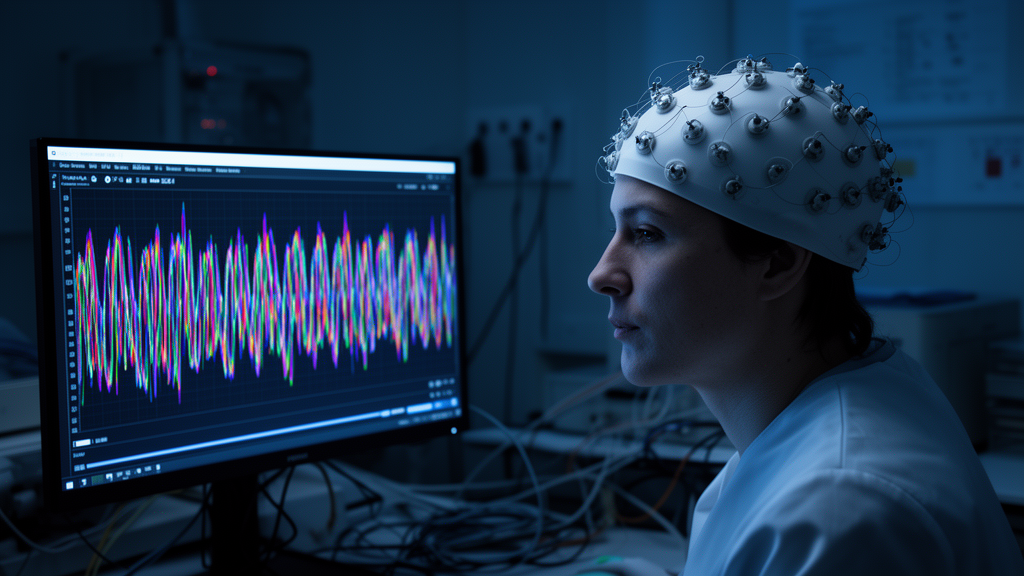
Researchers have unveiled a fully blind data-hiding framework that embeds hidden payloads into electroencephalography (EEG) recordings without ever needing the original signal on the receiving end. The study, published in Discover Networks, combines a temporal discrete cosine transform, Reed–Solomon error-correction coding, dithered scalar quantization index modulation (QIM), fixed carrier-reliability profiling, and a bounded synchronization search into a single reliability-adaptive pipeline. For multichannel EEG, the system adds a graph-signal-processing layer built exclusively from training data, directing embedding toward graph-smooth components of the inter-channel network.
The central engineering challenge is blindness. Many watermarking schemes quietly depend on side information—decomposition factors, carrier-location maps, or learned models—whose transmission cost goes unreported. The new framework specifies exactly what the receiver knows: a method version, fixed graph and carrier-profile assets, a secret key, and serialized public metadata containing protocol identifiers, a nonce, and one normalization scale per channel. It never requires the original EEG record or any payload-dependent matrix. Payload-dependent side information is zero, while the measured per-record metadata cost is 52 bytes for single-channel data and 136 bytes for 22-channel recordings.
The payload itself is framed with a 16-bit synchronization word, a length field, and a CRC32 checksum, then protected by Reed–Solomon coding with 27 parity bytes. At the maximum payload of 45 bytes, the frame expands to 640 coded bits, which are embedded in the 640 highest-ranked coefficients from a candidate budget of 645. Carrier ranking is learned only from build records, using a robust ratio of median amplitude to median absolute deviation, and a keyed pseudorandom permutation assigns symbols to positions and generates dithers. A frame is accepted only when synchronization, length, Reed–Solomon, and CRC checks all pass, and a unique valid candidate is required.
Two datasets with complementary roles anchored the evaluation. The Bonn database supplied 400 single-channel evaluation records as a reference implementation of the framing, coding, reliability, QIM, and synchronization machinery. The Graz A motor-imagery database extended the architecture to 22-channel EEG across nine subjects, using a build-only Pearson correlation graph with its Laplacian eigenbasis to project channels into a graph-smooth domain before temporal DCT embedding. Crucially, graph construction, carrier calibration, architecture selection, and PSNR matching all used only training-session data; the 90 evaluation-session records were held out entirely, although the subjects themselves were not new.
The clean-signal results were striking. At the 45-byte fixed-profile maximum, exact payload recovery reached 100 percent across all 400 Bonn records and all 90 Graz evaluation records. Mean normalized PSNR was 43.7510 ± 1.8222 dB for Bonn and 55.5594 ± 2.5057 dB for Graz Graph, with mean SSIM of 0.996508 and 0.999205 respectively. As payload grew from 8 to 45 bytes, Bonn PSNR declined from 46.4576 to 43.7510 dB while recovery stayed perfect—an expected capacity–fidelity trade-off rather than a free lunch.
The multichannel comparison, however, delivered mixed verdicts. Against an all-channel PSNR-matched Direct control, the Graph configuration achieved slightly lower exact recovery under seven prespecified attacks (80.159 percent versus 83.016 percent) and a higher pre-ECC bit error rate (5.6406 percent versus 3.9497 percent). Yet Graph met the predefined subject-paired non-inferiority criterion: the mean Graph-minus-Direct difference was −2.8571 percentage points, and the one-sided 95 percent bootstrap lower bound of −7.3016 points stayed above the −10-point margin fixed before evaluation. The authors are explicit that this supports non-inferiority, not equality, equivalence, or superiority.
Topology findings were similarly nuanced. The three primary sensor-space measures showed no clear Graph advantage after Holm adjustment. Graph did produce lower values on specific alternate-graph and method-aligned distortion measures, including topology-weighted distortion and high graph-frequency fraction, but the researchers caution these effects are metric-specific and partly expected by construction, since embedding in graph-smooth components naturally reduces high-frequency content measured in that basis. No composite topology-preservation score was created, precisely because different metrics favor different methods.
Recovery proved strongly condition-dependent. Both configurations preserved 100 percent exact recovery under 40 Hz low-pass filtering, 4/5 resampling, 12-bit quantization, notch filtering, and tested circular shifts of 10 and 50 samples, with the bounded auto-synchronization search compensating for temporal shifts across 129 candidate alignments. But additive noise was devastating: AWGN at 30 dB drove exact recovery to zero percent despite attacked-host PSNR remaining high, showing that waveform fidelity and payload decodability are distinct dimensions. Cropping, random block loss, salt-and-pepper corruption, channel loss, and channel permutation also defeated the fixed-layout decoder, which assumes a predefined channel set and ordering.
Security controls behaved conservatively. Wrong-key, unstego-host, unrelated-host, and overwrite tests each produced zero percent false-valid frames in both configurations, though the authors stress this is finite empirical behavior, not a cryptographic guarantee—CRC32 detects accidental mismatch but resists no deliberate forgery. Classifier-based steganalysis using handcrafted features with logistic regression and random forest models yielded AUCs near 0.5; Graz estimates were consistent with chance-level discrimination, while Bonn did not meet the prespecified chance-level criterion because confidence intervals exceeded the stated decision rule. These conclusions are limited to the tested features, classifiers, and protocols.
Runtime revealed a real cost for the graph layer. Graz Graph embedding took 14.2658 ms versus 6.0540 ms for the matched Direct control, roughly 2.36 times slower, and auto-sync extraction reached 1374.9629 ms versus 533.7129 ms, about 2.58 times slower, since both methods evaluate 129 candidate alignments. The study’s contribution is ultimately a fully specified, reproducible blind deployment protocol and a controlled Graph–Direct comparison with honestly mixed findings—future work must tackle erasure robustness, changing channel layouts, unseen subjects, and adaptive steganalysis before such systems leave the laboratory.
Subject of Research: Blind data hiding in EEG signals using quantization index modulation and graph-based embedding
Article Title: Network aware blind EEG data hiding using quantization index modulation
Article References: Efe, E. (2026). Network aware blind EEG data hiding using quantization index modulation. Discover Networks, 2(1), Article 38. https://doi.org/10.1007/s44354-026-00054-x
Image Credits: AI Generated
DOI: 10.1007/s44354-026-00054-x
Keywords: EEG, data hiding, steganography, quantization index modulation, Reed–Solomon coding, graph signal processing, blind extraction, watermarking, signal fidelity, non-inferiority, synchronization, biomedical signal processing
News Source: Cassandra Pierce. (October 28, 2026). Blind EEG Steganography Framework Hides Data in Brain Signals Without the Original Recording. Scienmag.