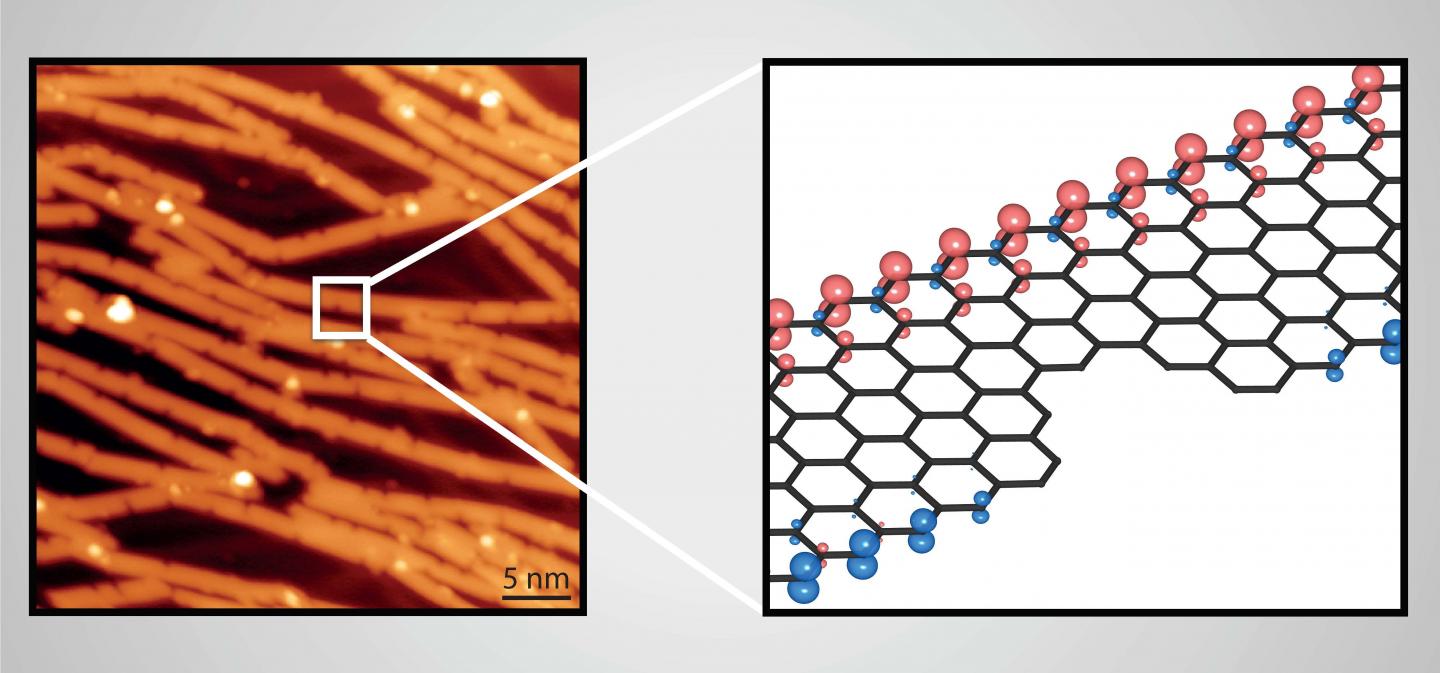
Credit: @Michele Pizzochero
Graphene nanoribbons (GNRs), narrow strips of single-layer graphene, have interesting physical, electrical, thermal, and optical properties because of the interplay between their crystal and electronic structures. These novel characteristics have pushed them to the forefront in the search for ways to advance next-generation nanotechnologies.
While bottom-up fabrication techniques now allow the synthesis of a broad range of graphene nanoribbons that feature well-defined edge geometries, widths, and heteroatom incorporations, the question of whether or not structural disorder is present in these atomically precise GNRs, and to what extent, is still subject to debate. The answer to this riddle is of critical importance to any potential applications or resulting devices.
Collaboration between Oleg Yazyev’s Chair of Computational Condensed Matter Physics theory group at EPFL and Roman Fasel’s experimental nanotech@surfaces Laboratory at Empa has produced two papers that look at this issue in armchair-edged and zigzag-edged graphene nano ribbons.
“Imperfections are known to play an important role in shaping a number of functionalities in crystals,” said Michele Pizzochero, formerly a PhD student in the lab of Oleg Yazyev at EPFL and now a post-doctoral researcher at Harvard University. “In these papers, we have revealed ubiquitous “bite” defects, namely missing groups of carbon atoms, as the main type of structural disorder in graphene nanoribbons fabricated via on-surface synthesis. Although we found that “bite” defects degrade the performance of electronic devices based on graphene nanoribbons, in some cases these imperfections may offer exciting opportunities for spintronic applications thanks to their peculiar magnetic properties.”
Armchair graphene nanoribbons
The paper “Quantum electronic transport across “bite” defects in graphene nanoribbons,” recently published in 2D Materials, specifically looks at 9-atom wide armchair graphene nanoribbons (9-AGNRs). The mechanical robustness, long-term stability under ambient conditions, easy transferability onto target substrates, scalability of fabrication, and suitable band-gap width of these GNRs has made them one of the most promising candidates for integration as active channels in field-effect transistors (FETs). Indeed, among the graphene-based electronic devices realized so far, 9-AGNR-FETs display the highest performance.
While the detrimental role of defects on electronic devices is well known, Schottky barriers, potential energy barriers for electrons formed at metal-semiconductor junctions, both limit the performance of current GNR-FETs and prevent experimental characterization of the impact of defects on device performance. In the 2D Materials paper, the researchers combine experimental and theoretical approaches to investigate defects in bottom-up AGNRs.
Scanning-tunnelling and atomic-force microscopies first allowed the researchers to identify missing benzene rings at the edges as a very common defect in 9-AGNR and to estimate both the density and spatial distribution of these imperfections, which they have dubbed “bite” defects. They quantified the density and found that they have a strong tendency to aggregate. The researchers then used first-principles calculations to explore the effect of such defects on quantum charge transport, finding that these imperfections significantly disrupt it at the band edges by reducing conductance.
These theoretical findings are then generalized to wider nanoribbons in a systematic manner, allowing the researchers to establish practical guidelines for minimizing the detrimental role of these defects on charge transport, an instrumental step towards the realization of novel carbon-based electronic devices.
Zigzag graphene nanoribbons
In the paper “Edge disorder in bottom-up zigzag graphene nanoribbons: implications for magnetism and quantum electronic transport,” recently published in The Journal of Physical Chemistry Letters, the same team of researchers combines scanning probe microscopy experiments and first-principles calculations to examine structural disorder and its effect on magnetism and electronic transport in so-called bottom-up zigzag GNRs (ZGNRs).
ZGNRs are unique because of their unconventional metal-free magnetic order that, according to predictions, is preserved up to room temperature. They possess magnetic moments that are coupled ferromagnetically along the edge and antiferromagnetically across it and it has been shown that the electronic and magnetic structures can be modulated to a large extent by, for example, charge doping, electric fields, lattice deformations, or defect engineering. The combination of tunable magnetic correlations, sizable band gap width and weak spin?orbit interactions has made these GNRs promising candidates for spin logic operations. The study specifically looks at six-carbon zigzag lines wide graphene nanoribbons (6-ZGNRs), the only width of ZGNRs that has been achieved with a bottom-up approach so far.
Again using scanning-tunnelling and atomic-force microscopies, the researchers first identify the presence of ubiquitous carbon vacancy defects located at the edges of the nanoribbons and then resolve their atomic structure. Their results indicate that each vacancy comprises a missing m-xylene unit, that is, another “bite” defect, which, as with those seen in AGNRs, comes from the scission of the C?C bond that occurs during the cyclodehydrogenation process of the reaction. Researchers estimate the density of “bite” defects in the 6-ZGNRs to be larger than that of the equivalent defects in bottom-up AGNRs.
The effect of these bite defects on the electronic structure and quantum transport properties of 6-ZGNRs is again examined theoretically. They find that the introduction of the defect, similarly to AGNRs, causes a significant disruption of the conductance. Furthermore, in this nanostructure, these unintentional defects induce sublattice and spin imbalance, causing a local magnetic moment. This, in turn, gives rise to spin-polarized charge transport that makes defective zigzag nanoribbons optimally suited for applications in all-carbon logic spintronics in the ultimate limit of scalability.
A comparison between ZGNRs and AGNRs of equal width shows that transport across the former is less sensitive to the introduction of both single and multiple defects than in the latter. Overall, the research provides global picture of the impact of these ubiquitous “bite” defects on the low-energy electronic structure of bottom-up graphene nanoribbons. Future research might focus on the investigation of other types of point defects experimentally observed at the edges of such nanoribbons, the researchers said.
###
Media Contact
Carey Sargent
[email protected]
Original Source
https:/
Related Journal Article
http://dx.