• HOME
  • NEWS
  • EXPLORE
    • CAREER
      • Companies
      • Jobs
    • EVENTS
    • iGEM
      • News
      • Team
    • PHOTOS
    • VIDEO
    • WIKI
  • BLOG
  • COMMUNITY
    • FACEBOOK
    • INSTAGRAM
    • TWITTER
Monday, August 17, 2026
BIOENGINEER.ORG
No Result
View All Result
  • Login
  • HOME
  • NEWS
  • EXPLORE
    • CAREER
      • Companies
      • Jobs
        • Lecturer
        • PhD Studentship
        • Postdoc
        • Research Assistant
    • EVENTS
    • iGEM
      • News
      • Team
    • PHOTOS
    • VIDEO
    • WIKI
  • BLOG
  • COMMUNITY
    • FACEBOOK
    • INSTAGRAM
    • TWITTER
  • HOME
  • NEWS
  • EXPLORE
    • CAREER
      • Companies
      • Jobs
        • Lecturer
        • PhD Studentship
        • Postdoc
        • Research Assistant
    • EVENTS
    • iGEM
      • News
      • Team
    • PHOTOS
    • VIDEO
    • WIKI
  • BLOG
  • COMMUNITY
    • FACEBOOK
    • INSTAGRAM
    • TWITTER
No Result
View All Result
Bioengineer.org
No Result
View All Result
Home NEWS Science News Biology

Birds dealing with change — Mapping migration routes can lead to conservation areas

Bioengineer by Bioengineer
May 19, 2021
in Biology
Reading Time: 2 mins read
0
IMAGE
Share on FacebookShare on TwitterShare on LinkedinShare on RedditShare on Telegram

IMAGE

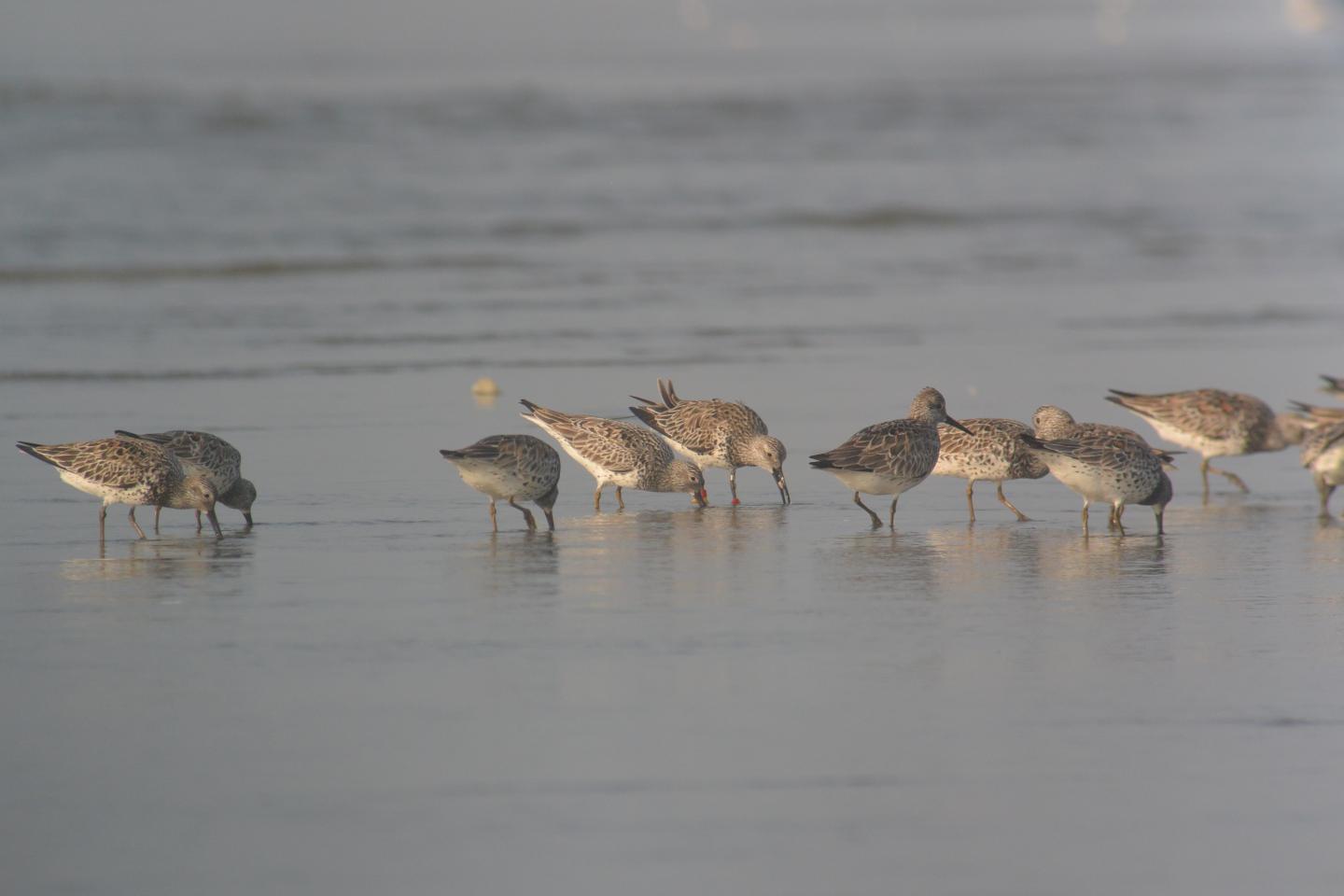
Credit: Photo: Ginny Chan

Tracking migratory birds that carry tiny satellite transmitters in featherlight ‘backpacks’, can teach us a lot about change in the environment. It may also point at possibilities to avoid loss of biodiversity. That is an important message in the PhD-thesis that Ying Chi Chan, a PhD candidate of the University of Groningen, based at the Royal NIOZ (Netherlands Institute for Sea Research), defends on May 28th 2021. “Bar-tailed godwits with transmitters on their backs, directed us to an important area along the coast of the Yellow Sea at Dafeng-Dongtai-Rudong, where many birds roost and feed. Showing the importance of this area for migratory birds led to a halt of intended land-claim in the tidal zone of the Yellow Sea”, Chan says.

Explorative birds are more successful

Chan and colleagues followed red knots, great knots and bar-tailed godwits with satellite transmitters for three years. Moreover, after catching the birds and before fitting them with the transmitters, the team performed simple ‘personality tests’ on the great knots. That way, they were able to see whether an individual bird was of the ‘explorative’ type or of the more ‘conservative’ type. Chan: “We saw that these different personalities led to very different strategies for coping with change in their environment. When the availability of shells for these birds changed, the more explorative individuals were able to deal with this better than the conservative birds. The explorative individuals left areas with poor prey quality sooner, to look for better places to feed. They also arrived earlier in their breeding areas in the Eastern Russian Arctic and thus had better odds for successfully raising chicks. This was supported by the fact that they stayed longer in the breeding area. When knots lose their eggs or chicks, they usually leave the breeding area shortly after.”

Recognition as UN World Heritage site

With their research, Chan and colleagues were the first to map the exact migration routes of great and red knots along the East Asian-Australasian Flyway. Previously, it was assumed that knots use only one or two stops on their way from the wintering grounds to the breeding area in the Arctic. Chan, however, discovered that the knots use multiple stopover sites in between. “Mapping the migration routes and the important feeding sites is crucial for understanding the ecology of these birds”, Chan says. “It is also essential to support evidence-based conservation. For example, showing how bar-tailed godwits used a particular area in the Yellow Sea to fuel up, has led to its recognition as World Heritage site by the UN.”

Having completed her work on waders, Chan will start working as a post-doc in Switzerland, doing research on the dispersal of red kites and little owls at the Swiss Ornithological institute in Sempach.

###

Media Contact
Henriette De Waal
[email protected]

Original Source

https://www.nioz.nl/en/news/birds-dealing-with-change-mapping-migration-routes-can-lead-to-conservation-areas

Tags: BiodiversityBiologyClimate ChangeEcology/Environment
Share12Tweet8Share2ShareShareShare2

Related Posts

Multi-database study identifies cervical cancer targets tailored to tumor subtypes

Multi-database study identifies cervical cancer targets tailored to tumor subtypes

August 17, 2026
High-resolution sequencing reveals genes shaping embryonic leaf development in maize

High-resolution sequencing reveals genes shaping embryonic leaf development in maize

August 17, 2026

Bar-Ilan Study Finds Attention Can Regulate Acute Inflammation in Humans

August 17, 2026

TikTok Video Helps Scientists Discover Rare Underground Eel in India

August 17, 2026
Please login to join discussion

POPULAR NEWS

  • Protein-Foldamer Building Blocks Enable Self-Assembling Hybrid Architectures

    29 shares
    Share 12 Tweet 7
  • EU Cement Decarbonization Faces Technological and Policy Uncertainty

    29 shares
    Share 12 Tweet 7
  • New Jersey Neonatal Collaborative Reveals Growth Disparities Across Intensive Care Units

    29 shares
    Share 12 Tweet 7
  • Global Cancer Genomics Enabled by Centralized Processing of Frozen Tumor Tissues

    29 shares
    Share 12 Tweet 7

About

We bring you the latest biotechnology news from best research centers and universities around the world. Check our website.

Follow us

Recent News

Protein-Foldamer Building Blocks Enable Self-Assembling Hybrid Architectures

EU Cement Decarbonization Faces Technological and Policy Uncertainty

New Jersey Neonatal Collaborative Reveals Growth Disparities Across Intensive Care Units

Subscribe to Blog via Email

Enter your email address to subscribe to this blog and receive notifications of new posts by email.

Join 85 other subscribers
  • Contact Us

Bioengineer.org © Copyright 2023 All Rights Reserved.

Welcome Back!

Login to your account below

Forgotten Password?

Retrieve your password

Please enter your username or email address to reset your password.

Log In
No Result
View All Result
  • Homepages
    • Home Page 1
    • Home Page 2
  • News
  • National
  • Business
  • Health
  • Lifestyle
  • Science

Bioengineer.org © Copyright 2023 All Rights Reserved.