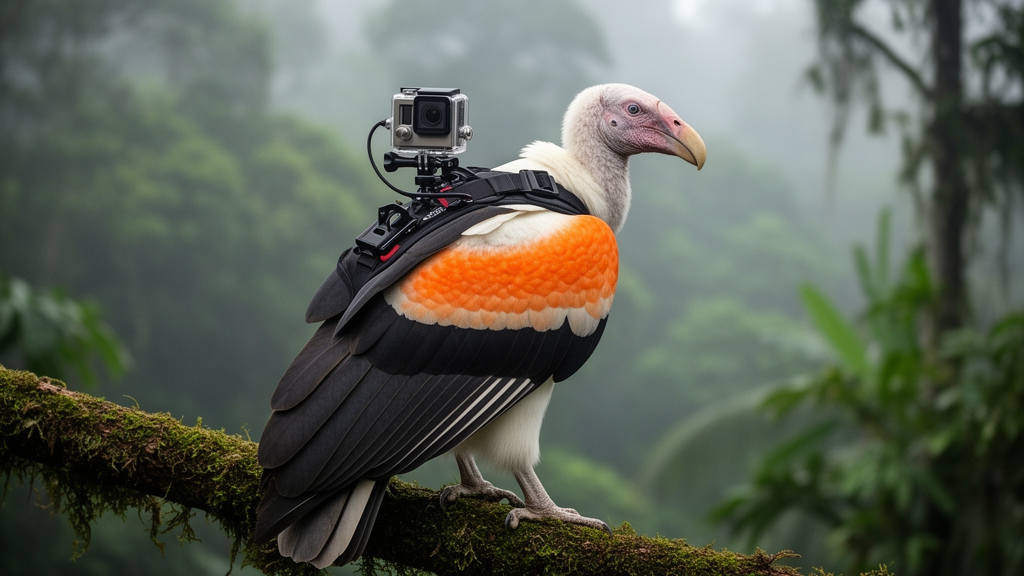
Researchers have tested a custom-built GPS-accelerometer device fitted with a small camera and a harness drop-off system on two adult King Vultures (Sarcoramphus papa), using the video footage to check how well behavioral classifications derived from accelerometer data actually match what the birds were doing. The study, published as a case report in Animal Biotelemetry, addresses a long-standing problem in animal-borne sensing: behavioral modes inferred from triaxial acceleration are rarely verified against direct observations, especially for elusive species that cannot be watched continuously in the field.
Animal-borne cameras integrated with multi-sensor devices offer a powerful tool for hypothesis-driven research, the authors note, because video recordings enable ground-truth validation of behavioral modes inferred from accelerometer data. The practical obstacle is that retrieving video is difficult: battery capacity is limited, and remote download stations are often unavailable at field sites. The prototype combined a GPS unit, an accelerometer, a customized camera, and a drop-off mechanism designed to release the harness after deployment.
The deployments on the two vultures succeeded, producing a total of 764 video files and 2 hours 16 minutes of footage that could be used for validation. From the video, the team established behavioral reference annotations, aligned them in time with the accelerometer records, and compared them against the output of a Self-Organizing Map algorithm used to classify behavior. Performance was evaluated with precision, recall, and F1-score metrics.
Five to six behavioral modes were identified per individual and matched with the accelerometer data. Resting dominated the time budget, accounting for 59.2 to 69.9 percent of recorded time, followed by flight modes such as soaring-gliding at roughly 19 percent and flapping at about 3 percent. Preening occupied 7.6 to 17.3 percent of activity, while feeding was infrequent, at 1.36 percent, and was observed in only one of the two birds.
Classification performance varied considerably across behaviors and individuals. Resting was classified reliably, with F1-scores between 0.72 and 0.89, and soaring-gliding performed even better in one case, ranging from 0.73 to 0.94. Flapping flight achieved moderate scores of 0.68 to 0.76. Preening proved harder to distinguish, with F1-scores of only 0.37 to 0.38, and feeding was poorly classified at 0.26, a result the authors attribute to higher behavioral variability and class imbalance in the reference data.
The authors conclude that animal-borne video provides behavioral reference data for evaluating accelerometer-based classification models, and that their prototype demonstrates utility for recording behavior in elusive species where direct validation of acceleration data is otherwise difficult.
The team is explicit that the prototype is not yet a finished tool. They identify several aspects requiring improvement in future designs, including the weight and shape of the device and the synchronization between sensors.
Once these limitations are overcome, the authors write, integrated GPS-accelerometer-camera systems combined with reliable drop-off mechanisms could provide a valuable tool for behavioral validation, with applications for both ecological research and conservation. The present study remains a two-individual case report with limited footage, so its performance estimates should be read as a prototype evaluation rather than a general benchmark for the species.
Subject of Research: Ground-truth validation of accelerometer-based behavioral classification in King Vultures using an integrated GPS-accelerometer-camera device.
Article Title: Ground-truth validation of behavioral classifications from accelerometer data using an integrated GPS-accelerometer-camera device: application to an elusive scavenger
Article References: Basso, E., Beirne, C., Petri, T., Goldhahn, C., Luthy, K., Crowe, W., Zinke, M., Wicks, S., Tubelli, E., Chulla, D. R., Berger, M., & Whitworth, A. (2026). Ground-truth validation of behavioral classifications from accelerometer data using an integrated GPS-accelerometer-camera device: application to an elusive scavenger. Animal Biotelemetry. https://doi.org/10.1186/s40317-026-00494-w
Image Credits: AI Generated
DOI: 10.1186/s40317-026-00494-w
Keywords: King Vulture, accelerometer, animal-borne camera, behavior classification, Self-Organizing Map, biotelemetry, ground-truth validation, GPS tracking, F1-score, Neotropical scavenger, harness drop-off, wildlife tracking
News Source: Drew Townsend. (October 29, 2026). Bird-borne cameras validate accelerometer behavior classifications in King Vultures. Scienmag.