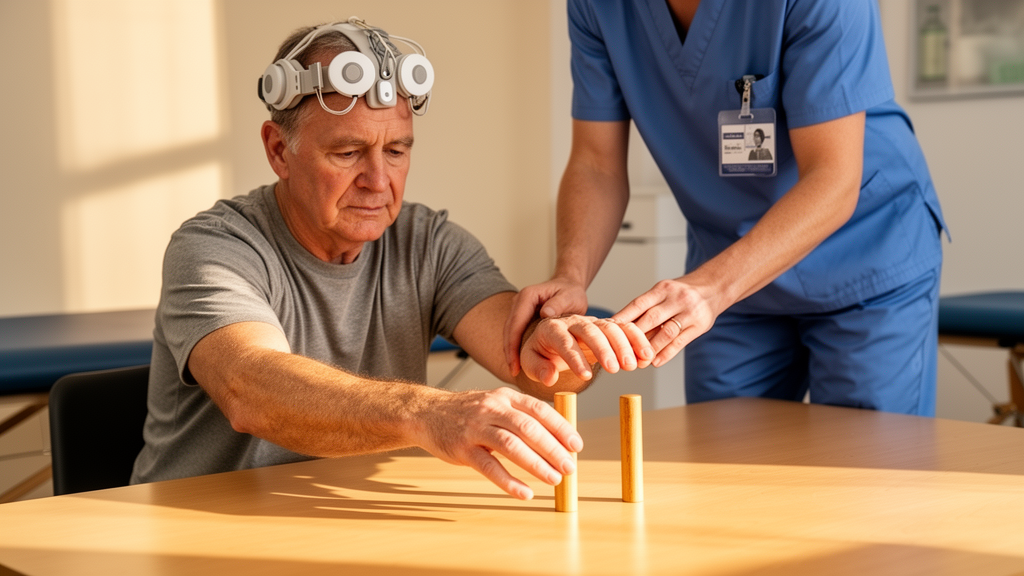
Bipolar transcranial direct current stimulation combined with conventional rehabilitation therapy significantly improves upper limb motor function and brain electrical activity in subacute stroke patients, according to a randomized controlled trial. Researchers evaluated the noninvasive technique to determine whether targeted electrical stimulation could accelerate motor recovery and help re-establish brain network equilibrium during the subacute phase of recovery following an ischemic stroke.
Upper limb motor dysfunction is a common consequence of stroke that substantially impairs a patient’s capacity to perform activities of daily living. The physiological rationale behind bipolar transcranial direct current stimulation, or bi-tDCS, centers on restoring interhemispheric balance across the motor cortex. By increasing cortical excitability in the ipsilesional hemisphere and decreasing excitability in the contralesional hemisphere, the intervention is designed to correct pathological interhemispheric imbalances and improve upper limb motor function.
The clinical trial recruited 44 participants diagnosed with subacute ischemic stroke affecting the basal ganglia. To test the intervention under controlled conditions, investigators randomly assigned the participants into two equal cohorts of 22 individuals each: an active bipolar stimulation group and a sham stimulation control group. Both cohorts completed a 30-day intervention regimen administered alongside conventional rehabilitation therapy, and the study was formally registered under the identifier ChiCTR2300077242.
To capture physical performance and underlying neurophysiological changes, the research team administered a battery of clinical and electrophysiological outcome measures. Functional assessments included the Fugl-Meyer Upper Limb Scale, the Wolf Motor Function Test, and the Modified Barthel Index to evaluate activities of daily living. In parallel, quantitative electroencephalography monitored neural activity, recording global DAR, global pdBSI, and spectral power changes across alpha and beta bands in the ipsilesional M1 region.
Following the 30-day intervention, participants who received active bipolar stimulation exhibited significantly greater improvements than those in the sham stimulation group. These treatment advantages were observed across upper limb motor function, activities of daily living, and multiple electroencephalographic parameters. All of these primary outcome measures demonstrated statistically significant time-by-group interaction effects, with significance confirmed at P < 0.05.
To explore how electrophysiological alterations corresponded to clinical recovery, the researchers applied a multiple linear regression model analyzing changes in electroencephalography parameters alongside functional progress. The statistical model revealed that an increase in alpha wave power within the ipsilesional M1 region independently predicted improvements on the Fugl-Meyer Upper Limb Scale. This electrophysiological change accounted for 87.7 percent of the variance in motor score improvements, yielding an adjusted R-squared of 0.828 at p < 0.001.
The authors concluded that bipolar transcranial direct current stimulation combined with conventional rehabilitation therapy enhances upper limb motor function, improves brain electrical activity, and supports restored interhemispheric balance in subacute stroke patients. Furthermore, the role of bilateral stimulation in advancing motor recovery was specifically associated with elevated alpha wave power in the ipsilesional M1, providing electrophysiological evidence for the mechanisms supporting upper limb motor rehabilitation.
Subject of Research: Bipolar transcranial direct current stimulation for upper limb motor recovery in subacute stroke
Article Title: Effects of bipolar transcranial direct current stimulation on upper limb motor function and brain electrical activity in subacute stroke patients: a randomized controlled trial
Article References: Wang, Y., Li, W., Liu, J., Li, W., & Wu, J. (2026). Effects of bipolar transcranial direct current stimulation on upper limb motor function and brain electrical activity in subacute stroke patients: a randomized controlled trial. Journal of NeuroEngineering and Rehabilitation. https://doi.org/10.1186/s12984-026-02227-9
Image Credits: AI Generated
DOI: 10.1186/s12984-026-02227-9
Keywords: bipolar transcranial direct current stimulation, bi-tDCS, subacute ischemic stroke, upper limb motor dysfunction, Fugl-Meyer Upper Limb Scale, Wolf Motor Function Test, Modified Barthel Index, ipsilesional M1 region, interhemispheric balance, alpha power, beta power, global DAR, global pdBSI, basal ganglia stroke, conventional rehabilitation therapy, brain electrical activity, activities of daily living
News Source: Cassandra Pierce. (November 20, 2026). Bipolar Brain Stimulation Improves Upper Limb Recovery in Subacute Stroke Patients. Scienmag.