Credit: Nenad Miljkovic, Grainger Engineering
Ice formation and accumulation are challenging concerns for several industrial applications including heating ventilation air conditioning and refrigeration (HVAC&R) systems, aircraft, energy transmission, and transportation platforms. Frost formation on heat exchangers, for example, reduces heat transfer efficiency and results in significant economic losses. Moreover, defrosting and de-icing techniques are energy-intensive, requiring large masses of ice to be melted completely and surfaces to be cleaned of leftover water during cyclic operation, making frosting-defrosting a multi-billion-dollar problem in the U.S.
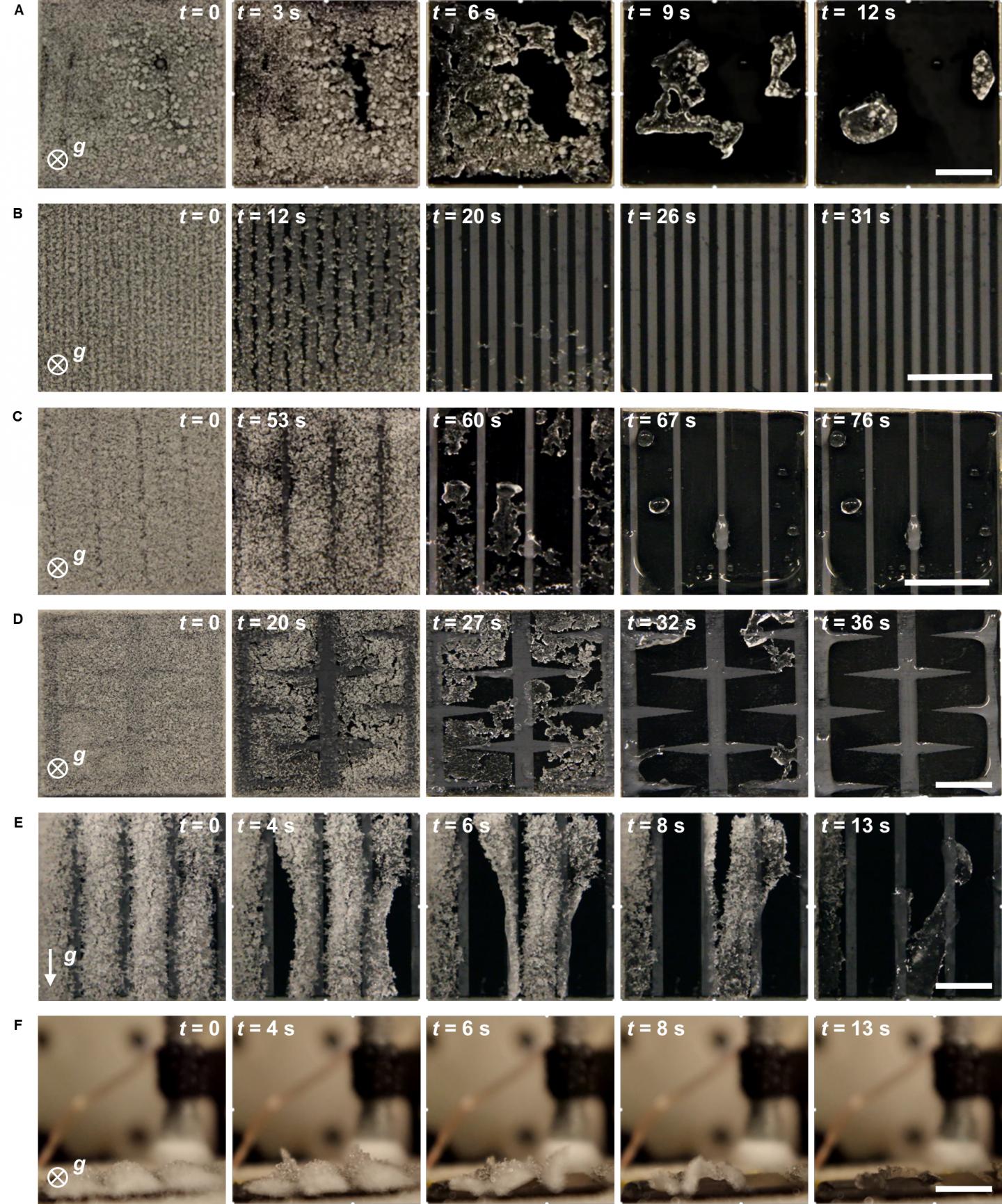
Nenad Miljkovic, along with researchers in his group, have discovered a way to significantly improve the defrosting of ice and frost on heat exchangers. Their findings, “Dynamic Defrosting on Superhydrophobic and Biphilic Surfaces,” have been published in Matter.
Defrosting of heat exchangers is a highly inefficient process. Common defrosting methods not only require significant energy to melt the frost but additional energy to evaporate melted water from the wettable surface. Researchers in the past have investigated the use of non-wettable surfaces (hydrophobic or superhydrophobic) to delay frosting and reduce ice adhesion, which does indeed improve defrosting performance. However, water retention remains prevalent on such heat exchangers during frost, defrost, and re-frost cycles.
In an effort to eliminate water retention, Miljkovic and a team led by graduate student Yashraj Gurumukhi and postdoctoral scholar Dr. Soumyadip Sett studied dynamic defrosting on heterogeneous surfaces with spatially distinct domains of wettability, known as biphilic surfaces. These biphilic surfaces have alternating superhydrophobic (water-repelling) and hydrophilic (water-loving) regions. Through optical imaging, the researchers showed that during defrosting, the frost layer on a superhydrophobic region melts into a highly mobile slush, which is pulled toward the hydrophilic regions by surface forces. This mobility enables removal of slush from the superhydrophobic regions prior to it completely melting, thereby cleaning the surface. Water is then restricted to hydrophilic areas, where it evaporates quickly due to the larger contact area.
Additionally, to optimize the design of their biphilic surfaces and understand the effects of pattern heterogeneity, the team studied banana-leaf-inspired branched biphilic patterns to determine if it would reduce cleaning time. They observed that binary biphilic designs were simpler to manufacture when compared to branched designs and offered better surface cleaning performance during defrosting.
“Defrosting cycles require systems to be shut down, frost completely melted, and surfaces cleaned before restarting the system, consuming significant time and energy. Enhancing cleaning efficiency by utilizing wettability-patterned biphilic surfaces can reduce system downtime and defrost energy input, thereby increasing overall efficiency,” Miljkovic said.
In effect, when combined with suitable large-scale manufacturing methods, biphilic surfaces have the potential to outperform homogenous surfaces in terms of heat transfer enhancements and energy requirements.
Their work not only provides fundamental design guidelines for fabricating biphilic surfaces, it illustrates the role of wettability gradients on defrosting dynamics. Future work from the researchers will further decrease defrost time by identifying critical bottlenecks in the process and provide design methodologies to create effective defrost-enhancing surfaces for industrial applications.
###
This project was funded by the Air Conditioning and Refrigeration Center (ACRC) in MechSE.
Media Contact
Julia Park
[email protected]
Original Source
https:/