


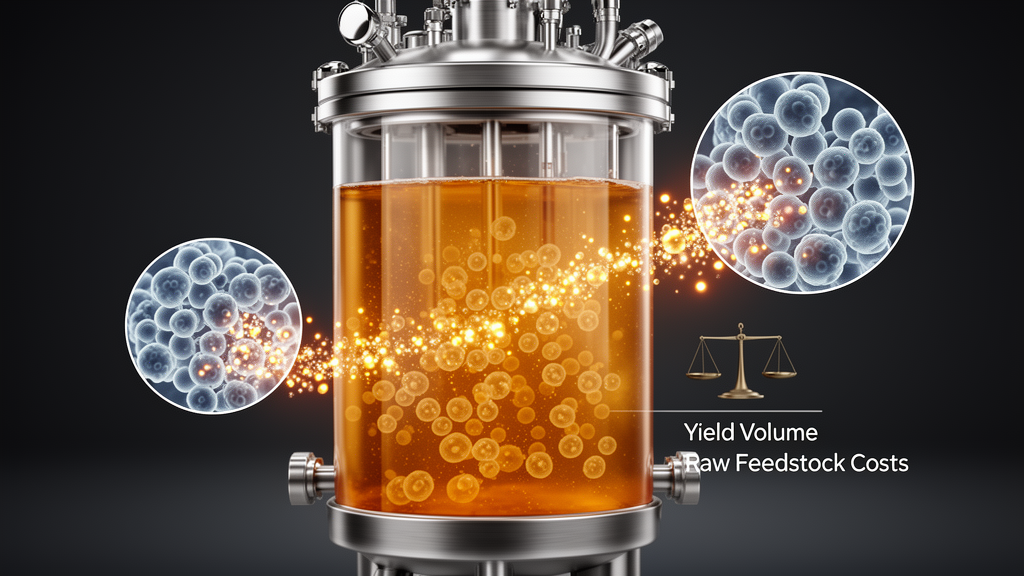
Turning fruit and vegetable waste into industrial enzymes sounds like circular economy perfection: cheap feedstock in, valuable lipase out. But a new techno-economic study of recombinant lipase production in the yeast Pichia pastoris finds that the price of the carbon source is almost irrelevant to whether such a process can ever make money. What matters, the analysis shows, is how much secreted enzyme each litre of broth delivers — and at current bench-scale levels, that figure falls catastrophically short of what commodity enzyme markets demand.
The study, published in Bioresources and Bioprocessing, evaluated the production of Candida rugosa lipase type 1 (CRL1) in P. pastoris under the constitutive pGAP promoter, a methanol-free expression system. Three carbon sources were compared: commercial glucose as a reference (Scenario A), mechanically pressed fruit and vegetable juice (Scenario B), and an enzymatically hydrolysed, nanofiltered fruit and vegetable sugar stream (Scenario C). The waste-derived feedstocks came from mixed market biowaste sourced through the Horizon Europe MixMatters project, with material pretreated by partners in Belgium and Spain.
Bench-scale fermentations were run at 0.75 litres working volume in batch mode and in continuous chemostat operation at a dilution rate of 0.05 per hour, which was confirmed as the only stable operating point for CRL1 production. These kinetics were then fed into 24 SuperPro Designer process models spanning four fermenter scales, from 1 to 5000 litres of vessel capacity, under both batch and continuous operation. The team interpreted the results through the titre-rate-yield (TRY) framework, which separates the three fermentation metrics that each shape a different slice of the cost structure.
The clearest technical win came from switching operating mode on glucose. Continuous chemostat culture raised volumetric CRL1 productivity 12.6-fold over batch, from 0.006 to 0.08 units per litre per hour, and lifted biomass from 4.57 to 25.75 grams dry cell weight per litre. That productivity gain is the primary engineering justification for continuous operation in the economic models. Strikingly, however, the same advantage did not appear on the hydrolysed waste stream: chemostat productivity there was actually lower than in batch (0.02 versus 0.07 units per litre per hour), a result the authors attribute to possible inhibitory compounds from the enzymatic pretreatment or to a dilution rate that is suboptimal for that substrate.
The headline economics are sobering. At the 5000-litre scale under continuous operation, unit production costs were $1186 per kilogram for glucose, $36,049 per kilogram for pressed juice, and $3416 per kilogram for the hydrolysed stream — exceeding the commodity lipase benchmark of $25 per kilogram by factors of 47, 1442 and 137 respectively. Break-even titres calculated from the modelled operating expenditures were 64, 3504 and 2557 grams per litre, while the highest steady-state titres actually measured under continuous operation were 1.20 grams per litre of total protein on glucose and 5.51 grams per litre on the hydrolysed stream. Even a reported ninefold improvement in CRL1 expression from multicopy cloning would leave the glucose scenario far below its threshold.
The cost structure explains why cheap waste does not help. In the glucose and pressed-juice scenarios, facility-dependent costs — capital depreciation, maintenance, insurance and plant overhead — dominated operating expenditure at 73 and 78 percent respectively. In the hydrolysed-stream scenario, raw materials accounted for 75 percent of operating costs, driven mainly by the cellulolytic enzyme reagents used in hydrolysis and by membrane consumables. The pressed-juice route, despite needing no hydrolysis or nanofiltration, carried the highest capital burden of all: because the fruit arrives unconcentrated, the model must size preprocessing equipment for roughly 85.5 million kilograms of fruit per year, driving total capital investment to $608.6 million compared with $122.0 million for the pre-concentrated stream.
Sensitivity analysis confirmed the pattern. A one-at-a-time analysis at 5000 litres showed that a 50 percent reduction in secreted titre doubles the unit production cost, while a 50 percent increase cuts it by a third; downstream recovery has an equivalent effect by the same mathematical mechanism. By contrast, varying electricity cost changed the unit cost by less than 2 percent in all scenarios, and labour and feedstock acquisition price together accounted for less than 13 percent of cost variation in any scenario. Zero feedstock cost under the European Union biowaste gate-fee model simply cannot offset preprocessing capital when the product titre is this low.
The downstream side of the process also revealed practical bottlenecks. When clarified broth from a 7-litre fruit-juice fermentation was concentrated by tangential-flow filtration with a 15-kilodalton ceramic membrane, the system achieved an 8.7-fold concentration factor against a theoretical target of 13, falling short because residual pectin from the raw juice fouled the membrane and clogged the pre-filter. The team responded by adding a disk-stack centrifugation stage upstream of the membranes in the process flowsheet, and suggests enzymatic depectinisation and more frequent membrane cleaning as further mitigations.
The authors are explicit about the limits of their dataset. Every fermentation was a single replicate, residual sugars and metabolites were not measured by HPLC, and scale-up assumed constant power input and superficial gas velocity without experimental verification above bench scale. The continuous pressed-juice model is a projection built on batch stoichiometry with no chemostat validation, so its cost figure cannot be compared reliably against the hydrolysed-stream result. The enzyme’s performance in real applications — detergent formulation, substrate hydrolysis, operational stability — was not tested. The economic outputs, the paper concludes, should be read as order-of-magnitude screening estimates rather than engineering-grade projections.
What the study does establish is a quantitative framework for early decisions in waste-to-enzyme bioprocess development. Feedstock acquisition cost is not the binding constraint; secreted protein titre and downstream recovery efficiency are. Before any pilot-scale investment in a biowaste-to-lipase biorefinery, the priority levers are biological — raising expression well beyond anything currently reported for this system — and process-engineering, such as decoupling feedstock preparation from the fermentation facility or cutting enzyme reagent costs in hydrolysis-based routes. Replicated cultivation data, direct residual-sugar measurements and pilot-scale validation will be needed before these models can support detailed industrial design, but as a screening tool they make one thing clear: the cheapest sugar in the world cannot rescue a process that makes too little enzyme per litre.
Subject of Research: Techno-economic analysis of recombinant lipase production from fruit and vegetable waste in Pichia pastoris fermentation
Article Title: What drives the cost of biowaste-to-lipase production? Linking titre, rate and yield to techno-economic performance in batch-to-continuous Pichia pastoris fermentation
Article References: G. Del Hierro, A., Raynal, V., Ordóñez, R., Verdú-Navarro, F., & Casey, E. (2026). What drives the cost of biowaste-to-lipase production? Linking titre, rate and yield to techno-economic performance in batch-to-continuous Pichia pastoris fermentation. Bioresources and Bioprocessing, 13(1), Article 160. https://doi.org/10.1186/s40643-026-01153-x
Image Credits: AI Generated
DOI: 10.1186/s40643-026-01153-x
Keywords: Pichia pastoris, lipase, biowaste, techno-economic analysis, fermentation, chemostat, titre, fruit and vegetable waste, SuperPro Designer, circular bioeconomy, enzyme production, break-even titre
News Source: Gregory Coleman. (October 29, 2026). Biowaste Lipase Costs Are Driven by Titre, Not Cheap Feedstock. Scienmag.



