• HOME
  • NEWS
  • EXPLORE
    • CAREER
      • Companies
      • Jobs
    • EVENTS
    • iGEM
      • News
      • Team
    • PHOTOS
    • VIDEO
    • WIKI
  • BLOG
  • COMMUNITY
    • FACEBOOK
    • INSTAGRAM
    • TWITTER
Monday, May 11, 2026
BIOENGINEER.ORG
No Result
View All Result
  • Login
  • HOME
  • NEWS
  • EXPLORE
    • CAREER
      • Companies
      • Jobs
        • Lecturer
        • PhD Studentship
        • Postdoc
        • Research Assistant
    • EVENTS
    • iGEM
      • News
      • Team
    • PHOTOS
    • VIDEO
    • WIKI
  • BLOG
  • COMMUNITY
    • FACEBOOK
    • INSTAGRAM
    • TWITTER
  • HOME
  • NEWS
  • EXPLORE
    • CAREER
      • Companies
      • Jobs
        • Lecturer
        • PhD Studentship
        • Postdoc
        • Research Assistant
    • EVENTS
    • iGEM
      • News
      • Team
    • PHOTOS
    • VIDEO
    • WIKI
  • BLOG
  • COMMUNITY
    • FACEBOOK
    • INSTAGRAM
    • TWITTER
No Result
View All Result
Bioengineer.org
No Result
View All Result
Home NEWS Science News Chemistry

Biosensors require robust antifouling protection

Bioengineer by Bioengineer
February 2, 2021
in Chemistry
Reading Time: 3 mins read
0
IMAGE
Share on FacebookShare on TwitterShare on LinkedinShare on RedditShare on Telegram

Despite advances in biosensor antifouling approaches, further development is needed
IMAGE

Credit: Yuliang Zhang and Aleksandr Noy (LLNL)

WASHINGTON, February 2, 2021 — Some promising biosensors and medical devices work well within pristine laboratory environments. However, they tend to stop working to deliver medical therapeutics or monitor chronic health issues once exposed to the real-world conditions of complex biological fluids.

A thick layer of foulants will quickly cover biosensors, and there is no good way to revive them once they quit working. Essentially, a biosensor is only as good as its antifouling properties.

In APL Materials, from AIP Publishing, Aleksandr Noy and Xi Chen, of Lawrence Livermore National Laboratory, review a variety of approaches developed to combat fouling. These approaches encompass physical barriers, chemical treatments, nonstick surfaces, and selective membranelike coatings that form “gates” to only allow certain species to reach a sensor’s working surface.

“There is a whole universe of very clever and quite effective approaches to protect biosensors from fouling,” said Noy. “Researchers have their pick of the technology they can tailor to the particular type of sensor they want to design.”

But despite all of this progress, Noy and Chen point out fouling remains a stubborn problem that can still wreck a good biosensor.

“Further development is needed to increase our arsenal of robust antifouling protection methods,” Noy said.

Fouling occurs in a four-stage process. First, surfaces immediately become coated with a small layer of molecules. Second, this layer gets covered with the main layer of foulant. Third, the fouled surface begins growing biofilms. Fourth, the biofilm progresses to macrofouling, which usually occurs within days or weeks.

The goal is to suppress the initial attachment of molecules, because it is incredibly difficult to remove biofilms once they form.

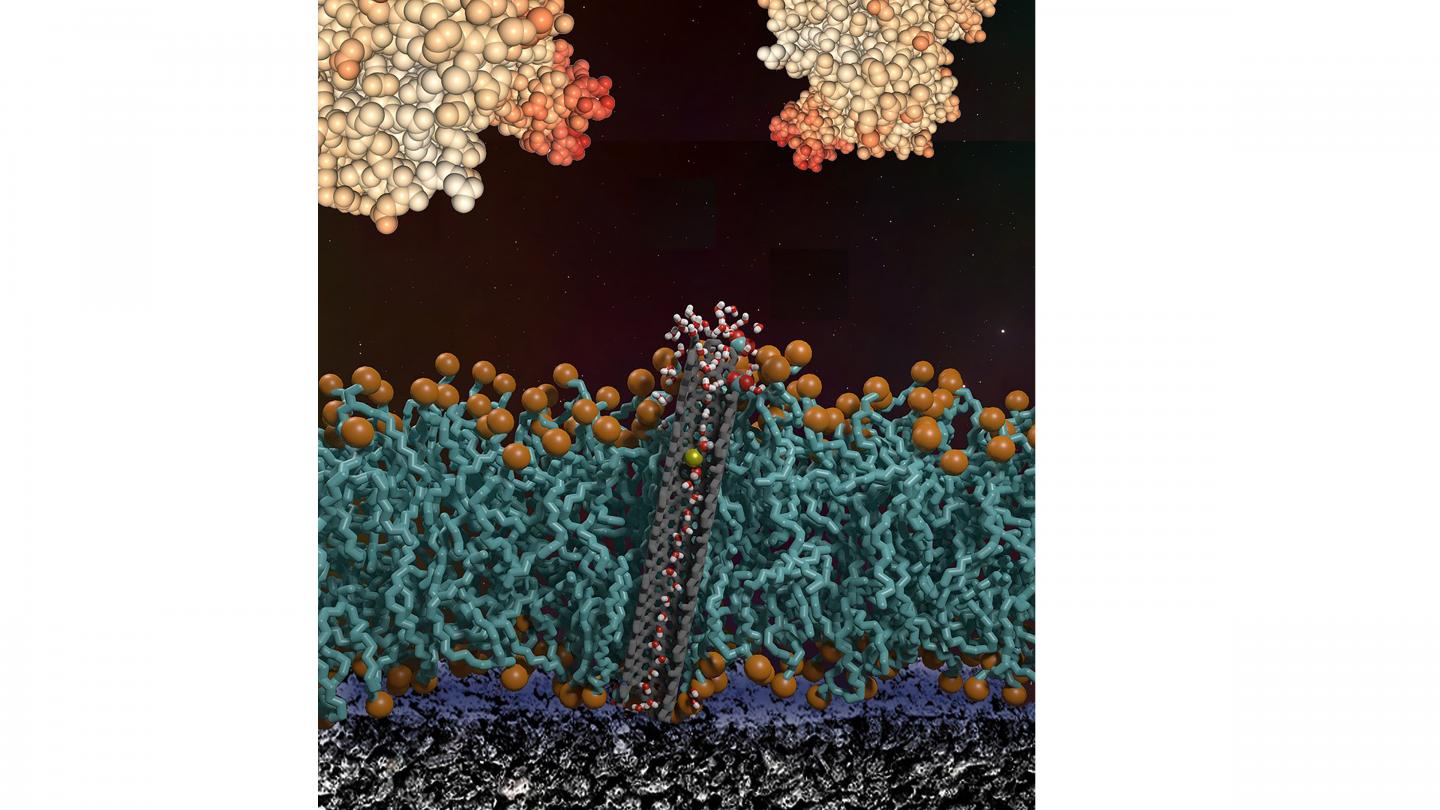
One example of antifouling protection, based on Noy’s own work, is a pH sensor with silicon nanowire transistors that are protected by a phospholipid membrane with carbon nanotube pores embedded within the membrane.

“Silicon nanowires are elegant, small, and efficient pH sensors that provide straightforward electrical signal that is modulated by solution pH,” he said. “Unfortunately, any time they come into contact with a real biological medium they foul up and cease to function.”

To get around this, his approach covers the sensors with a lipid membrane to provide a very robust protein fouling protective barrier.

“To allow protons to pass through this barrier, we embedded tiny carbon nanotube pores within the membrane,” Noy said. “These pores happen to be the most effective proton conductive channel known, so they provide an ideal conduit for shuttling protons across the protective barrier.”

Sensors protected this way “can withstand three-day exposure to protein solutions, milk, and even blood plasma and still measure pH quite well,” he said.

###

The article “Antifouling strategies for protecting biolectronic devices” is authored by Xi Chen and Aleksandr Noy. It will appear in APL Materials on Feb. 2, 2021 (DOI: 10.1063/5.0029994). After that date, it can be accessed at https://aip.scitation.org/doi/10.1063/5.0029994.

ABOUT THE JOURNAL

Physics of Fluids is devoted to the publication of original theoretical, computational, and experimental contributions to the dynamics of gases, liquids, and complex fluids. See https://aip.scitation.org/journal/phf.

Media Contact
Larry Frum
[email protected]

Related Journal Article

http://dx.doi.org/10.1063/5.0029994

Tags: BiologyBiomechanics/BiophysicsBiotechnologyChemistry/Physics/Materials SciencesTechnology/Engineering/Computer Science
Share12Tweet8Share2ShareShareShare2

Related Posts

Miniature Sensor Uses Light to Detect Touch — Chemistry

Miniature Sensor Uses Light to Detect Touch

May 8, 2026
Iron Minerals Determine Whether Dissolved Organic Matter Fuels Microbes or Becomes Long-Term Carbon Storage — Chemistry

Iron Minerals Determine Whether Dissolved Organic Matter Fuels Microbes or Becomes Long-Term Carbon Storage

May 8, 2026

Kate Evans Appointed Associate Lab Director for Biological and Environmental Systems Science at ORNL

May 8, 2026

Advancing Multiscale Modeling and Overcoming Operational Challenges in Autothermal COâ‚‚-to-Methanol Reactors

May 8, 2026
Please login to join discussion

POPULAR NEWS

  • Research Indicates Potential Connection Between Prenatal Medication Exposure and Elevated Autism Risk

    840 shares
    Share 336 Tweet 210
  • New Study Reveals Plants Can Detect the Sound of Rain

    727 shares
    Share 290 Tweet 181
  • Salmonella Haem Blocks Macrophages, Boosts Infection

    61 shares
    Share 24 Tweet 15
  • Breastmilk Balances E. coli and Beneficial Bacteria in Infant Gut Microbiomes

    57 shares
    Share 23 Tweet 14

About

We bring you the latest biotechnology news from best research centers and universities around the world. Check our website.

Follow us

Recent News

New Post-Hoc Analysis Explores Daily Oral Orforglipron Use in Adults Over 65 with Obesity, Regardless of Diabetes Status

Evaluating Digoxin Use in Patients with Symptomatic Rheumatic Heart Disease

Evaluating the Effectiveness and Safety of Digitalis Glycosides in Treating Heart Failure

Subscribe to Blog via Email

Enter your email address to subscribe to this blog and receive notifications of new posts by email.

Join 82 other subscribers
  • Contact Us

Bioengineer.org © Copyright 2023 All Rights Reserved.

Welcome Back!

Login to your account below

Forgotten Password?

Retrieve your password

Please enter your username or email address to reset your password.

Log In
No Result
View All Result
  • Homepages
    • Home Page 1
    • Home Page 2
  • News
  • National
  • Business
  • Health
  • Lifestyle
  • Science

Bioengineer.org © Copyright 2023 All Rights Reserved.