


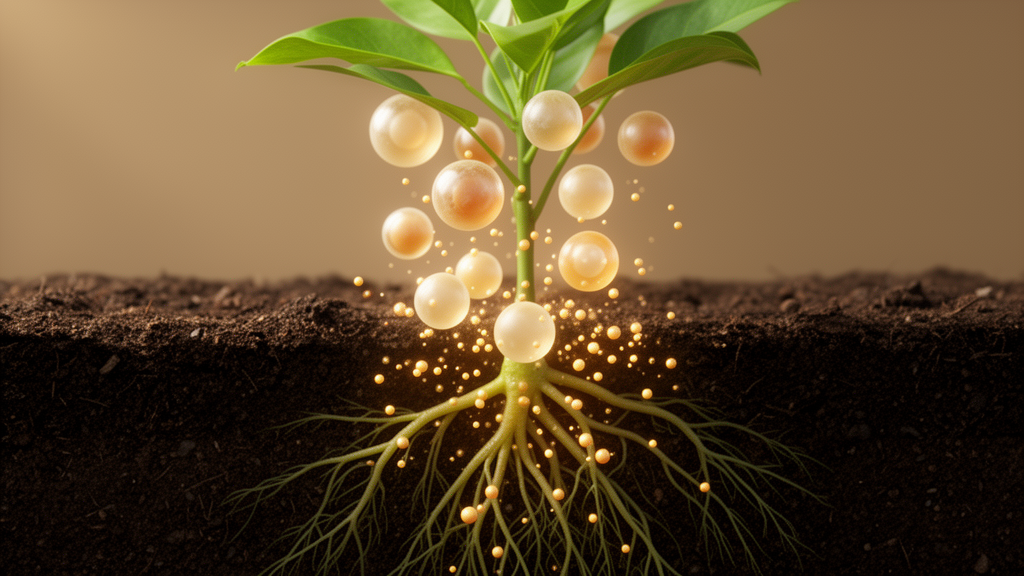
Agriculture faces a double bind: yields must keep rising while the environmental costs of conventional fertilizer use come under mounting scrutiny. A review published in Discover Plants argues that nanoscale biopolymer chemistry offers a credible route out of that bind, examining how five biodegradable polymers, chitosan, cellulose, alginate, lignin and starch, can be engineered into nano-enabled carriers that load, protect and release nutrients on demand. The paper, an open-access review rather than a single experimental study, pulls together recent advances in soil chemistry, plant nutrition, controlled-release systems and analytical monitoring, and it is candid that synthesis standardization, field validation, cost, scalability, environmental safety and regulation remain unresolved challenges.
The scale of the inefficiency problem is well documented in the review. Crop nitrogen-use efficiency has been reported at roughly 30 to 53 percent, meaning only about half of applied nitrogen is actually taken up by crops, and losses through leaching, runoff, volatilization and denitrification can reach as high as 70 percent. Those losses carry both an economic and an ecological price, contributing to soil acidification, groundwater contamination and ecological imbalance. One analysis cited in the review, covering 1521 field observations worldwide, found that a package of cost-effective nitrogen-management measures could cut nitrogen pollution from croplands by about a third while increasing yields, yielding a societal benefit estimated at around US$476 billion against much lower mitigation costs. It is against that backdrop that the authors position nano-biopolymer delivery systems as a tangible way forward.
The five biopolymers at the heart of the review each bring distinct chemistry. Chitosan, a cationic polysaccharide derived from chitin, carries amino and hydroxyl groups that enable nutrient chelation, film formation, antimicrobial activity and pH responsiveness; its positive surface charge attracts negatively charged nutrients and soil components, which the review says can minimize nutrient losses and enhance availability in the rhizosphere. Cellulose nanofibers offer high surface area, mechanical strength, hydrophilicity and abundant hydroxyl groups suited to binding nutrients, holding water and building porous fertilizer coatings. Alginate, an anionic polysaccharide mainly from brown algae, forms hydrogels with calcium ions and has been used to encapsulate fertilizers, beneficial microbes and plant-growth-promoting compounds in beads, capsules and nanogels. Lignin, with its phenolic, hydroxyl, methoxyl and carboxyl groups, provides chemical reactivity and structural stability suited to extended-release preparations, while starch completes the set as a widely available, readily modified polysaccharide.
Physicochemical characterization, the review stresses, is where agricultural nanotechnology lags behind pharmaceutical nanotechnology. Reported values place chitosan-based nanoparticles typically between about 50 and 300 nanometres, though NPK-loaded chitosan carriers as large as 300 to 750 nanometres, with zeta potentials near +50 millivolts and release extending beyond 240 hours, have been described. Alginate systems typically fall between 100 and 500 nanometres and are negatively charged owing to their carboxyl groups, making them suitable for calcium-crosslinked encapsulation of cationic nutrients such as calcium, zinc, iron and magnesium. Optimized nutrient carriers generally achieve encapsulation efficiencies of 50 to 70 percent, and polydispersity index values below 0.3 reflect acceptably uniform particle populations. The authors argue that agricultural studies would gain considerably in comparability if particle size, zeta potential, encapsulation efficiency and loading capacity were reported with the rigour long expected in drug delivery research.
Synthesis routes centre on three main approaches. Ionic gelation relies on the electrostatic interaction of oppositely charged polymers or multivalent ions, for example chitosan with tripolyphosphate or alginate with calcium ions, and is attractive because it requires no harsh solvents or high temperatures. Nano-encapsulation incorporates nutrients, pesticides or bioactive compounds into a biopolymer matrix or coating at the nanoscale, improving stability and protecting active ingredients from degradation and washout. Cross-linking, whether physical, ionic or chemical, strengthens biopolymer networks and regulates swelling, degradation and nutrient release, though the review cautions that cross-linking density must be optimized carefully, since too much can suppress nutrient release excessively. Particle size and release behaviour can be tuned by adjusting polymer concentration, pH, cross-linker concentration and reaction time.
Some of the most concrete results come from crosslinked chitosan-alginate systems. Humic acid cross-linked chitosan-alginate nanocapsules, studied for controlled release of nitrogen, phosphorus and potassium, sustained release over 30 days in laboratory testing. In a dialysis-bag experiment in citrate-phosphate buffer at pH 5.5 and 30 degrees Celsius, cumulative release from the cross-linked carrier reached 33.2 percent for nitrogen and 68.3 percent for potassium at 30 days, compared with 40.4 and 66.6 percent respectively from a non-cross-linked control. Under the Korsmeyer-Peppas model, nitrogen and phosphorus release was Fickian, diffusion-controlled, while potassium release was non-Fickian. The review also cites field-applied nano-nitrogen sprays that met crop demand while lowering conventional nitrogen input by approximately 25 percent, with measurable shifts in the soil microbial community. The authors are careful to note that where field studies have been done, they suggest partial rather than complete substitution, with conventional nitrogen usually cut by about a quarter while yield is held constant.
What happens once these carriers enter soil is central to the review’s argument. Nanoscale biopolymers interact with clay minerals, soil organic matter, ions in the soil solution, microorganisms and plant roots, and these interactions govern nutrient retention, mobility, release rate and rhizosphere availability. Positively charged chitosan adsorbs readily onto negatively charged clay surfaces, while alginate interacts with exchangeable cations, helping retain nutrients in the root zone and reduce leaching losses. But the review adds an important caveat: adsorption and slow-release models tend to assume the carrier remains intact in soil, and it rarely does. Chitosan, lignin and starch matrices are attacked by soil enzymes and microorganisms once applied, so within a single growing season the release regime can shift from diffusion-controlled to degradation-controlled. Microbial biomass, moisture, temperature and pH all govern the pace of breakdown, meaning an identical formulation may release nutrients quickly in warm, biologically active soil yet lag in one that is cold or degraded. Field predictability, the authors warn, falls well short of what closed-vessel laboratory kinetics would suggest.
Plants take up the delivered nutrients through both root and foliar pathways. Root uptake occurs via apoplastic or symplastic routes, determined by particle size, charge and surface chemistry, while biopolymer coatings around the root zone keep nutrients and moisture concentrated where roots can access them. Foliar formulations adhere to leaf surfaces, reduce wash-off and penetrate through stomata and cuticular pores, an approach the review describes as especially effective for correcting micronutrient deficiencies under drought, salinity, high soil pH or nutrient-fixing conditions. Beyond delivery, nanoscale biopolymers are increasingly relevant to monitoring: biopolymer-based nanosensors can detect changes in soil moisture, pH, salinity, nutrient levels and plant stress, and when linked to geographic information systems, Internet of Things networks, remote sensing and decision-support algorithms, sensor readings can be converted into variable-rate fertilizer and irrigation recommendations. The review frames this within site-specific nutrient management and integrated plant nutrient systems, noting that controlled-release carriers serve the timing and placement dimensions of the 4R principle.
Stress conditions form a particularly strong case for these materials. Under drought, nano-biopolymer hydrogels and coatings can keep the rhizosphere hydrated and release nutrients slowly even when moisture is limited, since cellulose, alginate, starch and chitosan all absorb and retain water. Under salinity, which raises osmotic pressure, disturbs ion balance and reduces nutrient uptake, nano-biopolymer systems are reported to help by improving water retention, controlling nutrient release and creating better root-zone conditions. The review cites ultra-absorbent hydrogels based on sodium alginate and gelatin, and chitosan treatments, that improved wheat water and nitrogen use efficiency under drought stress. Dual-action carriers are also emerging: chitosan and alginate matrices have been used to co-deliver nutrients alongside beneficial organisms such as Pseudomonas fluorescens and Bacillus velezensis, though the review notes that chitosan’s cationic surface can antagonize negatively charged bacterial membranes, while alginate’s gentler anionic surface usually suits living cells better.
The review is notably even-handed about the gaps. Much of the encouraging data comes from pot or single-season trials, and reproducibility across soils, climates and crops is far from guaranteed. Effects on soil microorganisms can vary from stimulatory at low doses to inhibitory at higher doses: controlled field application of nano-nitrogen and nano-zinc has been shown to maintain microbial biomass carbon and even enhance microbial diversity, with shifts in groups such as Actinobacteria and Bacteroidia, whereas higher or repeated doses can suppress nitrogen-fixing bacteria and arbuscular mycorrhizal fungi that underpin soil fertility. Formulation byproducts, residual solvents and sudden influxes of low-molecular-weight degradation products can temporarily disturb local microbial ecology, and questions of accumulation, persistence and food-chain transfer remain open. The long-term, multi-location record on persistence and non-target effects is still characterized by scarcity. The authors conclude that nanoscale biopolymer systems should be viewed as complements to existing nutrient management rather than replacements for it, and that realizing their potential will demand progress on standardization, cost-effectiveness, field acceptance, safety and regulation before laboratory-scale innovations translate into real-world field applications.
Subject of Research: Nanoscale biopolymer systems for nutrient delivery and precision agriculture
Article Title: Nanoscale biopolymer chemistry for precision agriculture
Article References: Mandal, S. (2026). Nanoscale biopolymer chemistry for precision agriculture. Discover Plants, 3(1), Article 505. https://doi.org/10.1007/s44372-026-00951-z
Image Credits: AI Generated
DOI: 10.1007/s44372-026-00951-z
Keywords: nanotechnology, biopolymers, precision agriculture, controlled-release fertilizers, chitosan, alginate, soil chemistry, nutrient-use efficiency, drought stress, salinity stress, nano-biosensors, sustainable farming
News Source: Alan Morgan. (October 29, 2026). Biopolymer Nanocarriers Promise Smarter Fertilizer Delivery for Precision Farming. Scienmag.



