• HOME
  • NEWS
  • EXPLORE
    • CAREER
      • Companies
      • Jobs
    • EVENTS
    • iGEM
      • News
      • Team
    • PHOTOS
    • VIDEO
    • WIKI
  • BLOG
  • COMMUNITY
    • FACEBOOK
    • INSTAGRAM
    • TWITTER
Saturday, July 11, 2026
BIOENGINEER.ORG
No Result
View All Result
  • Login
  • HOME
  • NEWS
  • EXPLORE
    • CAREER
      • Companies
      • Jobs
        • Lecturer
        • PhD Studentship
        • Postdoc
        • Research Assistant
    • EVENTS
    • iGEM
      • News
      • Team
    • PHOTOS
    • VIDEO
    • WIKI
  • BLOG
  • COMMUNITY
    • FACEBOOK
    • INSTAGRAM
    • TWITTER
  • HOME
  • NEWS
  • EXPLORE
    • CAREER
      • Companies
      • Jobs
        • Lecturer
        • PhD Studentship
        • Postdoc
        • Research Assistant
    • EVENTS
    • iGEM
      • News
      • Team
    • PHOTOS
    • VIDEO
    • WIKI
  • BLOG
  • COMMUNITY
    • FACEBOOK
    • INSTAGRAM
    • TWITTER
No Result
View All Result
Bioengineer.org
No Result
View All Result
Home NEWS Science News Chemistry

Biomedical instrument based on microvesicles

Bioengineer by Bioengineer
July 15, 2020
in Chemistry
Reading Time: 2 mins read
0
IMAGE
Share on FacebookShare on TwitterShare on LinkedinShare on RedditShare on Telegram

A paper saw light in Scientific Reports
IMAGE

Credit: Kazan Federal University

Researchers have proved that a microvesicle-based instrument can be effective in reducing inflammation and immune response.

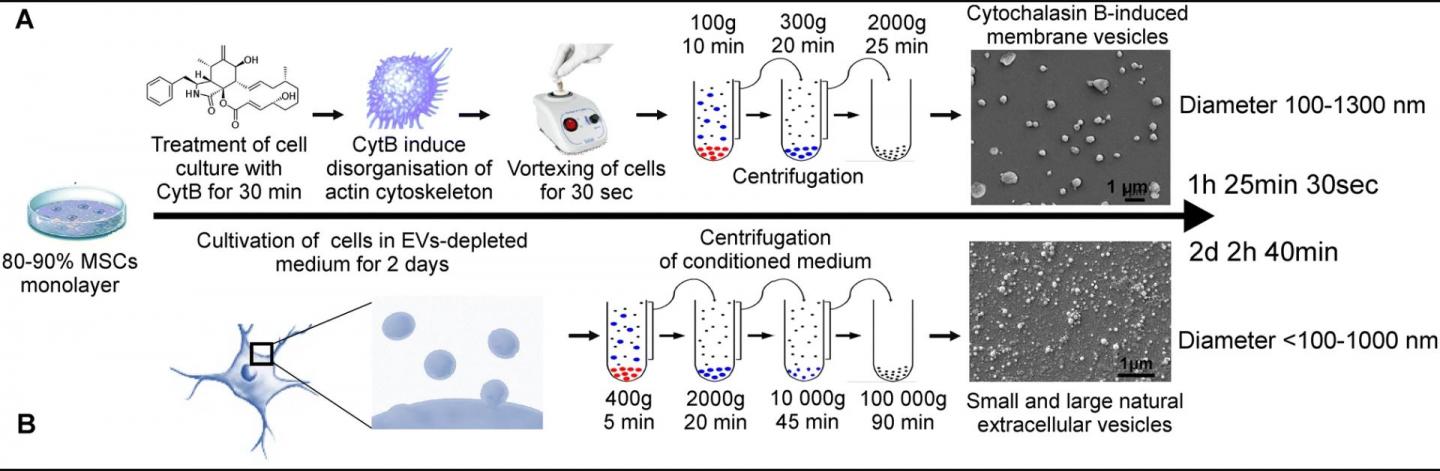
Group leader, Senior Research Associate Marina Gomzikova explains how microvesicles – bubbles surrounded by a natural cell membrane – can be biocompatible therapeutic instruments.

“We created a technology to obtain microvesicles from human stem cells and showed that they have significant biological activity and therapeutic potential. Microvesicles are basically miniature copies of cells. But, unlike stem cells, they are not oncogenic and can be a safe treatment medium,” she says.

The authors compared the activity of induced microvesicles with natural microvesicles and stem cells. The results show that induced microvesicles indeed can reduce the intensity of immune response.

“The uniqueness of induced microvesicles is that their technology is scalable and can be implemented at an industrial level. A new class of biomedical compounds can be based on microvesicles. The immunomodulating activity may be used to treat inflammations and autoimmune syndromes,” adds Albert Rizvanov, Director of Kazan Federal University’s Center for Precision and Regenerative Medicine.

Induced microvesicles can further down the road serve as vehicles to deliver medications against nervous system injuries, locomotor damage, ischemia, and many other illnesses. In contrast to stem cells, microvesicles can be prepared in large quantities, are easily stored and utilized even in facilities not equipped with biobanks or cell labs.

###

Media Contact
Yury Nurmeev
[email protected]

Original Source

https://kpfu.ru/eng/news-eng/microvesicles-for-therapy.html

Related Journal Article

http://dx.doi.org/10.1038/s41598-020-67563-9

Tags: BiochemistryBiologyCell Biology
Share12Tweet8Share2ShareShareShare2

Related Posts

Blue Light and Chemistry Simplify Complex Drug Production Steps

Blue Light and Chemistry Simplify Complex Drug Production Steps

July 10, 2026
New Discovery Promises Brighter, More Energy-Efficient Digital Displays

New Discovery Promises Brighter, More Energy-Efficient Digital Displays

July 10, 2026

New Crystalline 3D Frameworks Linked by Spiroborates Developed

July 10, 2026

IBEC Joins Major European Grant on Living Matter Physics

July 10, 2026
Please login to join discussion

POPULAR NEWS

  • Detection of EDCs in Breast Milk and Infant Urine Up to Six Months Highlights Early Exposure Risks

    77 shares
    Share 31 Tweet 19
  • New Drug Candidate Developed at McMaster Shows Potential for Treating Brain Cancer

    58 shares
    Share 23 Tweet 15
  • KTU Researchers Explore Ultrasound’s Role in Enhancing Blood Flow Beyond Diagnostics

    53 shares
    Share 21 Tweet 13
  • 高齢者の骨粗鬆症治療の持続性比較

    51 shares
    Share 20 Tweet 13

About

We bring you the latest biotechnology news from best research centers and universities around the world. Check our website.

Follow us

Recent News

Wild Carnivores in Netherlands Reveal West Nile and Usutu Virus Infection

Akkermansia massiliensis and FcRL3 Gene Linked to Multiple Sclerosis Protection

Calcineurin/NFAT Pathway Links Calcium Stress to Neurodegeneration Timing

Subscribe to Blog via Email

Enter your email address to subscribe to this blog and receive notifications of new posts by email.

Join 85 other subscribers
  • Contact Us

Bioengineer.org © Copyright 2023 All Rights Reserved.

Welcome Back!

Login to your account below

Forgotten Password?

Retrieve your password

Please enter your username or email address to reset your password.

Log In
No Result
View All Result
  • Homepages
    • Home Page 1
    • Home Page 2
  • News
  • National
  • Business
  • Health
  • Lifestyle
  • Science

Bioengineer.org © Copyright 2023 All Rights Reserved.