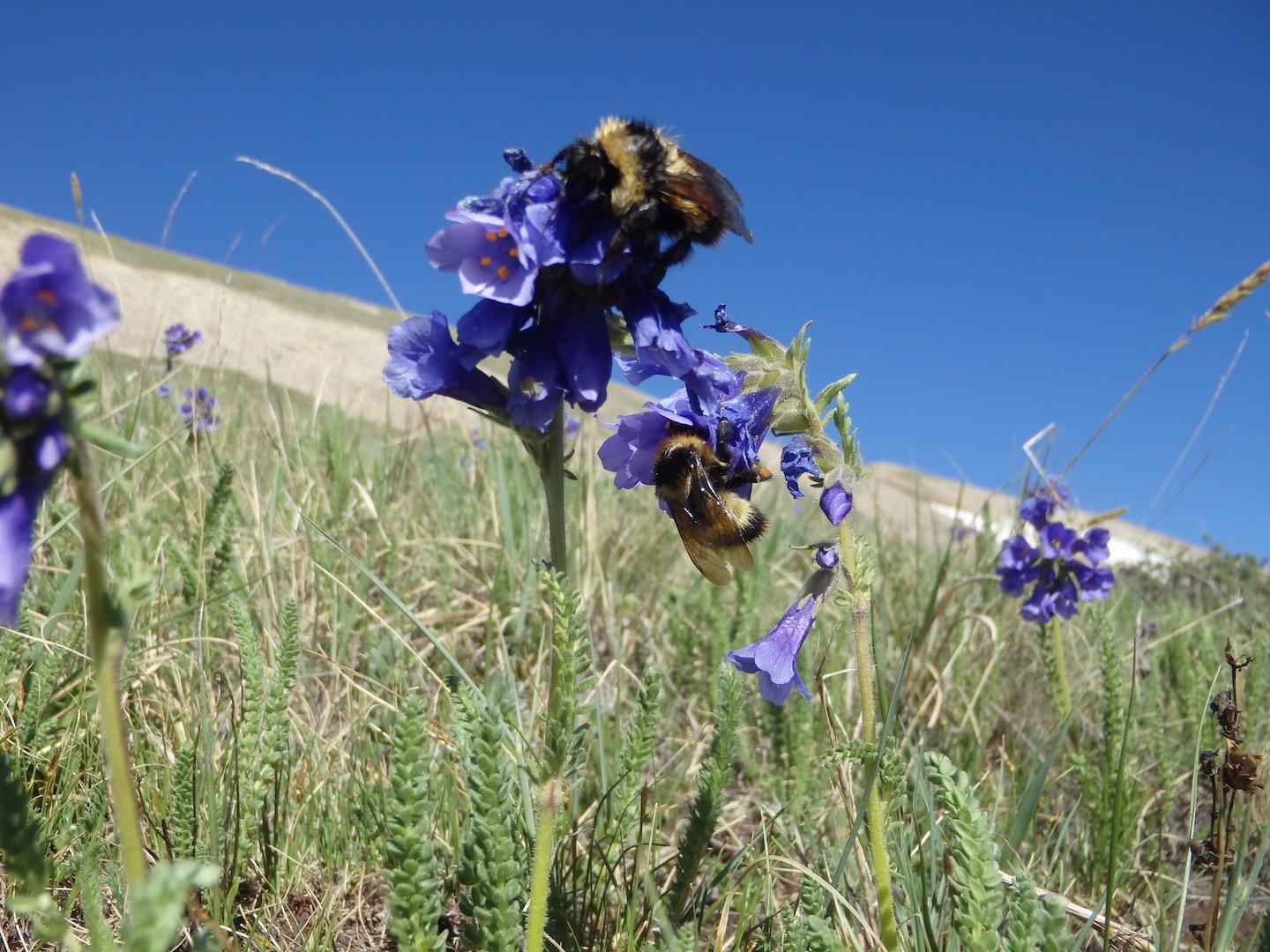
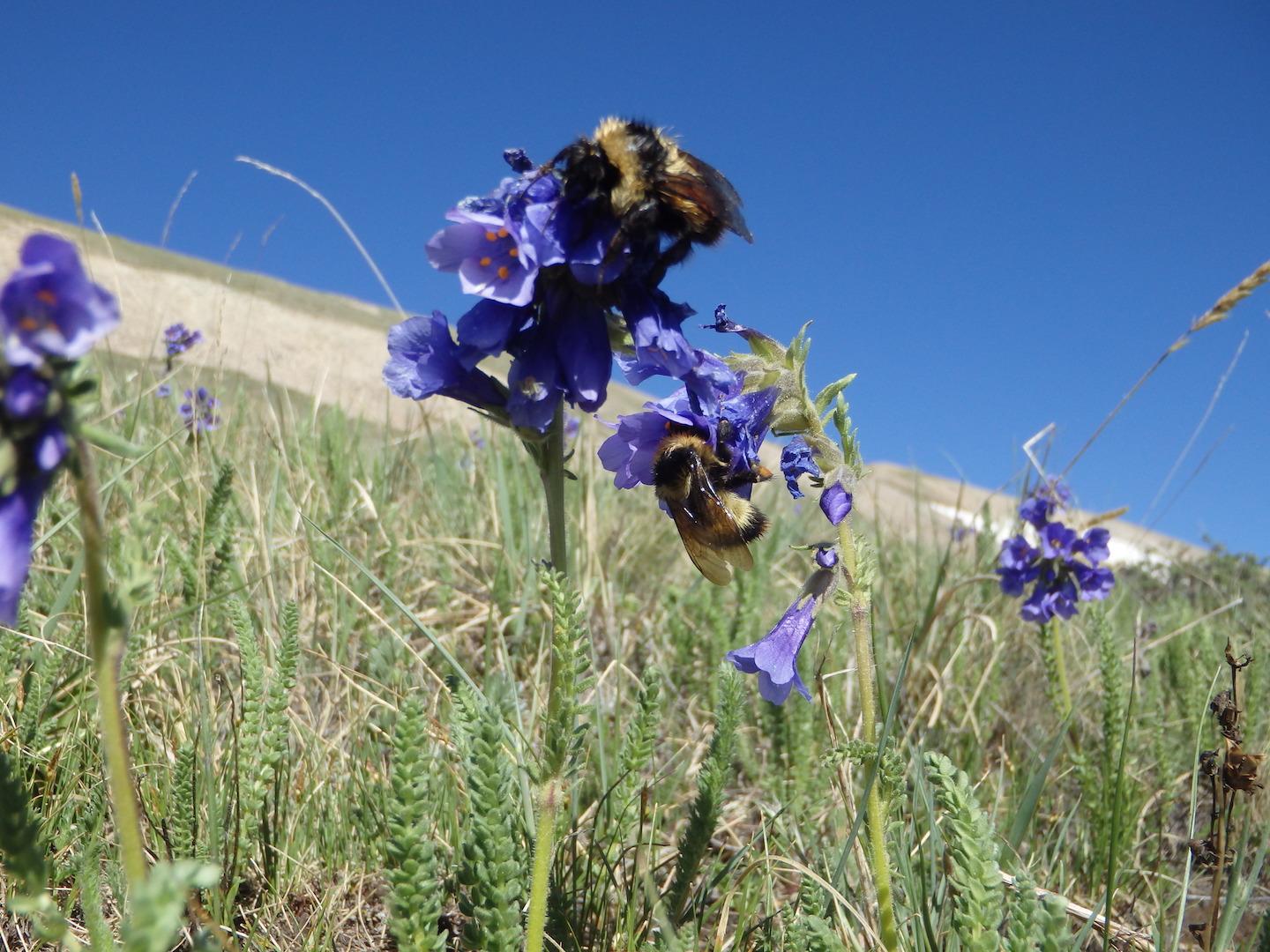
Credit: Courtesy: Nicole Miller-Struttmann
ST. LOUIS – Tracking pollinating bees is a huge business in the world of agriculture. It's estimated that farms in the United States pay more than $656 million dollars each year to rent more than 80 billion bees, which are set loose in almond fields and other crops to pollinate the plants. Keeping track of those bees can be expensive, and being alerted to when their pollinator services are lacking can help save a lot of money.
Webster University Biology Professor Nicole Miller-Struttmann believes she has a solution that could help lower those costs and head-off pollination deficits by keeping track of all those bees. In a paper published today in PLOS ONE, a scientific journal, Miller-Struttmann and her colleagues tracked the activity of bumble bees using microphones strategically placed in Colorado meadows and reported great success in being able to predict the bee activity and pollination services.
"Tracking these dynamic populations is costly, and the current methods used to track them are time consuming and often lethal," Miller-Struttmann said. "We used inexpensive sound equipment to monitor for buzzing sounds created by bees as they fly. We then developed a computer algorithm that rapidly identifies and quantifies bee flight activity. We believe that our method could be a much more cost and time efficient method for monitoring bee activity."
Using microphones and iPad minis, the professors recorded bees in three different alpine meadows on Pennsylvania Mountain in Colorado. At the same time, they visually recorded the number bees foraging in the area. The computer algorithm was used to extrapolated how many "buzzing" sounds that matched the frequency range of bumble bees were recorded. They compared the two counts to gauge accuracy. The acoustic counts were remarkably accurate and highly correlated with the visual counts.
In phase two, the researchers tested to see if the amount of buzzing caught by the microphones accurately predicted if the bees were pollinating plants in an area or just flying near the microphones. The researchers set up two sets of plants that bees pollinated, but made it so one set could only attract bees but could not be pollinated. Using the recorded sound from each set of plants, their system successfully predicted which flowers would set fruit and which did not, indicating that the method could be used to track bee activity and also detect the services bees provide to the plants they visit.
"We believe that this could potentially be a more cost-effective method of monitoring bees while also providing real-time data to conservation managers and farmers," Miller-Struttmann said. "The technology for acoustic data collection and processing is nimble, low cost, and suited to remote locations."
###
The study was published Thursday in PLOS ONE, volume 12, issue 6, and can be found online at http://journals.plos.org/plosone/article?id=10.1371/journal.pone.0179273.
With its home campus in St. Louis, Missouri, USA, Webster University comprises an action-oriented global network of faculty, staff, students and alumni who forge powerful bonds with each other and with their communities around the globe. Founded in 1915, Webster is a private non-profit university with nearly 16,000 students studying at campus locations in North America, Europe, Asia and Africa and in a robust learning environment online. The university is committed to delivering high-quality learning experiences that transform students for global citizenship and individual excellence.
Media Contact
Patrick Giblin
[email protected]
314-246-7174
@websteru
http://www.webster.edu
############
Story Source: Materials provided by Scienmag