• HOME
  • NEWS
  • EXPLORE
    • CAREER
      • Companies
      • Jobs
    • EVENTS
    • iGEM
      • News
      • Team
    • PHOTOS
    • VIDEO
    • WIKI
  • BLOG
  • COMMUNITY
    • FACEBOOK
    • INSTAGRAM
    • TWITTER
Monday, July 13, 2026
BIOENGINEER.ORG
No Result
View All Result
  • Login
  • HOME
  • NEWS
  • EXPLORE
    • CAREER
      • Companies
      • Jobs
        • Lecturer
        • PhD Studentship
        • Postdoc
        • Research Assistant
    • EVENTS
    • iGEM
      • News
      • Team
    • PHOTOS
    • VIDEO
    • WIKI
  • BLOG
  • COMMUNITY
    • FACEBOOK
    • INSTAGRAM
    • TWITTER
  • HOME
  • NEWS
  • EXPLORE
    • CAREER
      • Companies
      • Jobs
        • Lecturer
        • PhD Studentship
        • Postdoc
        • Research Assistant
    • EVENTS
    • iGEM
      • News
      • Team
    • PHOTOS
    • VIDEO
    • WIKI
  • BLOG
  • COMMUNITY
    • FACEBOOK
    • INSTAGRAM
    • TWITTER
No Result
View All Result
Bioengineer.org
No Result
View All Result
Home NEWS Science News

Biological invasions as costly as natural disasters

Bioengineer by Bioengineer
April 18, 2023
in Science News
Reading Time: 2 mins read
0
Biological invasions as costly as natural disasters
Share on FacebookShare on TwitterShare on LinkedinShare on RedditShare on Telegram

By invading new environments, some alien species have caused disastrous consequences for local species and ecosystems, as well as for human activities – damage to infrastructure, crops, forest plantations, fishing yields, health and tourism. The areas affected are multiple and the damage is costly.
Biological invasions as costly as natural disasters

Credit: © Turbelin et al./ Perspectives in Ecology and Conservation

By invading new environments, some alien species have caused disastrous consequences for local species and ecosystems, as well as for human activities – damage to infrastructure, crops, forest plantations, fishing yields, health and tourism. The areas affected are multiple and the damage is costly.

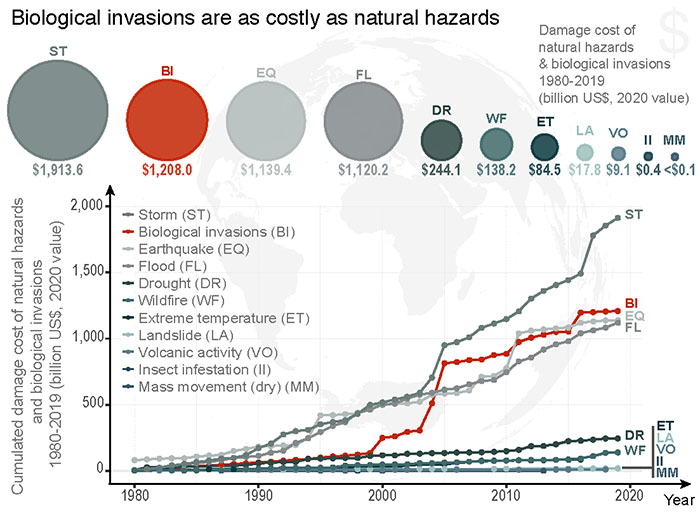
In a new study, an international research team led by scientists from the Écologie, systématique et évolution (CNRS/Université Paris-Saclay/AgroParisTech) reveals an explicit order of magnitude: the global economic impact of these biological invasions is equivalent to that of natural catastrophes. From 1980 to 2019, financial losses due to invasive alien species amounted to $1208 billion (US), compared to nearly $1914 billion in losses caused by storms, $1139 billion attributed to earthquakes and $1120 billion due to floods.

Scientists have also found that the costs of biological invasions increased more rapidly than those of natural disasters over a given period. Invasive alien species have a long-lasting and cumulative effect: for example, the zebra mussel is capable of attaching itself to a wide variety of substrates, wreaking havoc on everything from ship hulls to nuclear power plant pipes. Its spread is particularly problematic in North America.

To date, investments in preventing and managing biological invasions are ten times lower than the financial losses caused by them. For this research team, these results call for the deployment of action plans and international agreements on limiting the advance of invasive alien species, similar to those implemented in the context of natural disasters.

These results were obtained using the InvaCost database, which currently lists over 13,500 costs due to biological invasions worldwide. The costs of natural disasters at the global level were compiled using the International Disaster Database and data from the US National Oceanic and Atmospheric Administration (NOAA).


Journal

Perspectives in Ecology and Conservation

DOI

10.1016/j.pecon.2023.03.002

Article Title

Biological invasions are as costly as natural hazards.

Article Publication Date

29-Mar-2023

Share12Tweet8Share2ShareShareShare2

Related Posts

Scalable Nested-Block Framework Boosts Urban Infrastructure Efficiency and Equity

Scalable Nested-Block Framework Boosts Urban Infrastructure Efficiency and Equity

July 13, 2026
Computer-Controlled Electricity Quickly Shapes Flat Nanofilms into 3D Structures

Computer-Controlled Electricity Quickly Shapes Flat Nanofilms into 3D Structures

July 13, 2026

How Particle Shape and Spin Affect Optical Manipulation Efficiency

July 13, 2026

New Tick-Borne Threat: Anaplasmosis Spreads in Canada

July 13, 2026

POPULAR NEWS

  • Detection of EDCs in Breast Milk and Infant Urine Up to Six Months Highlights Early Exposure Risks

    77 shares
    Share 31 Tweet 19
  • New Drug Candidate Developed at McMaster Shows Potential for Treating Brain Cancer

    58 shares
    Share 23 Tweet 15
  • KTU Researchers Explore Ultrasound’s Role in Enhancing Blood Flow Beyond Diagnostics

    53 shares
    Share 21 Tweet 13
  • Experimental Therapy Simultaneously Destroys Prostate Tumor Cells and Reactivates Antitumor Immunity

    46 shares
    Share 18 Tweet 12

About

We bring you the latest biotechnology news from best research centers and universities around the world. Check our website.

Follow us

Recent News

Scalable Nested-Block Framework Boosts Urban Infrastructure Efficiency and Equity

Computer-Controlled Electricity Quickly Shapes Flat Nanofilms into 3D Structures

How Particle Shape and Spin Affect Optical Manipulation Efficiency

Subscribe to Blog via Email

Enter your email address to subscribe to this blog and receive notifications of new posts by email.

Join 85 other subscribers
  • Contact Us

Bioengineer.org © Copyright 2023 All Rights Reserved.

Welcome Back!

Login to your account below

Forgotten Password?

Retrieve your password

Please enter your username or email address to reset your password.

Log In
No Result
View All Result
  • Homepages
    • Home Page 1
    • Home Page 2
  • News
  • National
  • Business
  • Health
  • Lifestyle
  • Science

Bioengineer.org © Copyright 2023 All Rights Reserved.