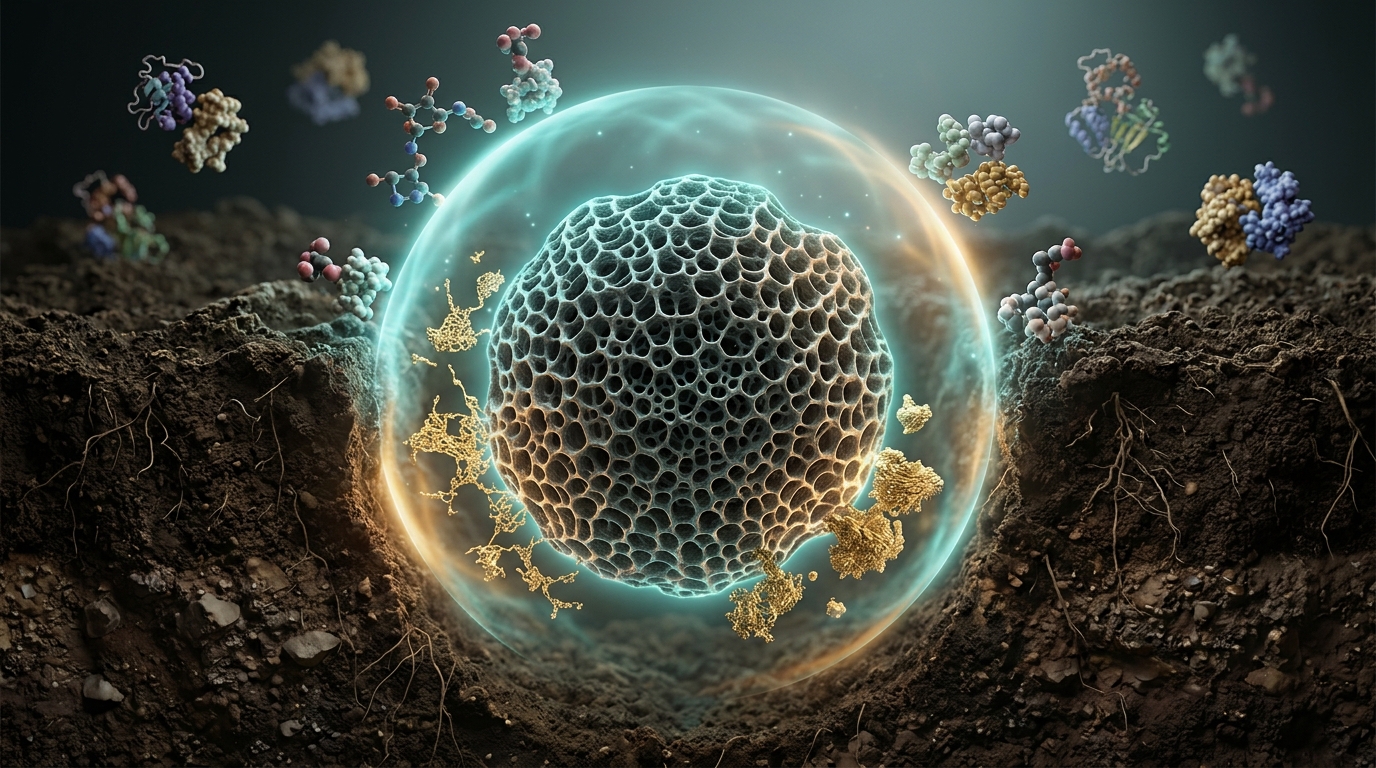
Biochar, the charcoal-like material increasingly dug into farmland to store carbon, appears to work in a more chemically aggressive way than many assumed. A rapid-report study published in Biochar on 6 July 2026 reports that biochar introduces persistent free radicals into soil, and that these radicals generate hydroxyl radicals capable of attacking the extracellular enzymes that decompose soil organic carbon. The result, in two of three tested soils, was measurably slower carbon mineralization and lower carbon dioxide emissions.
The research team, led by Ping Wu, Yingdong Fu, Hailong Wang and Shuping Qin, amended three distinct soils with untreated biochar and compared it with biochar whose persistent free radicals had been chemically quenched. A separate treatment quenched hydroxyl radicals in the soil directly. The researchers then tracked a suite of response variables, including carbon dioxide flux, hydroxyl radical content and the activities of key carbon-decomposing enzymes.
Quenching the persistent free radicals reduced hydroxyl radical yield, confirming that these biochar-borne radicals are a key source of the reactive oxygen chemistry. In the Black and Red soils, untreated biochar suppressed carbon dioxide emissions by 6.8 to 12.9 percent, whereas the quenched biochar stimulated them. The pattern reversed in the Fluvo-aquic soil, a calcareous soil, where both biochar types increased emissions, and the quenched biochar, which carried less hydroxyl radical activity, caused the larger increase.
Across all three soils, quenching soil hydroxyl radicals led to higher carbon dioxide emissions and higher dissolved organic carbon concentrations, alongside a significant drop in soil organic carbon. Enzyme activities rose when persistent free radicals were quenched and peaked when hydroxyl radicals were scavenged, a response that was particularly pronounced in the Red soil. The authors conclude that biochar-derived hydroxyl radicals can inhibit soil organic carbon mineralization primarily by suppressing hydrolase activities, the enzymes that hydrolyze complex carbon compounds into simpler, respirable molecules.
The protective effect, however, is not universal. In the acidic Black and Red soils, the radical-driven enzyme suppression dominated, keeping carbon locked in the soil. In the calcareous Fluvo-aquic soil, positive priming, in which added biochar accelerates the decomposition of native organic matter, overrode the protective chemistry, and carbon losses increased even as hydroxyl radicals were present. The study therefore frames biochar’s carbon benefit as soil-specific rather than an intrinsic property of the amendment itself.
Hydroxyl radicals are among the most reactive oxidants in nature, and their known capacity to damage extracellular enzymes had made their net effect on soil carbon cycling difficult to predict. The new findings suggest that in acidic soils this reactivity can act as a brake on decomposition, effectively adding a chemical preservation mechanism on top of biochar’s better-known physical sorption of organic compounds. The authors emphasize that this soil-specific role of biochar-derived reactive oxygen species in carbon cycling highlights the need for tailored biochar management strategies rather than one-size-fits-all application.
Subject of Research: How biochar-derived hydroxyl radicals protect soil organic carbon by suppressing extracellular enzymes in a soil-specific manner
Article Title: Soil-specific protection of organic carbon by biochar-derived hydroxyl radicals associated with enzyme suppression
Article References: Wu, P., Fu, Y., Wang, H., & Qin, S. (2026). Soil-specific protection of organic carbon by biochar-derived hydroxyl radicals associated with enzyme suppression. Biochar, 8(1), Article 126. https://doi.org/10.1007/s42773-026-00641-9
Image Credits: AI Generated
DOI: 10.1007/s42773-026-00641-9
Keywords: biochar, soil organic carbon, hydroxyl radicals, persistent free radicals, enzyme suppression, carbon mineralization, soil respiration, priming effect, acidic soils, calcareous soil, reactive oxygen species, carbon cycling
News Source: Alan Morgan. (November 4, 2026). Biochar’s Hydroxyl Radicals Shield Soil Carbon in Acidic Soils by Suppressing Enzymes. Scienmag.