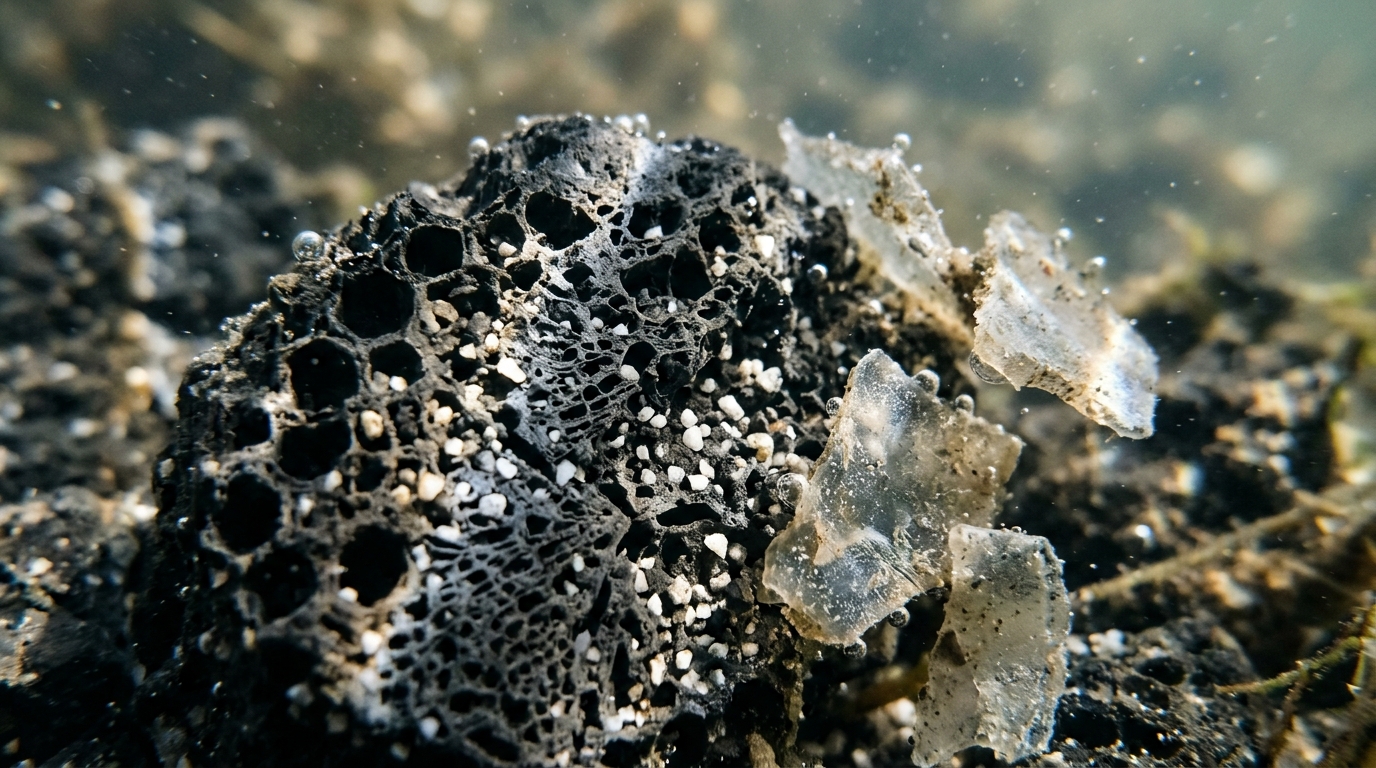
Researchers have developed a sustainable photocatalytic strategy to degrade polyethylene microplastics, a persistent pollutant derived from agricultural mulch films. The study, published in the journal Biochar, demonstrates that core-shell TiO2/biochar composites can significantly reduce the size of these plastic fragments under light exposure. Specifically, a composite made from walnut shell biochar and core-shell TiO2, designated as 12TJBC, reduced the particle size of 500-micrometer polyethylene microplastics to less than 70 micrometers within 40 hours. This performance was 2.8 times faster than that of pristine TiO2, highlighting the potential of engineered biochar materials for environmental remediation.
Polyethylene microplastics pose a critical threat to soil health and ecological stability due to their chemical inertness. The high bond dissociation energy of carbon-carbon and carbon-hydrogen bonds in polyethylene makes it highly resistant to biodegradation, with estimated environmental half-lives ranging from 200 to 400 years. These particles frequently accumulate in sediments, where their concentrations can be up to 100 times higher than in the overlying water. Consequently, there is an urgent need for effective technologies to mitigate this pollution, particularly in agricultural ecosystems where plastic mulch is extensively utilized for vegetable, fruit, and tuber cultivation.
The research team selected three distinct biomass-derived biochars—wheat straw, rice husk, and walnut shell—to modify core-shell structured TiO2 via hydrothermal synthesis. The goal was to overcome the inherent limitations of pristine TiO2, which suffers from rapid charge recombination and inefficient solar utilization. By integrating biochar with TiO2, the researchers aimed to create a synergistic system where the carbon scaffold accelerates charge separation and broadens light absorption. The physicochemical properties of these composites were quantitatively analyzed and correlated with their photocatalytic performance toward polyethylene microplastic degradation.
Structural characterization revealed that the walnut shell biochar composite exhibited the most pronounced structural modifications. X-ray diffraction analysis confirmed that the TiO2 predominantly exhibited an anatase crystal phase, while the incorporation of biochar facilitated the crystallization of this phase. The 12TJBC composite displayed an enhanced specific surface area of 355.65 square meters per gram and hierarchical porosity, likely driven by a higher density of micropores in the walnut shell biochar. Raman spectroscopy indicated an increase in carbon defects and lattice disorder, with the intensity ratio of the G band to the D band decreasing from 0.635 in the pristine biochar to 0.435 in the composite.
Optical absorption properties were significantly enhanced in the biochar-composited TiO2 samples compared to pristine TiO2. Bandgap calculations revealed a narrowing of the bandgap in the 12TJBC sample from 3.19 electron volts to 2.74 electron volts. This narrowing indicates heightened photoexcitation efficiency under solar irradiation, leading to improved photocatalytic degradation. Photoluminescence spectroscopy showed suppressed charge recombination in all composites, with the 12TJBC sample demonstrating superior electron-hole separation. Electrochemical impedance spectroscopy and photocurrent measurements further confirmed that the walnut shell-derived composite exhibited optimal interfacial electron transport efficiency.
Mechanistic investigations identified hydroxyl radicals as the dominant reactive oxygen species responsible for the degradation process. Quenching assays showed that scavenging hydroxyl radicals induced the most severe suppression of catalytic activity, confirming their primary role. Electron paramagnetic resonance spectroscopy corroborated the light-triggered generation of these radicals, with the 12TJBC composite showing pronounced enhancement over pristine TiO2. The steady-state concentration of hydroxyl radicals reached 8.84 micromolar, while superoxide anions reached 2.21 micromolar. These concentrations were 7 to 8 times higher than those generated by the leached dissolved organic matter alone.
A unique aspect of this study was the investigation of biochar-derived dissolved organic matter, which acts as a co-catalyst to amplify degradation. The researchers found that this organic matter enhances electron-accepting capacity, effectively counteracting its inherent light-shielding effects. The walnut shell-derived organic matter exhibited the highest electron-accepting ability among the samples tested. This aromatic-rich composition enhances electronic absorption capacity, leading to higher oxidation capabilities and an increase in hydroxyl radical generation. The study demonstrates that the dissolved organic matter does not merely act as a passive byproduct but plays an active role in the photocatalytic process.
The chemical fate of the polyethylene microplastics was elucidated using two-dimensional correlation spectroscopy and gas chromatography-mass spectrometry. The analysis revealed a sequential oxidation pathway starting with hydrogen abstraction at alkyl chains, followed by chain scission and oxidative fragmentation. Key photoproducts identified included various paraffins and oxygenated species such as ketones and esters. The concentration of carbon dioxide in the reaction increased over time, indicating progressive mineralization. However, the study noted that while particle size reduction was significant, complete mineralization to carbon dioxide was still limited, necessitating further assessment of the environmental toxicity of the intermediate products.
Ecotoxicological assessments using the ECOSAR software confirmed the environmental safety of the degradation products. Most intermediates were found to be harmless, with the toxicity of alkanes being negligible compared to the harm caused by the microplastics themselves. Additionally, the impact of the intermediate products on mung bean germination and growth was investigated. The results showed that the germination rate was not inhibited, remaining above 95% compared to the control group. The length of the representative mung bean roots was approximately 3 centimeters, indicating that the phytotoxicity of the degraded polyethylene solution is low and its impact on seed growth is negligible.
This work provides a dual-phase synergistic framework for mitigating plastic pollution while ensuring ecotoxicological integrity in agricultural ecosystems. The findings offer mechanistic insight into the role of interfacial bonding and biochar-derived organic matter in photocatalytic degradation. By engineering biomass-derived composites, the study presents a waste-to-resource strategy that addresses the persistent challenge of polyethylene microplastic pollution. The successful integration of biochar and TiO2 not only enhances photocatalytic efficiency but also ensures that the resulting degradation products are environmentally safe, paving the way for sustainable remediation technologies in agricultural settings.
The experimental setup for the photocatalytic degradation involved dispersing 50 milligrams of polyethylene microplastics and 50 milligrams of catalyst in 50 milliliters of ultrapure water within a 100-milliliter quartz reactor. The reaction mixture was subjected to ultrasonication for five minutes under an air purge before being sealed and irradiated with magnetic stirring at 500 revolutions per minute. The light source consisted of four 4-watt bulbs emitting wavelengths between 300 and 460 nanometers, with an irradiance of 1150 microwatts per square centimeter. To evaluate the specific contribution of different light wavelengths, the researchers also employed monochromatic light-emitting diodes at 365, 395, 420, and 450 nanometers. Spectral response analysis indicated that ultraviolet-driven activity surpassed visible-light activity, a difference attributed to intensified light absorption by both the polyethylene microplastics and the composite material within the ultraviolet spectrum. All experiments were repeated three times to minimize systematic errors, and dark controls were conducted to distinguish photocatalytic effects from thermal or chemical processes occurring in the absence of light.
Particle size reduction was quantified using optical microscopy and ImageJ software, analyzing 200 particles per sample to determine mean particle size and distribution. The researchers also monitored the thermal properties of the microplastics using differential scanning calorimetry, which revealed a decrease in enthalpy values from 100.17 joules per gram to 91.69 joules per gram after the reaction. This reduction in enthalpy suggests a disruption of molecular ordering within the polyethylene structure, likely resulting from oxygen atom incorporation during oxidation or structural defects induced by surface hydrogen abstraction. Furthermore, the hydrophilicity of the microplastics was assessed through contact angle goniometry. The initial contact angle of pristine polyethylene microplastics was 124.27 degrees, indicating inherent hydrophobicity. After 24 hours of irradiation with the 12TJBC composite, this angle decreased to 108.02 degrees, and it further declined to 106.74 degrees after 40 hours. This sustained reduction in contact angle demonstrates that extended photocatalytic duration enhances surface hydrophilicity, a change correlated with the emergence of oxidative functional groups on the plastic surface.
The stability of the catalyst was evaluated through recycling experiments, which showed that the 12TJBC composite maintained excellent structural stability across five consecutive cycles. The particle size distribution of the microplastics remained consistent during these repeated uses, suggesting that the catalyst does not degrade significantly over time. Additionally, the pH of the reaction solution was monitored throughout the entire reaction period and remained consistent, indicating that pH changes had a negligible effect on the particle reduction of the microplastics. The researchers also investigated the leaching of dissolved organic matter from the composites by dispersing 50 milligrams of each biochar-based composite in 50 milliliters of ultrapure water and irradiating the suspension for eight hours. The resulting leachate was filtered through a 0.22-micrometer membrane to collect the dissolved organic matter, which was then characterized for dissolved organic carbon content and aromaticity using ultraviolet-visible spectrophotometry.
To identify the specific intermediates formed during the degradation process, the reaction solutions were separated and filtered through 0.22-micrometer membranes. The solutions were then subjected to liquid-liquid extraction using equal volumes of tetrahydrofuran. The organic phase was concentrated via vacuum centrifugal evaporation and analyzed by gas chromatography-mass spectrometry. This analysis identified key photoproducts, including (1-methyl-1,2-propadienyl)-cyclopropane, 2,6,10-trimethyldodecane, 2-butyroctanol, 5-(1,2-propadienyloxy)-2-pentanone, and dodecane. These compounds predominantly comprised C10 to C20 paraffins, which is consistent with radical-enabled chain scission. Oxygenated species, characterized by hydroxyl and carbonyl groups, appeared sequentially as ethanol, followed by ketones and esters under progressive photooxidation. The concentration of carbon dioxide in the reaction was monitored simultaneously and showed an upward trend over time, mirroring typical free radical degradation pathways where high-molecular-weight intermediates transform into low-molecular-weight products, eventually becoming water and carbon dioxide.
The environmental toxicity of the detected intermediate compounds was quantitatively predicted using the ECOSAR v2.0 software, which follows United States Environmental Protection Agency protocols. The assessment evaluated both acute and chronic ecotoxicities toward fish, water fleas, and green algae. The results indicated that most intermediates were harmless, and the toxicity of the alkanes was negligible compared to the harm caused by the microplastics themselves. To further reflect the environmental toxicity of intermediate products in real-world scenarios, the researchers investigated the impact of these products on mung bean growth. Mung beans were exposed to intermediate solutions isolated at different reaction times, including 8, 16, 24, 32, and 40 hours. Compared to a blank group using deionized water, the germination of mung beans in the filtrates was almost not inhibited, with rates remaining above 95 percent. The length of the representative mung bean roots was approximately 3 centimeters, indicating that the phytotoxicity of the degraded polyethylene solution is low and its impact on seed growth is negligible. This comprehensive toxicity assessment supports the conclusion that the photocatalytic degradation process produces environmentally safe byproducts.
Subject of Research: Synergetic polyethylene microplastic photodegradation over core–shell TiO2/biochar: unraveling the dual roles of interfacial bonding and biochar-derived DOM
Article Title: Synergetic polyethylene microplastic photodegradation over core–shell TiO2/biochar: unraveling the dual roles of interfacial bonding and biochar-derived DOM
Article References: Li, Z., Chen, S., Sun, Y., Ding, Y., Chen, C., & He, J. (2026). Synergetic polyethylene microplastic photodegradation over core–shell TiO2/biochar: unraveling the dual roles of interfacial bonding and biochar-derived DOM. Biochar, 8(1), Article 117. https://doi.org/10.1007/s42773-026-00625-9
Image Credits: AI Generated
DOI: 10.1007/s42773-026-00625-9
Keywords: Synergetic, polyethylene, microplastic, photodegradation, over, core, shell, TiO2, biochar, unraveling, dual, roles
News Source: Alan Morgan. (November 7, 2026). Biochar-TiO2 Composites Shrink Polyethylene Microplastics. Scienmag.