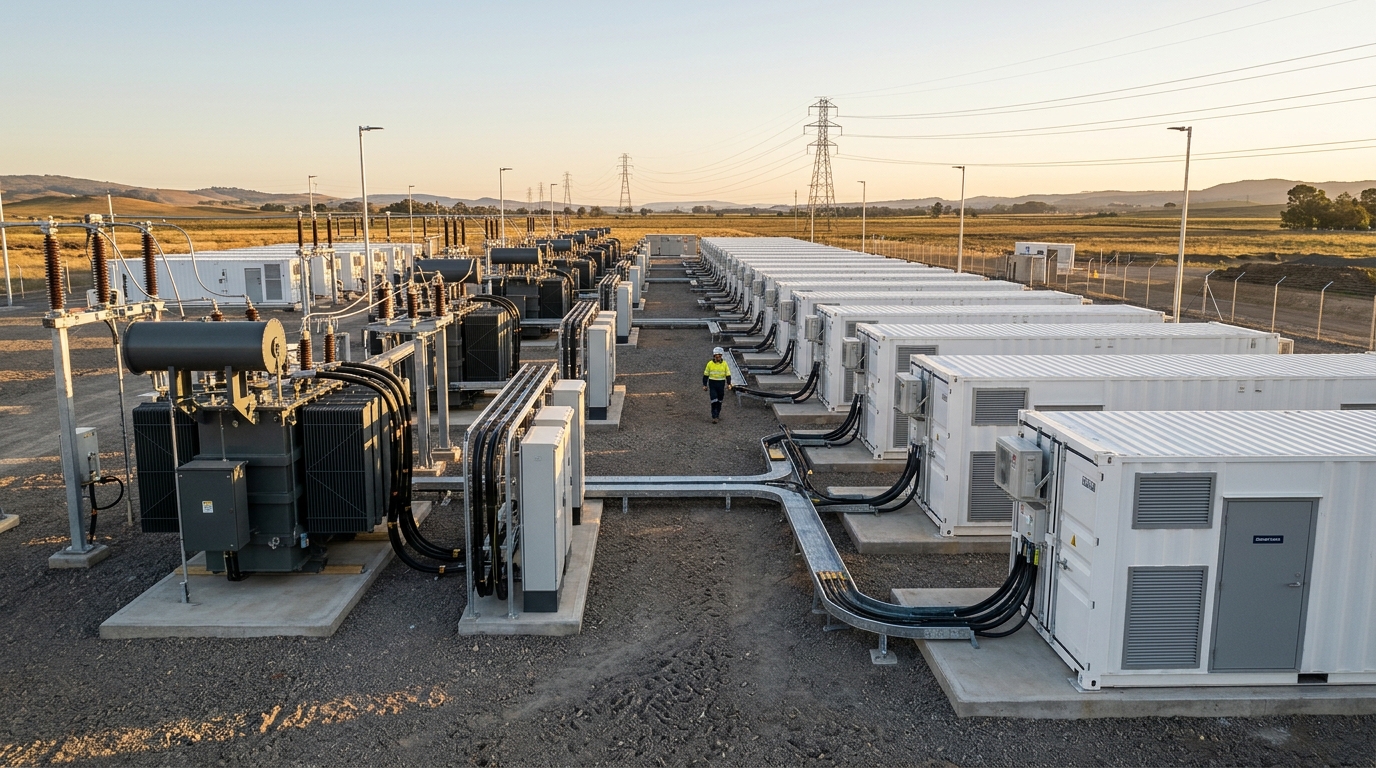
Grid-forming battery energy storage systems are increasingly expected to behave like the synchronous machines they replace, and the virtual synchronous generator is the control strategy most often used to make that happen. But a new study reports that these converters can slide into sustained low-frequency oscillations when connected to stiff, high short-circuit-ratio grids, and that a targeted change to the innermost control loop can eliminate the problem. Researchers from Hainan Power Grid and Tsinghua University replaced the conventional proportional-integral current regulator with an integral sliding-mode controller, reshaping the converter’s output impedance so that the crossover with the grid no longer carries a negative phase margin.
The work, published in Frontiers in Energy Research, begins from a familiar puzzle in modern power engineering. As converter-interfaced generation displaces synchronous machine capacity, the sources of inertia, damping, and voltage-frequency support available to the network change character. Grid-following converters synchronize through a phase-locked loop and regulate injected current, and their closed-loop dynamics can interact with network impedance, especially when power flows through long lines or weak AC systems with reduced short-circuit ratio. Grid-forming converters take the opposite approach: they establish their own terminal voltage and frequency rather than deriving both quantities from a PLL, with the virtual synchronous generator reproducing the rotor-motion and droop characteristics of a synchronous machine.
A cascaded VSG typically stacks three control stages: an outer power loop that mimics a synchronous machine’s inertial and droop response, a middle voltage-regulation loop, and an inner current-regulation loop, the latter two implemented with standard PI controllers in the synchronous dq frame. The study’s key insight is that the current loop is not merely a tracking element. It contributes directly to the terminal output impedance. For some parameter combinations, the positive-sequence impedance becomes strongly capacitive over the low-frequency interaction band, and a crossover with the predominantly inductive grid impedance can then occur with inadequate phase separation.
To diagnose this mechanism precisely, the team built a frequency-coupled sequence-impedance model. When a small-signal positive-sequence voltage perturbation is injected at the converter terminal, the Park transformation and modulation process generate an additional response at the mirror frequency, and this coupling must be retained for accurate stability predictions. The analysis was restricted to small-signal deviations from balanced three-phase steady-state operation, under which the zero-sequence path is not excited, leaving only the positive- and negative-sequence impedances relevant to the stability evaluation.
The baseline model’s predictions were striking. The negative-sequence impedance remained inductive over the low-frequency range, while the positive-sequence impedance exhibited a distinct capacitive region below about 50 Hz. The researchers selected three representative grid inductances for analysis: 6.5 mH, 3 mH, and 2.4 mH, corresponding to short-circuit ratios of 7, 15, and 20. As the grid inductance decreased and the SCR increased, the magnitude crossover shifted from 23 Hz to 33 Hz and then to 38 Hz, with phase margins of 16 degrees, minus 9 degrees, and minus 35.5 degrees respectively. Only the SCR = 7 case showed a positive margin; the two stronger-grid cases were predicted to be unstable.
A time-domain simulation at SCR = 20 confirmed the theory. The steady-state grid current exhibited a sustained low-frequency oscillation, and its fast Fourier transform revealed a dominant component at 38 Hz with a coupled component at 62 Hz, matching the predicted crossover frequency and its mirror-frequency counterpart. The close agreement between theoretical crossover and measured oscillation validated the impedance model and identified the mechanism clearly: the PI-controlled VSG’s capacitive positive-sequence impedance intersects the reduced grid impedance at high SCR, producing a negative phase margin and sustained oscillations.
The remedy changed only the inner current law. The plant, power loop, and PI voltage loop were kept identical to the baseline so that any change in terminal impedance could be attributed to the current-loop replacement. The integral sliding-mode controller constructs a sliding surface from the current error and its integral, uses an exponential reaching law to drive the state toward that surface, and replaces the ideal switching function with a saturation function within a boundary layer to reduce chattering. The d- and q-axis implementations are identical. Stability was examined with a Lyapunov candidate, and parameter selection balanced convergence speed, command amplitude, and chattering, yielding a sliding-surface integral gain of 20, a reaching parameter of 230 against a calculated lower bound of approximately 150, and a boundary-layer parameter of 1.
Small-signal impedance analysis under the new controller showed the capacitive interval contracting and the phase curve moving away from the critical grid angle. For grid inductances of 3 mH, 1.5 mH, and 0.75 mH, corresponding to SCR values of 15, 30, and 60, the calculated phase margins were 78, 72, and 63 degrees respectively, all positive, in contrast to the negative margins obtained with the PI loop at SCR = 15 and 20. The authors are careful to frame these results as controller-dependent impedance reshaping rather than proof of a universal stability boundary; the phase-margin assessment applies only to the balanced, linearized operating conditions and discrete grid-impedance cases examined.
Offline simulations in MATLAB/Simulink tested the controller under switching and stepped-grid conditions. With the grid inductance fixed at 3 mH (SCR = 15), the VSG operated with the PI regulator until 4.85 seconds and was then switched to the sliding-mode regulator; the pre-switch current contained a sustained oscillation whose envelope decayed after the switch, with recovery to within ±2% of the post-switch steady-state RMS value in approximately 0.2 seconds. In a separate test, the SCR was stepped from 7.5 to 15 at 1.6 seconds, from 15 to 30 at 2.9 seconds, and from 30 to 60 at 3.9 seconds. Each step produced a finite transient followed by a stable current waveform with no sustained divergent oscillation, all under one fixed controller parameter set.
The proposed controller was also benchmarked against a fixed virtual-inductance strategy with the plant and both outer loops unchanged. At the post-step SCR = 30 operating point with 1.5 mH grid inductance, the spectra gave a grid-current total harmonic distortion of 3.38% for the 2 mH fixed virtual-inductance benchmark versus 0.54% for the proposed current loop, with recovery times of 0.105 seconds and 0.06 seconds respectively. Additional benchmark cases at 1 mH and 3 mH virtual inductance, included as a fixed-parameter sensitivity check rather than an independently optimized comparison, showed recovery times of 0.14 and 0.13 seconds with THD values of 4.4% and 4.15%, so the comparison holds across the tested virtual-inductance values. Real-time simulation on an RT-LAB OP5600 platform extended the validation: with the PI regulator, sustained low-frequency oscillation appeared at both SCR = 15 and SCR = 20, while the sliding-mode regulator produced stable waveforms in the paired cases, and a dynamic SCR change from 7 to 15 that triggered sustained oscillation under PI control produced only a short transient before the current settled. The authors note that these conclusions are limited to the examined balanced three-phase operating conditions and do not establish a universal stability boundary for arbitrary grid impedances, multiple-crossover conditions, or unbalanced faults, with future work needed to quantify sensitivity to operating-point shifts, parameter uncertainty, digital delay, and experimental-prototype constraints.
Subject of Research: Replacing the PI current regulator of a virtual synchronous generator with an integral sliding-mode controller to reshape output impedance and suppress low-frequency oscillations in grid-forming battery energy storage systems.
Article Title: Integral sliding-mode current regulation for sequence-impedance shaping and oscillation suppression in virtual synchronous generators
Article References: Ma, L., Li, Z., Yin, J., Wang, H., Li, S., Zhang, C., & Lin, L. (2026). Integral sliding-mode current regulation for sequence-impedance shaping and oscillation suppression in virtual synchronous generators. Frontiers in Energy Research, 14, Article 1969492. https://doi.org/10.3389/fenrg.2026.1969492
Image Credits: AI Generated
DOI: 10.3389/fenrg.2026.1969492
Keywords: battery energy storage, grid-forming converters, virtual synchronous generator, sliding-mode control, sequence impedance, oscillation suppression, short-circuit ratio, phase margin, RT-LAB, power system stability, current regulation, Integral
News Source: Faith Mcneil. (November 7, 2026). Sliding-Mode Control Tames Oscillations in Grid-Forming Battery Storage. Scienmag.