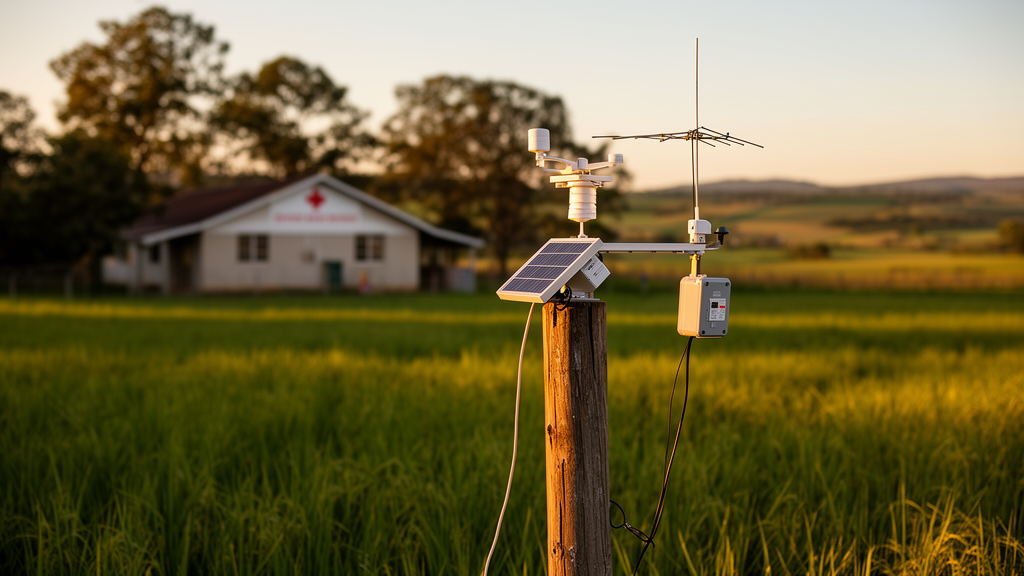
Wireless sensor networks are increasingly proposed as a way to monitor patients in remote and rural settings, where clinics may be far away, infrastructure is thin and continuous observation of vital signs is difficult. But these networks face a stubborn problem: their small, battery-powered sensor nodes are often deployed in places where nobody can easily reach them to swap or recharge batteries. A study published in the journal Discover Sensors on 28 September 2026 proposes an answer in the form of a new architecture called BISLE-WSN, short for Bio-Inspired Self-Learning Energy-Aware Wireless Sensor Network, which its authors report performed better than several existing protocols in simulation.
The research team, led by M. Ashok Kumar with colleagues including K. Kalaivanan, R. Santhana Krishnan, K. Saravanan and M. Muthukumar, set out to combine several ideas that have usually been treated separately: energy-aware clustering, predictive data transmission, federated learning and self-healing routing. Their argument is that rural healthcare monitoring fails not because any single technique is missing, but because energy management, communication optimization, intelligent decision-making and fault recovery are typically engineered in isolation. BISLE-WSN attempts to run all of these functions in parallel through a cross-layered design.
The bio-inspired part of the name reflects the design philosophy. Rather than following fixed rules, the network mimics the adaptive resource allocation seen in biological systems. Sensor nodes adjust their operational states according to their residual energy: nodes with healthy reserves stay active and handle sensing, communication and transmission, while nodes running low shift into low-power sleep modes. The total energy expenditure of a node is tracked as the sum of its transmission and reception energy, and residual energy is updated as the initial energy minus what has been consumed. This balancing is intended to prevent premature node failure and extend the overall lifetime of the network.
A self-learning component adds a predictive layer. Instead of relying only on each node’s current energy level, the system estimates future energy availability from historical behaviour, including energy consumption and interaction frequency with other nodes. A lightweight weighted prediction model, updated continuously through a gradient descent-based feedback mechanism with a learning rate of 0.01 and mean absolute error as the loss function, forecasts the next energy level from current energy, node load and communication demand. Nodes predicted to have more energy in the future are preferentially assigned to critical tasks such as serving as cluster heads. The authors emphasize that the model is called self-learning because its parameters keep updating from real-time observation, not because it uses a heavyweight machine learning architecture.
Clustering itself is handled intelligently. The network is divided into small groups, each led by a cluster head chosen not at random but according to predicted energy, node-to-node distance and communication ability, with a priority factor derived from the self-learning model and the urgency of the sensed data. A fitness function combining residual energy, connectivity and transmission cost, modeled on the collective behaviour of ant and bee colonies, ranks candidate nodes. When a cluster head’s energy drops below a threshold, the role rotates automatically to another node, spreading the load and preventing any single node from being overworked.
Two further mechanisms target communication efficiency and resilience. Predictive data transmission means the network estimates sensor readings and sends actual data only when a substantial deviation appears between the prediction and the observation, cutting the constant, undifferentiated streaming that drains conventional systems. Health-aware routing then weighs energy consumption, delay and reliability differently depending on the patient’s condition: routine monitoring follows low-energy paths, while emergencies shift the weighting toward delay so that urgent data travels quickly. If a node fails, the self-healing routine reroutes traffic and, if necessary, reorganizes clusters without human intervention, keeping data flowing.
Privacy is addressed through federated learning. Each cluster head trains a local model on the sensor data collected within its cluster, and only the trained model parameters, not raw physiological readings, are shared with a global aggregator that combines them using the FedAvg algorithm. The framework ran 20 federated learning rounds in the experimental evaluation, a balance the authors chose between prediction accuracy and communication cost. Because only model parameters move across the network, communication overhead stays well below that of centralized approaches that would transmit raw sensor data, and patient data never leaves its local cluster.
It is important to note what this study is and is not. The evaluation was carried out entirely in MATLAB simulation, with sensor nodes randomly deployed in a two-dimensional area and communicating over multiple rounds with a base station. The physiological parameters monitored, including heart rate, body temperature, blood oxygen saturation and blood pressure, were generated using clinically relevant threshold ranges from the literature rather than a real clinical dataset. Patient states, both normal and abnormal, were simulated, with sudden changes such as elevated heart rate, abnormal temperature, falling oxygen saturation and large blood pressure fluctuations modeling emergency events. The authors state explicitly that this is a representative healthcare use case serving as a basis for subsequent testing with real-world medical datasets, not a clinical deployment.
Within that simulated setting, the reported results are consistent across five metrics. BISLE-WSN sustained 2,300 communication rounds, about 21 percent more than the best of the compared existing methods, which reached 1,900 rounds. End-to-end latency fell to 380 milliseconds, roughly 24 percent below the 500 milliseconds achieved by the comparison techniques. The packet delivery ratio reached 97 percent, about four percentage points higher than the 93 percent best result among existing methods, indicating more reliable delivery of health information. Throughput peaked at 3,800 kbps, approximately 15 percent above the 3,300 kbps of the compared approaches, and residual energy at the end of evaluation was 15.2 joules, around 23 percent more than the 12.4 joules measured for current systems, suggesting reduced energy consumption.
The authors conclude that the combination of energy-adaptive node behaviour, self-learning energy prediction, event-driven transmission, condition-based routing, federated learning and self-healing makes BISLE-WSN a feasible candidate for healthcare monitoring in resource-limited rural areas. They also flag what comes next: real-world deployment, integration of more complex AI algorithms, and pairing with wearable technology to improve performance and usability. Until those steps are taken, the findings remain those of a simulation, however carefully constructed, and the gap between a MATLAB model and a working network in a village with intermittent connectivity is exactly the kind of distance that field testing will have to close.
Subject of Research: An AI-enabled, bio-inspired wireless sensor network architecture for energy-efficient health data delivery in rural communities, evaluated through MATLAB simulation.
Article Title: Energy-efficient AI-enabled wireless sensor networks for health information delivery in rural communities
Article References: Kumar, M. A., Kalaivanan, K., Krishnan, R. S., Saravanan, K., & Muthukumar, M. (2026). Energy-efficient AI-enabled wireless sensor networks for health information delivery in rural communities. Discover Sensors, 2(1), Article 56. https://doi.org/10.1007/s44397-026-00090-w
Image Credits: AI Generated
DOI: 10.1007/s44397-026-00090-w
Keywords: wireless sensor networks, rural healthcare, energy efficiency, federated learning, self-healing routing, cluster head selection, predictive transmission, edge AI, health monitoring, simulation study, network lifetime, bio-inspired computing
News Source: Denise Maddox. (October 28, 2026). Bio-inspired self-learning sensor network extends lifetime of rural health monitoring. Scienmag.