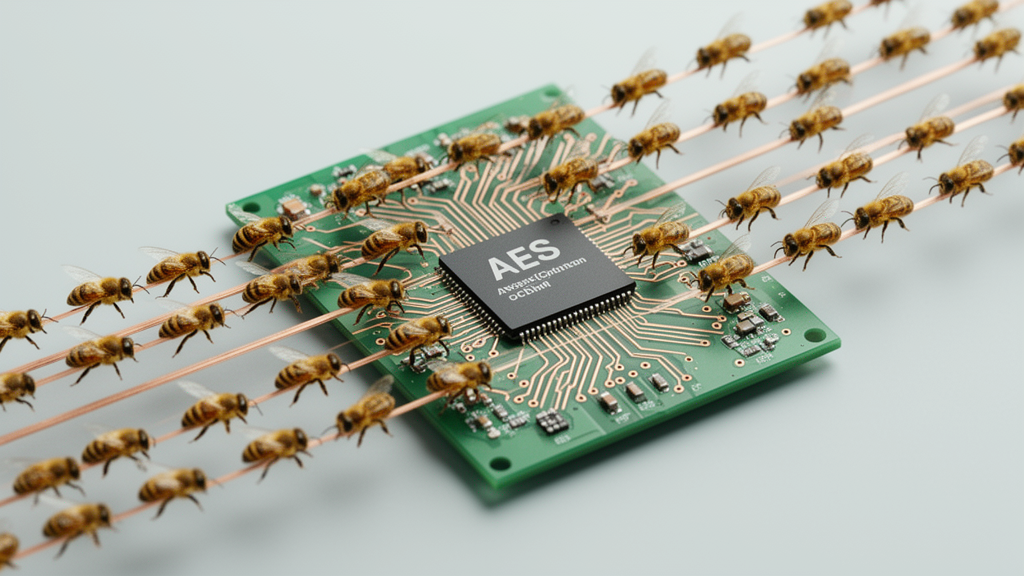
A multiple sequence alignment method adapted from bioinformatics recovered an Advanced Encryption Standard key with up to 44% fewer power traces than a commercial elastic-alignment method in a preliminary side-channel experiment. The test used 500 AES traces containing random-delay desynchronization; the bio-inspired method recovered all subkeys with 140 traces, while elastic alignment required 250. In a separate experiment, the research team also found exploitable power leakage in unprotected reference implementations of the post-quantum CRYSTALS-Kyber algorithm running on two microcontroller architectures.
These findings support a testable proposal for improving physical-security evaluations, but they do not demonstrate that the alignment technique has already been validated for post-quantum systems. The work appears in a Hypothesis and Theory article that combines a practical evaluation of CRYSTALS-Kyber with proof-of-concept evidence drawn from a controlled AES benchmark. Side-channel analysis examines unintended physical signals generated while a device executes cryptography, including variations in power consumption, timing, electromagnetic emissions, temperature and sound.
If an operation depends on secret data, an attacker may gather many traces, align corresponding events and use statistical analysis to determine which secret value best explains the observations. The research is relevant as organizations move toward post-quantum cryptography, which is intended to resist known mathematical attacks by quantum computers but can remain exposed through physical behavior during execution. For the post-quantum experiment, the team used the PQClean reference software for CRYSTALS-Kyber on two CW308T targets mounted on a ChipWhisperer CW308 UFO board.
One target contained an STM32F3 microcontroller with an Arm Cortex-M3 core, while the other used an FE310-G002 with a RISC-V core. A ChipWhisperer-Lite sampled synchronously at approximately 29.5 million samples per second, using a transition on a target GPIO to trigger acquisition. The 10-bit analog-to-digital converter operated at about four times the target clock rate of 7.37 MHz.
The attack point was the fqmul computation involving subkeys in the decryption stage. By manipulating ciphertexts, the researchers made the power consumed during this operation vary in a visually distinguishable way for subkey values of −2, −1, 0, 1 and 2 on the Arm target. The corresponding RISC-V traces did not separate into visually distinguishable groups for those values.
Nevertheless, non-profiled vertical correlation power analysis detected leakage in the RISC-V implementation. The attack assumed knowledge of the input ciphertexts and used a Hamming-Weight leakage model, but it did not use a profiling device containing a known key. The difference between the platforms shows that leakage behavior can depend on processor architecture and implementation rather than following one universal signature.
These results concern deliberately unprotected reference implementations. Neither target incorporated countermeasures or architecture-specific optimizations, so the experiment does not show that all CRYSTALS-Kyber implementations have the same vulnerability. Instead, it establishes that the algorithm is not inherently immune to side-channel analysis and that the same operation can reveal different traces on different hardware.
Security testing therefore cannot be reduced to a single attack transferred automatically between algorithms, processors or code paths. Alignment becomes especially important when countermeasures introduce temporal differences among traces. Random delays can move the same cryptographic operation to different positions in successive acquisitions, while masking, noise injection and shuffling can further complicate the relationship between traces.
If corresponding samples do not represent equivalent computations, correlation with a secret-dependent value can be weakened or missed. Existing preprocessing approaches may align traces against a single reference, use a small number of landmarks or work only with periodic signals. Multiple sequence alignment, or MSA, instead seeks a common arrangement across a collection of related sequences and can accommodate local substitutions and insertion- or deletion-like variations through gap placement.
The biological framing in the study is motivational rather than a claim that hardware traces contain genetic information. The technical rationale is a shared computational problem: both genome analysis and side-channel analysis can involve multiple noisy sequences representing the same underlying process but exhibiting local variation. The authors also note that the analogy is not exact.
This distinction is central to interpreting the method as a computational borrowing rather than a biological model of cryptography. For the proof-of-concept, the team built a Python pipeline that converted side-channel traces in TRS format into DNA-like sequences in FASTA format, called MAFFT version 7 to construct a multiple alignment, and transformed the aligned FASTA output back into TRS traces for subsequent analysis. The amplitude range of each trace was divided uniformly into seven intervals, each represented by one of the symbols A, M, C, S, G, K and T. Four symbols are standard DNA bases and three are ambiguity codes, but here they served only as labels for quantized amplitude ranges.
MAFFT’s –anysymbol option was used because these characters had no biological meaning in the analysis. The researchers used MAFFT’s local-pairwise option to construct its guide tree because random delays were expected to displace limited regions while leaving much of the underlying trace structure related. They enabled 1,000 iterative-refinement steps and selected the gap-opening penalty empirically from values between 0 and 26.
Although alignment operated on the seven-symbol representation, the original numerical value of every power sample was retained separately. That information allowed the researchers to reconstruct aligned power traces after MAFFT had determined the sequence correspondences, preserving the amplitudes needed for correlation analysis rather than analyzing only the quantized symbols. The controlled benchmark consisted of 500 power traces collected from a Riscure pinta board running AES with implemented random delays.
Each trace contained 6,400 samples, and the attack targeted the final AES round under the standard Hamming-Weight leakage model. The same trace set was processed using static alignment, elastic alignment and the experimental MSA-based method. Alignment quality was assessed in two ways: through the maximum correlation coefficient for each output byte and through known-key analysis, with the number of traces required to recover all AES subkeys serving as the principal performance measure.
MSA-based alignment found all subkeys with 140 traces. With the same number, elastic alignment found only half of the subkeys and needed 250 traces to find all of them. The benchmark therefore supports a limited empirical conclusion: under the tested AES random-delay condition, jointly aligning many traces through MAFFT required fewer observations for complete key recovery than the tested elastic method.
It does not establish a new alignment algorithm, because the authors reused MAFFT with modified input and output conversion. The study also did not test the pipeline directly on CRYSTALS-Kyber, and it did not evaluate feature-based synchronization, template-based methods or deep-learning preprocessing. AES was chosen because its known key and established attack point permitted a controlled comparison of desynchronization handling before the much more complicated leakage behavior of post-quantum implementations is addressed.
Several technical limitations could change performance in hardened systems. Quantization discards amplitude differences within each of the seven intervals, and nearby samples on opposite sides of a boundary can receive different symbols. The number and placement of the intervals may therefore influence alignment quality.
MSA can also place gaps so that similar local patterns are treated as corresponding even when they do not represent the same cryptographic operation, a particular concern for post-quantum algorithms containing repeated chunks of computation. Practical implementations may combine random delays, shuffling, masking and noise injection, producing more complicated desynchronization than the single AES countermeasure used in the benchmark. Leakage characteristics can also differ by algorithm, architecture, implementation and individual algorithmic stage.
Scale presents a further challenge. Post-quantum executions can produce substantially longer traces than the AES examples, while comprehensive security assessments may require thousands to millions of traces. Constructing a multiple alignment for such a collection could become expensive in computation and memory even though MAFFT scales comparatively well as sequence counts increase.
The authors suggest evaluating sequence alignment alongside elastic, feature-based, template-based and deep-learning approaches to identify cases in which it adds complementary robustness or efficiency. They also propose investigating custom neural-network layers or loss functions that could reduce the effects of residual misalignment. Until those comparisons are carried out on post-quantum algorithms, their implementations and relevant countermeasure combinations, the method remains a promising but experimentally unconfirmed addition to the security-testing toolbox rather than a validated defense or a demonstrated improvement for deployed post-quantum cryptography.
Subject of Research: Preliminary evaluation of multiple sequence alignment for side-channel analysis of AES and CRYSTALS-Kyber
Article Title: The potential of bio-inspired trace alignment for side-channel analysis
Article References: Alachiotis, N., Ottavi, M., Forlin, B. E., Paraskevopoulos, K., Mariot, L., & Varbanescu, A.-L. (2026). The potential of bio-inspired trace alignment for side-channel analysis. Frontiers in Computer Science, 8, Article 1869476. https://doi.org/10.3389/fcomp.2026.1869476
Image Credits: AI Generated
DOI: 10.3389/fcomp.2026.1869476
Keywords: side-channel analysis, multiple sequence alignment, post-quantum cryptography, CRYSTALS-Kyber, power-trace alignment, bioinformatics, correlation power analysis, hardware security, MAFFT, AES, potential, bio-inspired
News Source: Denise Maddox. (October 21, 2026). Bio-Inspired Alignment Cut AES Trace Needs in Preliminary Test. Scienmag.