


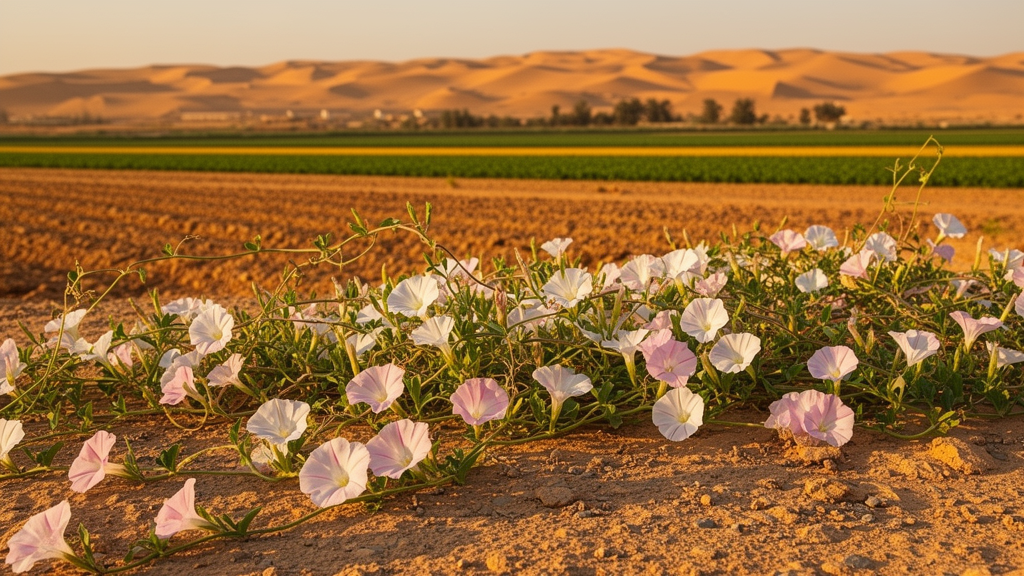
Across a single patch of roadside habitat in Marsa Matrouh governorate on Egypt’s Mediterranean coast, the same perennial herb produces flowers in three distinct shades: pure white, pale pink, and pink. A new open access study published in BMC Biotechnology on 25 September 2026 reports that this flower color polymorphism, long treated as a simple visual curiosity, sits atop a measurable genetic and structural architecture that can now be fingerprinted with molecular markers, pollen grains, seeds, and cross-sections of stems, petioles, and leaves.
The research team, led by Faiza A. Shehata with Muhammad A. Elsobky, Marwa M. Hegazy, and Ehab M. B. Mahdy, collected eight accessions of C. arvensis during the spring 2024–2025 seasons from three roadside localities within the same habitat in Marsa Matrouh. The collections were made during the annual flora excursion of the Botany and Microbiology Department at Menoufia University, and the specimens were identified by Professor Zaki Abd El-Hamied Turki using local floras. Voucher specimens were deposited in the Cairo University Herbarium. Based on floral pigmentation, the accessions were assigned to three biotypes: Biotype 1 with white flowers (accessions 1, 4, and 7), Biotype 2 with pale pink flowers (accessions 2, 5, and 8), and Biotype 3 with pink flowers (accessions 3 and 6).
The study’s central question was whether these color-based biotypes correspond to genuine biological entities or merely to superficial variation. To answer it, the researchers combined four lines of evidence. They recorded macro-morphological characters following standard taxonomic terminology, examined micro-morphology using scanning electron microscopy of pollen grains and seeds, sectioned stems, petioles, and leaf blades for anatomical study, and profiled the plants’ genomes with CDDP markers, short conserved DNA-derived polymorphism primers that target functionally known gene regions. Ten CDDP primers were tested, and seven of them amplified successfully and distinguished between the accessions, providing the binary band data used for all downstream statistics.
The morphological results were striking. Although all eight accessions came from the same roadside habitat, they differed consistently in stem outline, leaf shape, and floral details. Biotype 1 plants have sagittate leaves, a cylindrical ridged stem, and a greenish white dorsal midpetaline area; Biotype 2 plants have subsagittate leaves and an angular stem; Biotype 3 plants have hastate leaves and a ridged, flattened stem. Corolla length ranged from 5 to as much as 25 millimeters, and the internal petal coloration differed among the biotypes. The authors assembled these differences into an artificial identification key, allowing any of the three biotypes to be separated using ordinary morphological, anatomical, seed, and pollen characters.
The microscopic characters added further resolution. Pollen grains in all biotypes were symmetrical, isopolar monads with trizonocolpate, papillate apertures and scabrate-punctate sculpture, but the biotypes diverged in shape class and in the density of papillae. Biotype 2 pollen was subprolate to perprolate with 18 to 20 papillae per 5 by 5 micrometers, while biotypes 1 and 3 were oblate with 25 to 27 and 37 to 39 papillae respectively, and with distinct endoapertural sculpture: hollow with solitary papillae in Biotype 1, irregular papillate and granulate solid bulk in Biotype 2, and hollow with tufts of papillae in Biotype 3. Seed coat sculpture separated Biotype 1, with striated lateral wall ornamentation, from Biotypes 2 and 3, which are wrinkled. Seed length-to-width ratios ranged from 1.36 to 1.48 across the accessions.
Anatomy told a similar quantitative story. Stem vascular bundles numbered up to 9 in Biotype 1, 12 to 13 in Biotype 2, and 15 to 16 in Biotype 3, while petiole outlines were horseshoe-shaped in Biotypes 1 and 3 but ovate in Biotype 2. In the leaf midrib, the presence and number of parenchyma layers above the main vascular bundle differed sharply: Biotype 3 lacked this tissue entirely, Biotype 2 had a single layer, and Biotype 1 had three to four layers. The angle between the upper midrib epidermis and the wing epidermis also varied, from nearly a right angle in Biotype 1 to obtuse angles exceeding 150 degrees in Biotype 2 and between 120 and 150 degrees in Biotype 3. In total, 66 macro- and micro-morphological characters changed measurably along the white-to-pink pigmentation gradient.
The molecular data, however, delivered the study’s most surprising result. CDDP marker analysis revealed high polymorphism of 74.36 percent across primers, with resolving power peaking at 9.50 for accession 7. Accession 7, a white-flowered plant from the third locality, showed the highest expected heterozygosity (H index 0.1497) and polymorphism information content (0.1154), followed closely by accession 8, a pale pink plant from the same locality with a PIC of 0.1140 and resolving power of 9.25. The lowest contributor was accession 5, with a resolving power of 5.75. Pairwise genetic distances ranged from 0.06, between accessions 7 and 8, to 0.46, between accession 2 and the 7–8 pair, and the heatmap partitioned the samples into two clusters aligned primarily by collection locality rather than by flower color.
This geography-overrides-color pattern is the paper’s key conceptual finding. Accessions 1, 2, and 3, representing all three flower colors from the first locality, clustered tightly together, and accession 4, a white plant from the second locality, joined them, likely because the GPS coordinates of the first two localities lie only about two kilometers apart. Accessions 7 and 8, despite their different flower colors, were the most genetically similar pair in the entire dataset. The authors conclude that the interaction between genotype and ecological conditions underlies the genetic variation in flower color in C. arvensis, and that geographic proximity exerts a stronger influence on genetic similarity than floral pigmentation does.
When molecular and morphological data were integrated, the picture shifted again. Hierarchical clustering of the combined distance matrix, computed with Euclidean distances and Ward.D2 linkage in R, grouped Biotype 1 and Biotype 2 closely, with the lowest integrated distance between them (12.37), while Biotype 3 emerged as clearly distinct, at 13.30 from Biotype 1 and 12.49 from Biotype 2. The authors interpret this as confirmation that the three biotypes are distinct biological entities with unique internal and genetic profiles, while acknowledging that the molecular-only clustering conflicted with the morphological and locality-based groupings, a discrepancy they attribute to ecological mechanisms, population structure, pollinators, and collection methods.
The broader context makes the study more than a local taxonomic exercise. Convolvulaceae encompasses 57 genera and roughly 1,955 accepted species, and C. arvensis itself is a morphoplastic perennial native to Europe that has spread globally, with some sixty varieties described in Europe while Egypt has recorded none formally. Previous Egyptian work had identified five genotypes from a single habitat and concluded that phenoplasticity in the species is genetically controlled. The new study adds a nuance: in Marsa Matrouh, both genes and geography matter, and neither morphological nor molecular data alone gives the full picture. The authors suggest that population genetics, phylogeography, pollinator studies, and higher-resolution tools such as SNP markers and DNA barcoding will be needed to resolve the mechanisms shaping the white-pale pink-pink spectrum, and they highlight the potential role of citizen science platforms in mapping this remarkably variable weed.
Subject of Research: Biosystematics and molecular characterization of flower color biotypes of Convolvulus arvensis in Marsa Matrouh, Egypt
Article Title: Biosystematics and molecular characterization of three biotypes of Convolvulus arvensis L. (convolvolaceae) in Marsa Matrouh, Egypt
Article References: Shehata, F. A., Elsobky, M. A., Hegazy, M. M., & Mahdy, E. M. B. (2026). Biosystematics and molecular characterization of three biotypes of Convolvulus arvensis L. (convolvolaceae) in Marsa Matrouh, Egypt. BMC Biotechnology, 26(1), Article 115. https://doi.org/10.1186/s12896-026-01202-5
Image Credits: AI Generated
DOI: 10.1186/s12896-026-01202-5
Keywords: Convolvulus arvensis, field bindweed, flower color polymorphism, CDDP markers, genetic diversity, Marsa Matrouh, Egypt, pollen morphology, seed coat sculpture, plant anatomy, biotypes, BMC Biotechnology
News Source: Juliet Wilcox. (October 29, 2026). Bindweed’s Secret Colors: Genetics and Geography Shape Field Bindweed Biotypes in Egypt. Scienmag.



