

• HOME
  • NEWS
  • EXPLORE
    • CAREER
      • Companies
      • Jobs
    • EVENTS
    • iGEM
      • News
      • Team
    • PHOTOS
    • VIDEO
    • WIKI
  • BLOG
  • COMMUNITY
    • FACEBOOK
    • INSTAGRAM
    • TWITTER
Monday, June 29, 2026
BIOENGINEER.ORG
No Result
View All Result
  • Login
  • HOME
  • NEWS
  • EXPLORE
    • CAREER
      • Companies
      • Jobs
        • Lecturer
        • PhD Studentship
        • Postdoc
        • Research Assistant
    • EVENTS
    • iGEM
      • News
      • Team
    • PHOTOS
    • VIDEO
    • WIKI
  • BLOG
  • COMMUNITY
    • FACEBOOK
    • INSTAGRAM
    • TWITTER
  • HOME
  • NEWS
  • EXPLORE
    • CAREER
      • Companies
      • Jobs
        • Lecturer
        • PhD Studentship
        • Postdoc
        • Research Assistant
    • EVENTS
    • iGEM
      • News
      • Team
    • PHOTOS
    • VIDEO
    • WIKI
  • BLOG
  • COMMUNITY
    • FACEBOOK
    • INSTAGRAM
    • TWITTER
No Result
View All Result
Bioengineer.org
No Result
View All Result
Home NEWS Science News Health

‘Bilingual’ molecule connects two basic codes for life

Bioengineer by Bioengineer
January 9, 2020
in Health
Reading Time: 2 mins read
0
IMAGE
Share on FacebookShare on TwitterShare on LinkedinShare on RedditShare on Telegram

Synthesized molecule holds potential for biomedical applications
IMAGE

Credit: Emory University

The nucleic acids of DNA encode genetic information, while the amino acids of proteins contain the code to turn that information into structures and functions. Together, they provide the two fundamental codes underlying all of life.

Now scientists have found a way to combine these two main coding languages into a single “bilingual” molecule.

The Journal of the American Chemical Society published the work by chemists at Emory University. The synthesized molecule could become a powerful tool for applications such as diagnostics, gene therapy and drug delivery targeted to specific cells.

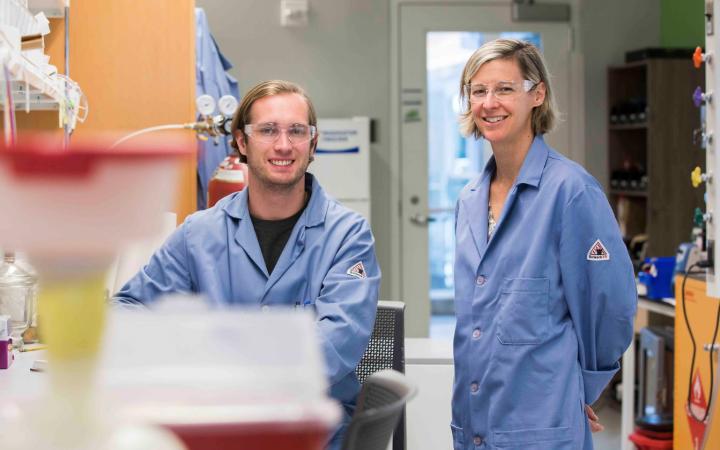
“Much like a translator enables communication between two people from different regions of the world, we envision that our bilingual molecule will enable us to mediate new forms of communications between nucleic acids and proteins in the cellular environment,” says Jennifer Heemstra, associate professor of chemistry at Emory University and senior author of the study.

Nucleic acids store information in an “alphabet” of four bases, known as nucleotides. Peptides and proteins use an entirely different alphabet, made up of 20 different amino acids.

“The nucleic acid language is easy to speak, but kind of limited,” Heemstra says. “While the protein language is incredibly complex and difficult to predict. Both of these molecules have developed exquisite properties over billions of years of evolution.”

Previously synthesized molecules have focused on the properties of either nucleic acids or amino acids. The Emory researchers wanted to harness the powers of both information systems within a single molecule.

The challenge was enormous, drawing on techniques from organic chemistry, molecular and cellular biology, materials science and analytical chemistry. The researchers built a protein scaffold and then attached functioning fragments of nucleotides and amino acids to this framework.

“The two different codes needed to be synthesized separately and then brought together into the scaffold,” says Colin Swenson, first author of the paper and a graduate student in Heemstra’s lab.

The resulting bilingual molecule is stable, made of inexpensive materials, and highly generalizable, giving it the potential for diverse biomedical and nanotechnology applications. “It’s like a programmable, universal adaptor that brings proteins and nucleic acids together,” Heemstra says. “We hope that other researchers are inspired to think about different ways that it might be applied.”

The Emory chemists are now exploring using the bilingual molecule for targeted drug delivery to particular cells. “It’s essentially a stimuli-sensitive container,” Heemstra says. “We’ve demonstrated that it can bind to drug molecules. And it’s programmable to fall apart in the presence of specific RNA molecules that are more abundant in cancer cells.”

###

Media Contact
Carol Clark
[email protected]
404-727-0501

Original Source

https://esciencecommons.blogspot.com/2020/01/bilingual-molecule-connects-two-basic.html

Tags: BiochemistryBiotechnologyChemistry/Physics/Materials SciencesMicrobiologyNanotechnology/MicromachinesPharmaceutical Sciences
Share12Tweet8Share2ShareShareShare2

Related Posts

Tracking Lanthanide-Labeled Microplastics in Plants

June 25, 2026

Neural Design Enables Zero-Shot Drug-Binding Proteins

June 25, 2026

Genomic Insights into Human Skin Fungi Diversity

June 25, 2026

Chiral Laser Gyroscopes Surpass Lock-In Limit

June 25, 2026
Please login to join discussion

POPULAR NEWS

  • Saying Goodbye to PGY-6: Pediatric Fellowship Realities

    103 shares
    Share 41 Tweet 26
  • Multi-Hospital Study Reveals Long Covid Burden Is Twice as High as Current Estimates

    92 shares
    Share 36 Tweet 23
  • Detection of EDCs in Breast Milk and Infant Urine Up to Six Months Highlights Early Exposure Risks

    77 shares
    Share 31 Tweet 19
  • New Drug Candidate Developed at McMaster Shows Potential for Treating Brain Cancer

    58 shares
    Share 23 Tweet 15

About

We bring you the latest biotechnology news from best research centers and universities around the world. Check our website.

Follow us

Recent News

Tracking Lanthanide-Labeled Microplastics in Plants

POSTECH Researchers Slash Cost of Reconstituted Cell-Free Systems by 95%

AI and Physics Collaborate to Design Advanced Hydrogen Storage Materials

Subscribe to Blog via Email

Success! An email was just sent to confirm your subscription. Please find the email now and click 'Confirm' to start subscribing.

Join 82 other subscribers
  • Contact Us

Bioengineer.org © Copyright 2023 All Rights Reserved.

Welcome Back!

Login to your account below

Forgotten Password?

Retrieve your password

Please enter your username or email address to reset your password.

Log In
No Result
View All Result
  • Homepages
    • Home Page 1
    • Home Page 2
  • News
  • National
  • Business
  • Health
  • Lifestyle
  • Science

Bioengineer.org © Copyright 2023 All Rights Reserved.

