

• HOME
  • NEWS
  • EXPLORE
    • CAREER
      • Companies
      • Jobs
    • EVENTS
    • iGEM
      • News
      • Team
    • PHOTOS
    • VIDEO
    • WIKI
  • BLOG
  • COMMUNITY
    • FACEBOOK
    • INSTAGRAM
    • TWITTER
Sunday, July 5, 2026
BIOENGINEER.ORG
No Result
View All Result
  • Login
  • HOME
  • NEWS
  • EXPLORE
    • CAREER
      • Companies
      • Jobs
        • Lecturer
        • PhD Studentship
        • Postdoc
        • Research Assistant
    • EVENTS
    • iGEM
      • News
      • Team
    • PHOTOS
    • VIDEO
    • WIKI
  • BLOG
  • COMMUNITY
    • FACEBOOK
    • INSTAGRAM
    • TWITTER
  • HOME
  • NEWS
  • EXPLORE
    • CAREER
      • Companies
      • Jobs
        • Lecturer
        • PhD Studentship
        • Postdoc
        • Research Assistant
    • EVENTS
    • iGEM
      • News
      • Team
    • PHOTOS
    • VIDEO
    • WIKI
  • BLOG
  • COMMUNITY
    • FACEBOOK
    • INSTAGRAM
    • TWITTER
No Result
View All Result
Bioengineer.org
No Result
View All Result
Home NEWS Science News Chemistry

Big planets get a head start in pancake-thin nurseries

Bioengineer by Bioengineer
October 5, 2022
in Chemistry
Reading Time: 2 mins read
0
ALMA: Oph163131 disc
Share on FacebookShare on TwitterShare on LinkedinShare on RedditShare on Telegram

Super-thin planet nurseries have a boosted chance of forming big planets, according to a study announced this week at the Europlanet Science Congress (EPSC) 2022 in Granada, Spain. An international team, led by Dr Marion Villenave of NASA Jet Propulsion Laboratory (JPL), observed a remarkably thin disc of dust and gas around a young star, and found that its structure accelerated the process of grains clumping together to form planets. 
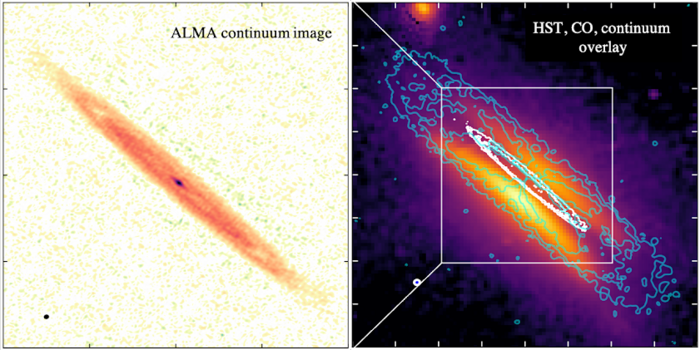
ALMA: Oph163131 disc

Credit: Credit: ALMA (ESO/NAOJ/NRAO) /Hubble/NASA/ESA /M. Villenave

Super-thin planet nurseries have a boosted chance of forming big planets, according to a study announced this week at the Europlanet Science Congress (EPSC) 2022 in Granada, Spain. An international team, led by Dr Marion Villenave of NASA Jet Propulsion Laboratory (JPL), observed a remarkably thin disc of dust and gas around a young star, and found that its structure accelerated the process of grains clumping together to form planets. 

“Planets only have a limited opportunity to form before the disc of gas and dust, their nursery, is dissipated by radiation from their parent star. The initial micron-sized particles composing the disc must grow rapidly to larger millimetre-sized grains, the building blocks of planets. In this thin disc, we can see that the large particles have settled into a dense midplane, due to the combined effect of stellar gravity and interaction with the gas, creating conditions that are extremely favourable for planetary growth,” explained Dr Villenave.

Using the Atacama Large Millimeter Array (ALMA) in Chile, the team obtained very high resolution images of the proto-planetary disc Oph163131, located in a nearby star-forming region called Ophiuchus. Their observations showed that, while disc is twice the diameter of our Solar System, at its outer edge the bulk of the dust is concentrated vertically in a layer only half the distance from Earth to the Sun. This makes it one of the thinnest planetary nurseries observed to date.

“Looking at proto-planetary discs edge-on gives a clear view of the vertical and radial dimensions, so that we can disentangle the dust evolution processes at work”, said Villenave. “ALMA gave us our first look at the distribution of millimetre-sized grains in this disc. Their concentration into such a thin layer was a surprise, as previous Hubble Space Telescope (HST) observations of finer, micron-sized particles showed a region extending almost 20 times higher.”

Simulations by the team based on the observations show that the seeds of gas-giant planets, which must be at least 10 Earth-masses, can form in the outer part of the disc in less than 10 million years. This is within the typical lifetime of a planetary nursery before it dissipates.  

“Thin planet nurseries appear to be favourable for forming big planets, and may even facilitate planets forming at large distance from the central star,” said Villenave. “Finding further examples of these thin discs might help provide more insights into the dominant mechanisms for how wide-orbit planets form, a field of research where there are still many open questions.”



Share12Tweet8Share2ShareShareShare2

Related Posts

Intelligent Microgrid Management Promises Lower Household Energy Bills and Reduced Diesel Emissions — Chemistry

Intelligent Microgrid Management Promises Lower Household Energy Bills and Reduced Diesel Emissions

July 4, 2026
Graz University of Technology Deciphers the Structural Secrets of MOF Thin Films — Chemistry

Graz University of Technology Deciphers the Structural Secrets of MOF Thin Films

July 2, 2026

Breaking Thermodynamic Limits: Wavelength-Driven Catalysis Advances Ammonia Synthesis

July 2, 2026

From Quantum Mechanics to AI-Powered Materials Discovery: MARVEL Marks 12 Years of Transforming Computational Science

July 2, 2026

POPULAR NEWS

  • Detection of EDCs in Breast Milk and Infant Urine Up to Six Months Highlights Early Exposure Risks

    77 shares
    Share 31 Tweet 19
  • Saying Goodbye to PGY-6: Pediatric Fellowship Realities

    103 shares
    Share 41 Tweet 26
  • New Drug Candidate Developed at McMaster Shows Potential for Treating Brain Cancer

    58 shares
    Share 23 Tweet 15
  • KTU Researchers Explore Ultrasound’s Role in Enhancing Blood Flow Beyond Diagnostics

    53 shares
    Share 21 Tweet 13

About

We bring you the latest biotechnology news from best research centers and universities around the world. Check our website.

Follow us

Recent News

Quasi-Bound States Boost Quantum Well Photoresponse

Lysine Pyruvylation Links Glycolysis to Epigenetics

Multiphysics Coupling: Single vs. Multiple DeepONet Branches

Subscribe to Blog via Email

Success! An email was just sent to confirm your subscription. Please find the email now and click 'Confirm' to start subscribing.

Join 83 other subscribers
  • Contact Us

Bioengineer.org © Copyright 2023 All Rights Reserved.

Welcome Back!

Login to your account below

Forgotten Password?

Retrieve your password

Please enter your username or email address to reset your password.

Log In
No Result
View All Result
  • Homepages
    • Home Page 1
    • Home Page 2
  • News
  • National
  • Business
  • Health
  • Lifestyle
  • Science

Bioengineer.org © Copyright 2023 All Rights Reserved.