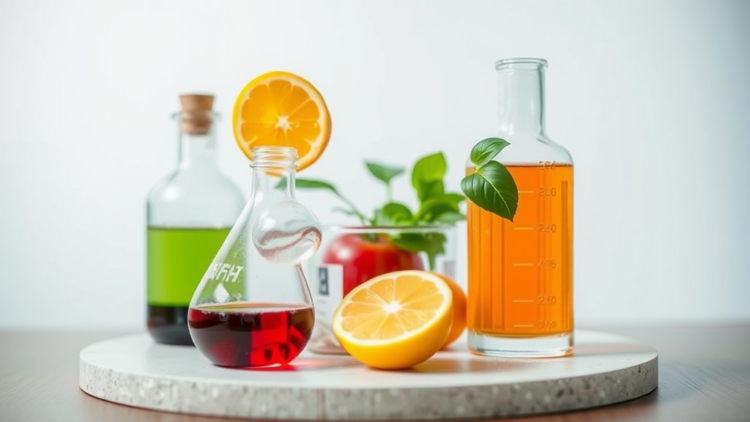
A team of chemists in India and Nepal has shown that some of the most humble ingredients found in any kitchen—lemon juice, banana peel, garlic, kiwi, orange, tomato, aloe vera and onion—can replace conventional, often hazardous catalysts in one of organic chemistry’s most widely used reactions. In a study published in Discover Green Chemistry, the researchers demonstrate that these natural extracts efficiently drive the condensation of benzaldehyde and aniline to form N-benzylideneaniline, a model Schiff base, with yields ranging from 59 to 86 percent under mild, environmentally friendly conditions. The work offers a compelling example of how green chemistry principles can be translated into practical laboratory protocols that reduce waste, cost and toxicity without sacrificing performance.
Schiff bases occupy a special place in the chemical sciences. First characterized in 1864 by the Italian-based German chemist Hugo Schiff, these compounds feature a defining carbon–nitrogen double bond—the imine linkage—formed when a primary amine reacts with a carbonyl compound. Structurally, they follow the general formula R1R2C=NR3, where the substituents can be combined in countless ways, giving rise to an enormously diverse family of molecules. Depending on their architecture, Schiff bases are classified as secondary ketimines or secondary aldimines, and imines derived from anilines carry the historical name “anils.” The parent compound targeted in this study, N-benzylideneaniline, is the simplest and most frequently studied member of this class.
What makes Schiff bases so valuable is their extraordinary versatility. They serve as ligands in coordination and inorganic chemistry, where they readily bind metal ions to form complexes with rich catalytic and magnetic properties. In biology and medicine, Schiff base derivatives have been reported to display antifungal, antibacterial, anticancer, antioxidant and anti-inflammatory activities, making them recurring motifs in drug discovery programs. Certain Schiff base transition metal complexes also exhibit strong catalytic performance at elevated temperatures, and recent literature describes sophisticated supported variants—manganese, cobalt, copper and palladium complexes immobilized on nanocellulose, MCM-41 and magnetic nanoparticles—that catalyze oxidations, epoxidations and cross-coupling reactions. Any improvement in how these building blocks are manufactured therefore resonates across multiple disciplines.
The trouble with traditional Schiff base synthesis lies in what surrounds the reaction rather than the reaction itself. Conventional protocols frequently deploy mineral acids, Lewis acids or metal salts as catalysts, alongside volatile organic solvents that are hazardous, flammable or expensive to dispose of. These reagents can pose risks to laboratory workers and accumulate as persistent waste in the environment. The new study confronts this problem directly, drawing on the twelve principles of green chemistry articulated in 1998 by Paul Anastas and John C. Warner—guidelines that urge chemists to prevent pollution at the source, minimize material and energy use, and design safer molecules and processes rather than cleaning up emissions after the fact.
The research team, led by Sarvesh Kumar Pandey of D.D.U. Gorakhpur University with collaborators at Tribhuvan University in Nepal and GITAM University in Hyderabad, systematically optimized the model condensation of benzaldehyde and aniline. In the absence of any catalyst, stirring the two reagents at room temperature for one hour produced no detectable product, and heating at 60 degrees Celsius for two hours gave only a small amount. When small quantities of natural fruit and vegetable extracts were added, however, the reaction proceeded readily, furnishing the yellow crystalline product in moderate to excellent yields. The juices were prepared simply by pressing fresh produce and filtering through cotton, and their acidity was verified with pH strips: lemon juice proved the most acidic at pH 2.0, followed by kiwi and orange at pH 3.0, while garlic was nearly neutral at pH 6.0.
The mechanistic logic is straightforward. The carbonyl group of benzaldehyde is electrophilic, and the amine group of aniline is nucleophilic, so condensation should in principle be facile; what the natural catalysts contribute is protonation of the heteroatoms by their organic acids, which activates the carbonyl toward nucleophilic attack and accelerates dehydration to the imine. Consistent with this picture, the more acidic extracts generally performed best. The team also explored solvent effects, testing neat conditions and green solvents, and found that certain combinations of extract and medium shortened reaction times and improved yields further. Microwave assistance added another dimension: irradiating the catalyst-free reaction at 600 watts for 80 seconds without solvent was ineffective, but adding a natural catalyst under microwave irradiation delivered the Schiff base in 70 percent yield at 400 watts and 76 percent at 600 watts, compressing hours of conventional heating into seconds.
To confirm that the chemistry was really happening as intended, the researchers monitored reactions by thin-layer chromatography and quantitatively by ultraviolet–visible spectroscopy using a Shimadzu UV-1800 spectrophotometer. As the condensation progressed, a new broad absorption band appeared at 264 nanometers, characteristic of the conjugated imine chromophore. Spectra of benzaldehyde and aniline recorded separately, along with spectra of each catalyst extract, allowed the team to unambiguously attribute the new band to product formation. The isolated N-benzylideneaniline was fully characterized by melting point, FTIR spectroscopy—showing the diagnostic C=N stretch at 1621 wavenumbers—proton and carbon-13 NMR, elemental analysis and electrospray mass spectrometry, which confirmed the molecular formula C13H11N with a parent ion at mass-to-charge ratio 181.
Importantly, the protocol proved general. The team extended the optimized conditions to a series of substituted aromatic aldehydes bearing both electron-donating and electron-withdrawing groups, and the reactions proceeded smoothly to give the corresponding Schiff base derivatives in good to excellent yields. This functional group tolerance indicates that the natural catalysts are not finicky about the electronic character of the substrates, broadening the method’s utility well beyond the parent compound. Compared with many previously reported green catalysts, the extracts used here are inexpensive, biodegradable and available from local markets with minimal processing, and they enable product formation under mild conditions—including, in some cases, solvent-free microwave irradiation—while products are purified by simple recrystallization from ethanol.
The authors are candid about the limitations of their approach. Recovering and reusing liquid biological extracts is technically challenging and may require processing that is not economically or energetically favorable; instead, the green credentials of these catalysts rest on their renewable origin, biodegradability, low cost and safe disposal with minimal environmental impact. The natural variability in the composition of fruit and vegetable juices from batch to batch, and the current restriction of the protocol to bench-scale synthesis, remain hurdles to industrial adoption. Even so, the study demonstrates that readily available food waste and produce can match the performance of synthetic catalysts in a cornerstone transformation, and the researchers argue that the framework can be readily extended to the synthesis of novel Schiff bases. As the chemical industry faces mounting pressure to decarbonize and detoxify its supply chains, recipes borrowed from the kitchen may prove to be among the most powerful tools in the green chemist’s repertoire.
Subject of Research: Green catalytic synthesis of Schiff bases using natural fruit and vegetable extracts
Article Title: Green catalytic approaches for the synthesis of Schiff’s base
Article References: Khurseed, F., Dwivedi, P. D., Arya, D., Upadhyay, A., Sharma, M. L., Pathak, P., Dwivedi, A. R., & Pandey, S. K. (2026). Green catalytic approaches for the synthesis of Schiff’s base. Discover Green Chemistry, 1(1), Article 33. https://doi.org/10.1007/s44509-026-00034-y
Image Credits: AI Generated
DOI: 10.1007/s44509-026-00034-y
Keywords: Schiff base, green chemistry, natural catalysts, imine synthesis, N-benzylideneaniline, benzaldehyde, aniline, microwave synthesis, solvent-free reactions, sustainable chemistry, fruit extracts, condensation reaction
Cite Scienmag News
APA
MLA
Chicago
Bethany Barker. (September 12, 2026). Kitchen Chemistry: Fruit and Vegetable Juices Catalyze Cleaner Synthesis of Schiff Bases. Scienmag. https://scienmag.com/kitchen-chemistry-fruit-and-vegetable-juices-catalyze-cleaner-synthesis-of-schiff-bases/
Bethany Barker. “Kitchen Chemistry: Fruit and Vegetable Juices Catalyze Cleaner Synthesis of Schiff Bases.” Scienmag, 12 September 2026, https://scienmag.com/kitchen-chemistry-fruit-and-vegetable-juices-catalyze-cleaner-synthesis-of-schiff-bases/. Accessed 12 September 2026.
Bethany Barker. “Kitchen Chemistry: Fruit and Vegetable Juices Catalyze Cleaner Synthesis of Schiff Bases.” Scienmag. September 12, 2026. https://scienmag.com/kitchen-chemistry-fruit-and-vegetable-juices-catalyze-cleaner-synthesis-of-schiff-bases/
Copy citation
Download RIS
Tags: anilinebenzaldehydecondensation reactioneco-friendly organic reactions using fruit and vegetable extractsenvironmentally friendly methods for Schiff base productionfruit extractsgreen chemistrygreen chemistry in kitchen-based organic synthesisgreen chemistry principles in laboratory protocolshazardous catalyst replacement in organic synthesisimine synthesismicrowave synthesismild conditions for environmentally sustainable chemical reactionsN-benzylideneanilinenatural catalystsnatural catalysts for Schiff base formationnatural extract-based catalysis in organic chemistryorganic reaction catalysis with natural ingredientsplant-derived catalysts in chemical reactionsSchiff basesolvent-free reactionssustainable chemistrysustainable synthesis of N-benzylideneanilineuse of citrus and vegetable peels in organic chemistry