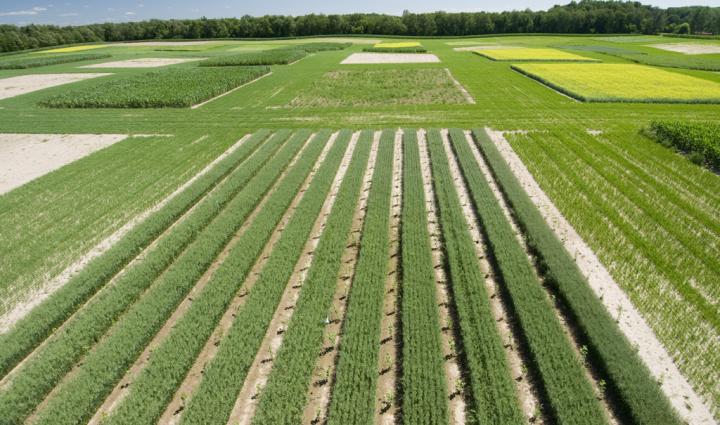
Credit: Michigan State University
EAST LANSING, Mich. – A new Michigan State University study shines a light on how big data and digital technologies can help farmers better adapt to threats — both present and future — from a changing climate.
The study, published in Scientific Reports, is the first to precisely quantify soil and landscape features and spatial and temporal yield variations in response to climate variability. It is also the first to use big data to identify areas within individual fields where yield is unstable.
Between 2007 and 2016, the U.S. economy took an estimated $536 million economic hit because of yield variation in unstable farmland caused by climate variability across the Midwest. More than one-quarter of corn and soybean cropland in the region is unstable. Yields fluctuate between over-performing and underperforming on an annual basis.
Bruno Basso, MSU Foundation professor of earth and environmental sciences, and his postdoctoral research fellow, Rafael Martinez-Feria, set out to address the key pillars of the National Institute for Food and Agriculture’s Coordinated Agricultural Project that Basso has led since 2015.
“First, we wanted to know why — and where — crop yields varied from year to year in the corn and soybean belt of the U.S.,” Basso said. “Next, we wanted to find out if it was possible to use big data to develop and deploy climate-smart agriculture solutions to help farmers reduce cost, increase yields and limit environmental impact.”
Basso and Martinez-Feria first examined soil and discovered that alone, it could not sufficiently explain such drastic yield variations.
“The same soil would have low yield one year and high yield the next,” Basso said. “So, what is causing this temporal instability?”
Using an enormous amount of data obtained from satellites, research aircraft, drones and remote sensors, and from farmers via advanced geospatial sensor suites present in many modern combine harvesters, Basso and Martinez-Feria wove big data and digital expertise together.
What they found is that the interaction between topography, weather and soil has an immense impact on how crop fields respond to extreme weather in unstable areas. Terrain variations, such as depressions, summits and slopes, create localized areas where water stands or runs off. Roughly two-thirds of unstable zones occur in these summits and depressions and the terrain controls water stress experienced by crops.
With comprehensive data and the technology, the team quantified the percentage of every single corn or soybean field in the Midwest that is prone to water excess or water deficit. Yields in water-deficient areas can be 23 to 33% below the field average for seasons with low rainfall but are comparable to the average in very wet years. Areas prone to water excess experienced yields 26 to 33% below field average during wet years.
Basso believes their work will help determine the future of climate-smart agriculture technologies.
“We are primarily concerned with helping farmers see their fields in a new manner, helping them make better decisions to improve yield, reduce cost and improve environmental impact,” Basso said. “Knowing that you have an area shown to be water deficient, you will plan your fertilizer applications differently. The amount of fertilizer for this area should be significantly lower than what you would apply in areas of the same field with more water available to the plants.”
###
The study was funded by USDA NIFA (awards 2015-68007-23133, 2018- 67003-27406) and AgBioResearch.
“Combining big data spatially with landscape position this way could forever change the way midwestern farmers fertilize their fields, and ultimately reduce the amount of reactive nitrogen getting into our water,” said Jim Dobrowolski, NIFA national program leader.
NIFA supports an integrated approach to ensure that groundbreaking discoveries in agriculture-related sciences and technologies reach the people who can put them into practice.
“NIFA’s collaboration with the Michigan State University team has led to various papers with students and postdoctoral fellows. It supports one of its critical mandates to fund innovative agricultural science and develop the next generation of scientists,” said Scott Angle, NIFA director.
(Note for media: Please include a link to the original paper in online coverage: https:/
Michigan State University has been working to advance the common good in uncommon ways for 160 years. One of the top research universities in the world, MSU focuses its vast resources on creating solutions to some of the world’s most pressing challenges, while providing life-changing opportunities to a diverse and inclusive academic community through more than 200 programs of study in 17 degree-granting colleges.
For MSU news on the Web, go to MSUToday. Follow MSU News on Twitter at twitter.com/MSUnews
Media Contact
Caroline Brooks
[email protected]
517-432-0920
Original Source
https:/