• HOME
  • NEWS
  • EXPLORE
    • CAREER
      • Companies
      • Jobs
    • EVENTS
    • iGEM
      • News
      • Team
    • PHOTOS
    • VIDEO
    • WIKI
  • BLOG
  • COMMUNITY
    • FACEBOOK
    • INSTAGRAM
    • TWITTER
Thursday, November 19, 2026
BIOENGINEER.ORG
No Result
View All Result
  • Login
  • HOME
  • NEWS
  • EXPLORE
    • CAREER
      • Companies
      • Jobs
        • Lecturer
        • PhD Studentship
        • Postdoc
        • Research Assistant
    • EVENTS
    • iGEM
      • News
      • Team
    • PHOTOS
    • VIDEO
    • WIKI
  • BLOG
  • COMMUNITY
    • FACEBOOK
    • INSTAGRAM
    • TWITTER
No Result
View All Result
Bioengineer.org
No Result
View All Result
Home NEWS Science News

Big bumblebees learn locations of best flowers

Bioengineer by Bioengineer
December 28, 2020
in Science News
Reading Time: 2 mins read
0
IMAGE
Share on FacebookShare on TwitterShare on LinkedinShare on RedditShare on Telegram

IMAGE

Credit: Natalie Hempel de Ibarra

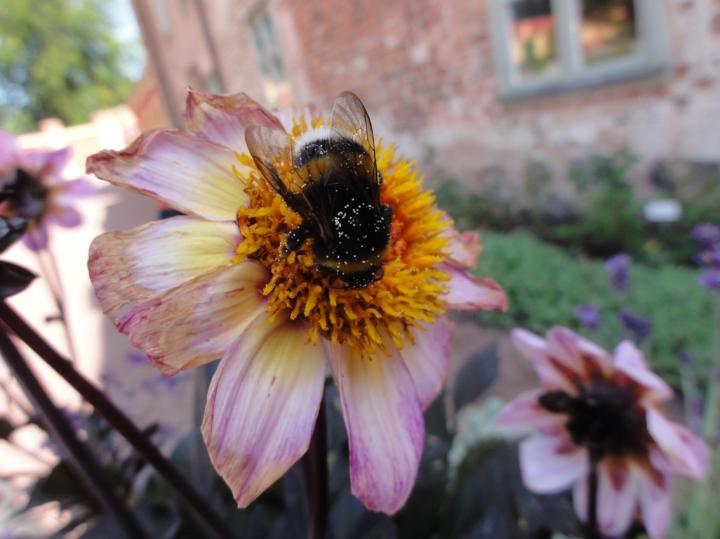
Big bumblebees take time to learn the locations of the best flowers, new research shows.

Meanwhile smaller bumblebees – which have a shorter flight range and less carrying capacity – don’t pay special attention to flowers with the richest nectar.

University of Exeter scientists examined the “learning flights” which most bees perform after leaving flowers.

Honeybees are known to perform such flights – and the study shows bumblebees do the same, repeatedly looking back to memorise a flower’s location.

“It might not be widely known that pollinating insects learn and develop individual flower preferences, but in fact bumblebees are selective,” said Natalie Hempel de Ibarra, Associate Professor at Exeter’s Centre for Research in Animal Behaviour.

“On leaving a flower, they can actively decide how much effort to put into remembering its location.

“The surprising finding of our study is that a bee’s size determines this decision making and the learning behaviour.”

In the study, captive bees visited artificial flowers containing sucrose (sugar) solution of varying concentrations.

The larger the bee, the more its learning behaviour varied depending on the richness of the sucrose solution.

Smaller bees invested the same amount of effort in learning the locations of the artificial flowers, regardless of whether sucrose concentration was high or low.

“The differences we found reflect the different roles of bees in their colonies,” said Professor Hempel de Ibarra.

“Large bumblebees can carry larger loads and explore further from the nest than smaller ones.

“Small ones with a smaller flight range and carrying capacity cannot afford to be as selective, so they accept a wider range of flowers.

“These small bees tend to be involved more with tasks inside the nest – only going out to forage if food supplies in the colony are running low.”

The study was conducted in collaboration with scientists from the University of Sussex.

The bees were observed in greenhouses at the University of Exeter’s award-winning Streatham Campus, and Professor Hempel de Ibarra thanked the university’s Grounds and Gardens team for their continued support.

The study was funded by the Leverhulme Trust.

The paper, published in the journal Current Biology, is entitled: “Small and large bumblebees invest differently when learning about flowers.”

###

Media Contact
Alex Morrison
a.morrison@exeter.ac.uk

Related Journal Article

http://dx.doi.org/10.1016/j.cub.2020.11.062

Tags: BiodiversityBiologyEcology/EnvironmentEvolutionNutrition/NutrientsPlant SciencesZoology/Veterinary Science
Share12Tweet8Share2ShareShareShare2

Related Posts

LiDAR-Gated Motion Magnification Enables Automated Structural Monitoring from Mobile Platforms

LiDAR-Gated Motion Magnification Enables Automated Structural Monitoring from Mobile Platforms

November 19, 2026
Recursive Fitness-Based Scheduling Enhances 5G Uplink Efficiency for Machine Communications

Recursive Fitness-Based Scheduling Enhances 5G Uplink Efficiency for Machine Communications

November 19, 2026

Carbon Monoxide Exposure Linked to Increased Obesity and Mental Health Risks

November 19, 2026

Neural-ODE Framework Models Cuprate Bulk Fields but Encounters High-Temperature Limitations

November 19, 2026
Please login to join discussion

POPULAR NEWS

  • Dyspnea and Eco-Anxiety Independently Link to Poorer Quality of Life in COPD

    Dyspnea and Eco-Anxiety Independently Link to Poorer Quality of Life in COPD

    29 shares
    Share 12 Tweet 7
  • Dystrophic Epidermolysis Bullosa Patients in Poland Face High Mental Health Morbidity

    29 shares
    Share 12 Tweet 7
  • Machine Learning Predicts Liver Fibrosis Risk in Prior Schistosoma Japonicum Infection

    29 shares
    Share 12 Tweet 7
  • Israeli Policy and Nursing Perspectives Diverge on Second Victim Phenomenon

    29 shares
    Share 12 Tweet 7

About

We bring you the latest biotechnology news from best research centers and universities around the world. Check our website.

Follow us

Recent News

LiDAR-Gated Motion Magnification Enables Automated Structural Monitoring from Mobile Platforms

Recursive Fitness-Based Scheduling Enhances 5G Uplink Efficiency for Machine Communications

Carbon Monoxide Exposure Linked to Increased Obesity and Mental Health Risks

Subscribe to Blog via Email

Enter your email address to subscribe to this blog and receive notifications of new posts by email.

Join 88 other subscribers
  • Contact Us

Bioengineer.org © Copyright 2023 All Rights Reserved.

Welcome Back!

Login to your account below

Forgotten Password?

Retrieve your password

Please enter your username or email address to reset your password.

Log In
No Result
View All Result
  • Homepages
    • Home Page 1
    • Home Page 2
  • News
  • National
  • Business
  • Health
  • Lifestyle
  • Science

Bioengineer.org © Copyright 2023 All Rights Reserved.