Nearly nine in ten cases of sudden cardiac death (SCD) due to hypertrophic cardiomyopathy (HCM) in young people are preceded by symptoms, ECG abnormalities or a positive family history, according to a new study published this week in the open-access journal PLOS ONE by Erik Börjesson of Sahlgrenska University Hospital, Sweden, and colleagues. Those findings suggest that expanding cardiac screening beyond competitive athletes could aid in the prevention of SCD in the young population with HCM.
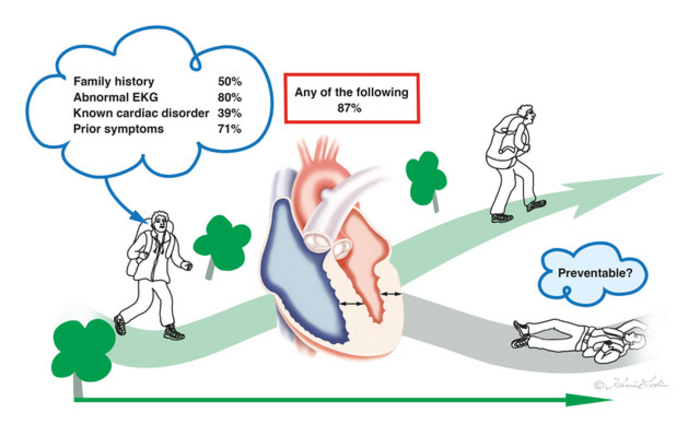
Credit: Karin Lodin, CC-BY 4.0 (https://creativecommons.org/licenses/by/4.0/)
Nearly nine in ten cases of sudden cardiac death (SCD) due to hypertrophic cardiomyopathy (HCM) in young people are preceded by symptoms, ECG abnormalities or a positive family history, according to a new study published this week in the open-access journal PLOS ONE by Erik Börjesson of Sahlgrenska University Hospital, Sweden, and colleagues. Those findings suggest that expanding cardiac screening beyond competitive athletes could aid in the prevention of SCD in the young population with HCM.
HCM is a genetic cardiovascular disease believed to affect one in 500 individuals in the general population. While sudden death due to HCM is rare, it is still a major cause of natural death in the young. Identifying at-risk patients can reduce the risk of SCD in young individuals with HCM, for example by exercise restriction and drug therapies. Implantable cardioverter defibrillators (ICDs) can also prevent deaths and improve quality of life. For instance, after suffering an on-field cardiac arrest last year, Danish footballer Christian Eriksen was able to return to playing eight months later with an ICD.
In the new study, the researchers analyzed all cases of SCD with HCM between 2000 and 2010 in Sweden among individuals under age 35, along with controls. They characterized the clinical symptoms, medical history, family history and ECG findings before the occurrence of SCD using data from national registries, autopsy reports, medical records, and interviews with relatives post-mortem.
Among the 38 SCD cases identified, which included 31 males and 7 females, 71% presented with possible cardiac symptoms, including chest pain and palpitations, before death, and 69% received medical care in the 180 days before death (compared to just 21% of controls receiving medical care in that time period). 39% had a known cardiac disorder prior to death and 50% had a positive family history for heart disease. In total, 28 individuals underwent ECG evaluation at some point during their lifetime. Of these, 23 (82%) had ECG findings that were considered abnormal, but the overall number of abnormal ECG-recordings is around 60% when looking at all the cases.
The authors conclude that it may be possible to predict, and prevent, SCD in young individuals with HCM. ECG screening, for instance, could be expanded beyond competitive athletes and a routine school screening program could ensure equal detection across males and females.
The authors add: “The majority of young people dying from sudden cardiac death due to HCM present with one or more abnormalities that may be recognized during cardiac screening.”
#####
In your coverage please use this URL to provide access to the freely available article in PLOS ONE: https://journals.plos.org/plosone/article?id=10.1371/journal.pone.0273567
Citation: Börjesson E, Svennblad B, Wisten A, Börjesson M, Stattin E-L (2022) Symptoms and ECG changes precede sudden cardiac death in hypertrophic cardiomyopathy—A nationwide study among the young in Sweden. PLoS ONE 17(9): e0273567. https://doi.org/10.1371/journal.pone.0273567
Author Countries: Sweden
Funding: ELS: Marcus Borgström, Uppsala University Hospital, and Uppsala University, The Swedish Society of Medicine. AW: Norrbotten County council, Sweden. MB: Internal funding Region of Western Sweden (ALFGBG-720691). The sponsors did not play any role in the study design, data collection and analysis, decision to publish, or preparation of the manuscript.
Journal
PLoS ONE
DOI
10.1371/journal.pone.0273567
Method of Research
Observational study
Subject of Research
People
Article Title
Symptoms and ECG changes precede sudden cardiac death in hypertrophic cardiomyopathy—A nationwide study among the young in Sweden
Article Publication Date
14-Sep-2022
COI Statement
The authors have declared that no competing interests exist.