The world of insect taxonomy has lost one of its most meticulous practitioners. Bernhard Merz, the Swiss entomologist whose name became synonymous with the study of true flies, died on February 14, 2023 at the Cantonal Hospital in Chur, Switzerland, at the age of 59. An obituary published in the journal Alpine Entomology by his colleagues Giulio Cuccodoro and Bernard Landry of the Natural History Museum of Geneva now chronicles a career that transformed the understanding of fly diversity across the West Palearctic region and far beyond. Over a span of roughly three decades, Merz published 236 scientific papers on the taxonomy and faunistics of Diptera and other insects, described 96 new taxa, and saw 30 taxa dedicated to him by fellow researchers, a level of recognition that places him among the greatest Swiss entomologists of his generation.
Merz was born on July 29, 1963 in Basel, Switzerland, and attended school in the canton of Basel-Landschaft. His scientific path began not with insects but with plants. He studied biology at the ETH Zürich from 1982 to 1986, graduating with a Bachelor’s thesis on the vegetation composition of semi-dry grasslands after ten years of fallow, mowing and burning management near Merishausen in the canton of Schaffhausen, under the supervision of Professor Elias Landolt. That early training in field botany left a lasting mark: throughout his career, Merz approached flies not as isolated specimens but as organisms bound to specific habitats, host plants and landscapes, a perspective that informed both his collecting strategy and his taxonomic reasoning.
A trip to the USA, New Zealand and Australia from January to April 1987 broadened his horizons, and on May 1, 1987 he took up a position as a technical collaborator at the entomological collection of the Institute of Entomology of the ETH Zürich. He remained in the collection as a PhD student of Professor Willy Sauter from March 1, 1988 to September 30, 1992. His doctorate, awarded at the ETH Zürich on September 11, 1992, was a substantial piece of systematic work: a revision of the West Palearctic genera and species of the Paroxyna group together with a revision of the fruit flies of Switzerland. The Tephritidae, the family of fruit flies that includes many agriculturally significant species, would remain at the center of his research for the rest of his life.
Professional responsibility followed quickly. On October 1, 1992, Merz became curator of the entomological collection at the ETH Zürich, a post he held until November 30, 1998. In parallel, he served as a teaching assistant and lecturer, first at the Institute of Entomology and then in Applied Entomology at the Institute of Plant Science of the ETH Zürich, where he was promoted to senior scientist on March 1, 1996. On December 1, 1998, he was hired as a research scientist at the Department of Entomology of the Natural History Museum of Geneva, and exactly one year later he was promoted to curator, the position that would define the second half of his career.
At the Geneva museum, Merz’s passion for Diptera found its fullest expression. His research interests spanned the taxonomy, nomenclature, phylogeny and biogeography of the world’s Tephritidae, Pallopteridae and Clusiidae, the taxonomy of the West Palearctic Lauxaniidae, and the faunistics of the Diptera of Switzerland in general and of Geneva in particular. The fruit flies, with their intricate wing patterns and highly specific host associations, offered a technically demanding arena in which morphological precision and biogeographic insight had to converge. The Lauxaniidae, a family of small, often brightly colored flies abundant in humid forest habitats, became another specialty, and his West Palearctic revisions of the group remain standard references for anyone working on European fly diversity.
The scale of his fieldwork was extraordinary. Beyond countless excursions across Switzerland, Merz collected with his net in more than twenty countries on four continents. His itineraries, preserved in the obituary, read like a global sampling program: France, Spain, mainland Italy, Sardinia, Sicily, Malta, Crete, Cyprus, Turkey, Israel, Andorra, Austria, Czechia, Hungary, Holland, England, Sweden, the Canary Islands, Kyrgyzstan, South Korea, Thailand, Australia, Canada and Kenya. Each expedition yielded specimens that entered the Geneva collection as carefully labeled, georeferenced material. The fruits of this labor increased the Diptera collection at the Museum of Geneva from barely 10,000 specimens to nearly 100,000 specimens, including more than 30,000 Lauxaniidae and Tephritidae, a tenfold expansion achieved largely through the systematic vision of a single curator.
Merz’s taxonomic output was equally remarkable. During his career he described 96 taxa, comprising five genera and 91 species, and 30 taxa, two genera and 28 species, were dedicated to him by colleagues honoring his contributions. Describing a new species in a well-studied group requires more than a good specimen: it demands comparison against type material across international collections, a command of the nomenclatural literature, and the ability to articulate diagnostic characters that will hold up under phylogenetic scrutiny. Merz’s prodigious memory, noted by those who knew him, served this work directly. Colleagues recall that he could discuss tea for hours, and the same conversational depth applied to the morphology and distribution of flies he had studied decades earlier.
His engagement extended well beyond the laboratory. Merz was involved in numerous academic societies, including the Swiss Entomological Society from 1988 to 2015, the Entomological Society of Zurich, where he served on the committee and as president from 1995 to 1999, Pronatura Zürich, the Entomological Society of Geneva, where he was president from 2003 to 2008, and the Entomological Society of Basel. These roles made him a connector within the European entomological community, someone who organized field meetings, mentored students and maintained the informal networks through which specimens, ideas and taxonomic problems circulate. In an era when museum curation is increasingly digital, Merz embodied the traditional model of the curator-scientist: deeply embedded in collections, fieldwork and society life alike.
For health reasons, Merz was forced to give up his research and his position as curator at the Geneva museum, which he left definitively on January 31, 2014, at the age of 50. Despite great courage in the face of illness, he passed away on Tuesday, February 14, 2023, at the Cantonal Hospital in Chur. The obituary’s authors, Giulio Cuccodoro and Bernard Landry, remember him as a generous man with great qualities and abilities, including the prodigious memory he put to use in his work and his other passions, especially tea, which he could discuss for hours. They thank Betty Oudomsouk and Philippe Wagneur of the Natural History Museum of Geneva, Tommy Andriollo of Annemasse, Patrick Graff of Basel and Valery Korneyev of the National Academy of Sciences of Ukraine in Kiev for providing relevant information, and Jean Wüest of Geneva for his comments and suggestions.
The legacy Merz leaves is measurable in specimens, species and papers, but also in the standards he set for systematic entomology. The 100,000-specimen Diptera collection in Geneva now stands as a research infrastructure for future generations, its Lauxaniidae and Tephritidae holdings among the most significant in the region. His 236 publications remain the foundation for anyone revising West Palearctic fly groups, and the 28 species and two genera bearing his name ensure that his influence will surface whenever researchers consult a catalog or a type specimen. In a scientific field where accuracy, patience and accumulated knowledge determine progress, Bernhard Merz’s career demonstrates what a single dedicated taxonomist can achieve: a tenfold expansion of a national collection, nearly a hundred new species brought to light, and a body of work that will anchor fly taxonomy for decades to come.
Subject of Research: Obituary of Swiss entomologist Bernhard Merz, specialist in Diptera taxonomy
Article Title: Bernhard Merz (29.VII.1963–14.II.2023)
Article References: Cuccodoro, G., & Landry, B. (2023). Bernhard Merz (29.VII.1963–14.II.2023). Alpine Entomology, 7, 275-277. https://doi.org/10.3897/alpento.7.108429
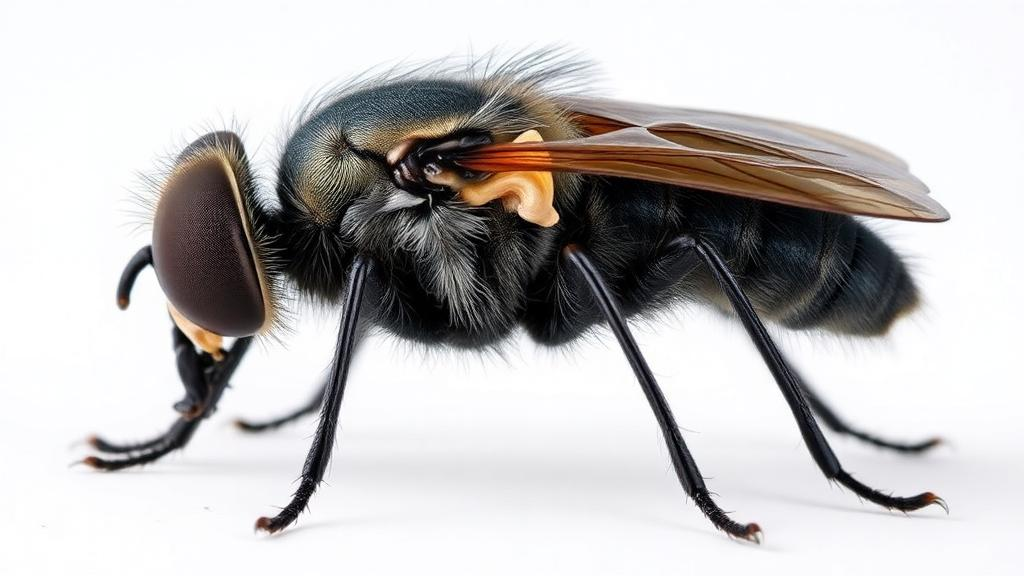
Image Credits: AI Generated
Keywords: entomology, Diptera, taxonomy, obituary, Switzerland, Bernhard, Merz, scientific research
News Source: Drew Townsend. (October 17, 2026). Bernhard Merz: The Swiss Fly Expert Who Described 96 New Taxa. Scienmag.